•
•
•
•
•
•
•
•
•
•
•
•
•
•
•
•
•
•
•
•
•
•
•
•
•
•
•
•
•
•
•
•
•


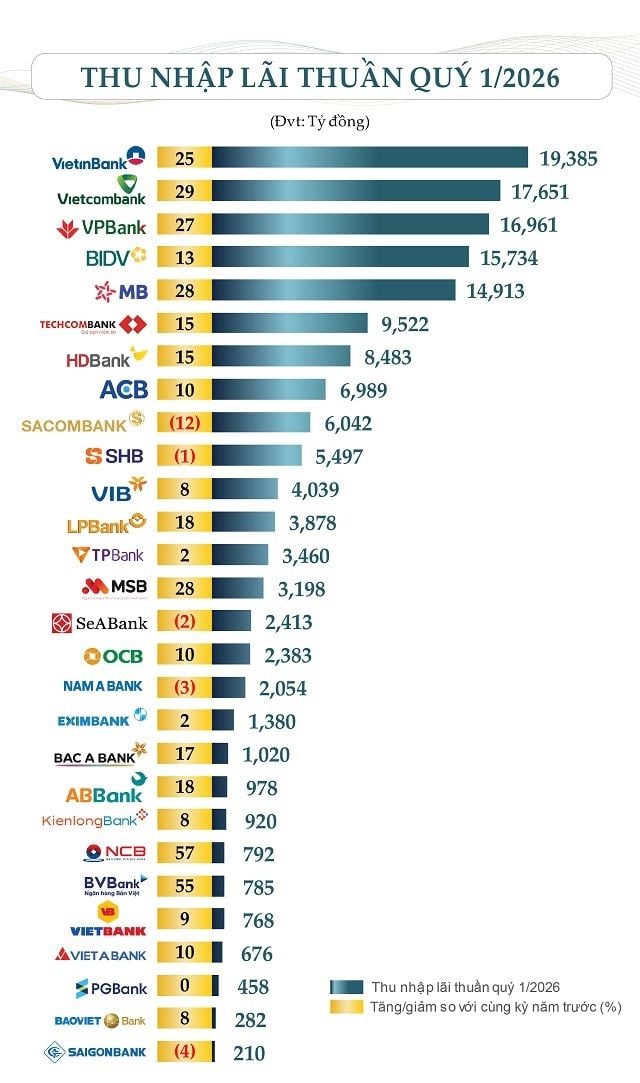
Macro-economic conditions in Q1 2026, shaped by multiple external headwinds, have put banks in a position where they must both support growth and manage risk tightly. While net interest income remained the primary driver of earnings, declines in several non-interest income lines and higher provisioning pressures led to noticeable profit divergence across banks.
In the first three months of 2026, the global economy faced geopolitical and financial-market pressures. The escalation of conflict in the Middle East weighed on commodity markets and international finance. Persistently high oil prices and supply-chain risks kept inflation concerns elevated, prompting major central banks to proceed cautiously with monetary policy. Meanwhile, high global interest rates and demand for safe-haven assets supported a stronger U.S. dollar.
These developments affected open economies such as Vietnam. The State Bank of Vietnam (SBV) flexibly managed policy to keep system-wide credit growth on track at around 15% for 2026, while maintaining inflation control and macro stability. By the end of Q1 2026, total credit outstanding across the economy exceeded VND 19.18 quadrillion, up 3.18% from the start of the year, indicating capacity to absorb capital.
Credit growth supported banks’ core income. VietstockFinance data for 28 banks that released Q1 2026 results show total net interest income reached VND 150,871 billion, up 17% year-on-year.
Most banks participated in the increase: 23 out of 28 reported growth in net interest income. Leading performers included NCB (+57%, to VND 792 billion), BVBank (+55%, to VND 785 billion), and Vietcombank (+29%, to VND 17,651 billion).
As the sector shifts away from heavy reliance on credit, service income benefited from digital transformation. Total service income across the 28 banks reached VND 20,724 billion, up 43% year-on-year. Twenty banks reported growth, including several with double-digit increases supported by digital banking usage, card payment fees, and wealth management advisory. Examples cited include VIB (up 5.2x), SHB (up 3.9x), NCB (up 3.7x), PGBank (up 3.2x), and ABBank (up 2.5x). Some banks, however, still saw service income decline or post losses.
By contrast, investment securities income was weaker in Q1 amid market volatility. Several banks that performed well a year earlier posted losses. Sacombank reported profit of VND 75 billion (compared with a loss of VND 1 billion year-on-year), while LPBank earned VND 76 billion. Nam A Bank and VietinBank also recorded strong growth.
Foreign exchange conditions also weighed on earnings. Total income from foreign exchange across the 28 banks fell 11% to VND 6,202 billion, with many banks moving from profit to loss. OCB, LPB, SHB, and VAB were among the brighter spots, though they still delivered growth.
Mr. Bui Van Huy, Vice Chairman and CEO of the Investment Research Division at CTCP FIDT, said the decline in non-interest income in Q1 is notable because it indicates banks’ profit model is returning to rely more heavily on lending. When net interest income rises while FX and securities fall, profit growth becomes more driven by net interest income, which is more sensitive to the interest-rate cycle, funding costs, and asset quality.
He pointed to three main reasons for weaker non-interest income: (1) bancassurance has not resumed its prior high-growth phase due to higher product transparency requirements, slower customer trust recovery, and banks’ caution in selling insurance products; (2) payments, cards, and digital banking face stiffer competition, leading some banks to accept lower fees to retain customers and drive transactions; and (3) FX and securities income depend heavily on market conditions, so volatile exchange rates, tighter liquidity, and higher interest rates reduce capital-market contributions.
Mr. Nguyen Quang Huy, CEO of Financial Studies at Nguyen Trai University, added that the weakness in some non-interest income sources also reflects a retreat in investment appetite and greater risk aversion in the economy. With higher interest rates, higher input costs, and global risks, firms prioritize cash preservation over expansion, reducing demand for value-added financial services. He also cited geopolitical volatility and oil-price pressures as factors that kept forex, securities, and financial investments from performing smoothly, while slower international trade recovery reduced opportunities to generate non-interest income.
With net interest income providing a solid base, and with services and operating costs managed effectively, net profit from banking activities among the 28 banks rose 18% year-on-year to VND 133,798 billion. Mid-sized banks showed faster acceleration, including ABBank (3x), NCB (2x), and BVBank (92%).
At the same time, macro risks and rising loan costs prompted banks to increase provisioning. Total loan-loss provisions across the 28 banks rose to VND 39,515 billion, up 28% year-on-year. Sacombank led with VND 2,024 billion (10x year-on-year), LPBank recorded VND 774 billion (3.9x), and NCB posted VND 298 billion (4.6x).
Higher provisioning costs provided the clearest signal of sector-wide profit divergence. While total pre-tax profit for the 28 banks increased 14% to VND 94,280 billion, individual bank outcomes were mixed.
Banks reporting outsized annual profits included ABBank (VND 1,500 billion, up 3.6x), PGBank (VND 276 billion, up 2.8x), and BVBank (VND 216 billion, up 2.7x). Conversely, banks facing heavier provisioning and weaker core income—SeABank, Eximbank, and Sacombank—saw pre-tax profits decline versus the prior year.
Overall, Q1 2026 pre-tax profits rose 14%, while provisioning costs rose 28%, reflecting the sector’s need to build risk buffers amid rising credit risks. The main driver continued to be net interest income, supported by credit growth and asset re-pricing, with some banks maintaining high asset yields.
Looking ahead, the focus is not only on how quickly quarterly profits rise, but whether that growth is sustainable and whether it comes with acceptable credit quality and capital adequacy in subsequent quarters.
Mr. Bui Van Huy noted that the 28% increase in provisioning costs against a 14% rise in pre-tax profits suggests the banking system is adapting in the early phase of a rising bad-debt cycle. He emphasized that profit growth remains heavily dependent on net interest income, warranting caution regarding the longer-term balance of risk.
Mr. Nguyen Quang Huy said non-interest income mix recovery will take time, and banks should prioritize building stable, repeatable income streams rather than relying on temporary fee spikes or trading gains. In the longer run, sustainable growth supported by recurring income sources and prudent risk management is expected to matter more than short-term profit surges.
Source: VietstockFinance and FILI
Premium gym chains are entering a “golden era” that is ending or already in decline, as rising operating costs collide with shifting consumer preferences toward more flexible, community-based ways to exercise. Long-term memberships are shrinking, margins are pressured by higher rents and facility expenses, and competition from smaller, more personalized…