•
•
•
•
•
•
•
•
•
•
•
•
•
•
•
•
•
•
•
•
•
•
•
•
•
•
•
•
•
•
•
•
•
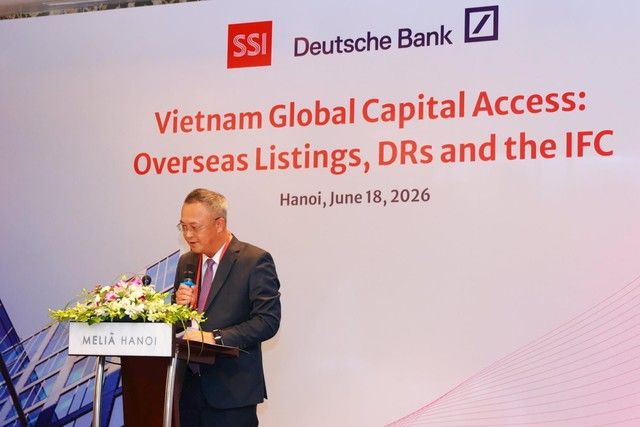
At a conference on June 18, 2026 in Vietnam titled “Vietnam Global Capital Access: Overseas Listings, DRs and the IFC,” co-organized by SSI Securities and Deutsche Bank, the leadership of the State Securities Commission outlined a clear stance: international access to capital must supplement rather than replace domestic capital-market development. The Vietnamese capital market is entering a watershed phase, with efforts to upgrade market infrastructure, launch a new operating system, and apply instruments such as Depositary Receipts (DRs) aimed at widening channels for global capital to flow into the economy.
Mr. Daniel Clark, Global Depositary Receipt head and APAC & MEA regional head at Deutsche Bank, said the conference focused on real-world problems rather than macro theory. He framed the central question as how to optimize equity capital and unlock global flows at a pivotal time, including whether Vietnamese firms listing abroad and linking with international financial centers can deliver long-term benefits.
The regulator emphasized that upgrading market infrastructure is not an end in itself, but a means to enable capital to reach Vietnamese enterprises safely and efficiently. Once technical barriers are removed, access to capital becomes a shared responsibility for both regulators and enterprises.
Global capital flows, the conference noted, will follow trust—earned through transparency, solid governance, strong business performance, and clear, ongoing communication with shareholders.
The use of Depositary Receipts or cross-listings was presented as an emerging trend among leading domestic players seeking access to international investors. Legally, Decree 155 was cited as providing a framework to enable these tools as Vietnam integrates more deeply with global markets.
However, the conference stressed that these instruments are not shortcuts. Firms are expected to prepare seriously and meet higher standards for disclosures, governance, accounting standards, and clear purposes for capital use.
An important element of the capital strategy discussed was the relationship between domestic and international markets. The State Securities Commission clarified that international access should supplement rather than replace domestic market development, and that regulators do not encourage firms to leave domestic markets.
Instead, a solid domestic listing base with strong liquidity was described as a launching pad for international markets. Foreign investor participation was also framed as a source of positive pressure that can help raise standards and support more realistic asset valuations.
The creation of an International Financial Center in Vietnam was positioned in this broader context. It was described not only as a hub for foreign institutions, but as an ecosystem built on trust, a complete legal framework, and professional standards.
The conference said Vietnamese enterprises should begin capital access by preparing early in governance, financial reporting, and ESG standards, and by building the ability to communicate strategy transparently in English.
For market participants such as brokerage firms, banks, and advisory units, the core task is to continue building infrastructure. For regulators, the State Securities Commission reiterated its commitment to maintaining a legal framework that maximizes support for innovation.
The conference concluded that a new capital wave has opened, and that the market as a whole must demonstrate its capacity to seize global capital flows.

Ready Card users outside the European Economic Area have reportedly faced an abrupt service halt after a transition involving the card issuer disrupted the USDC spending product, according to user notices shared on X.
A notice shared…