•
•
•
•
•
•
•
•
•
•
•
•
•
•
•
•
•
•
•
•
•
•
•
•
•
•
•
•
•
•
•
•
•


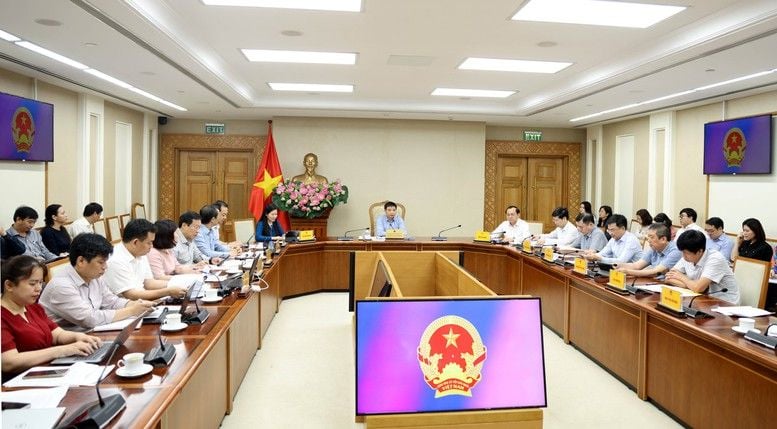
On Apr 23, 2026, Deputy Prime Minister Nguyen Van Thang chaired a meeting of the Price Management Steering Committee at the Government’s Secretariat to review results of price management in the first quarter of 2026 and to finalize price-management scenarios for the remaining months of 2026.
Opening the meeting, the Deputy Prime Minister said international fluctuations are putting significant pressure on domestic prices, creating risks of imported inflation. He asked ministries and agencies to closely assess volatile factors, including fuel prices and construction materials, as well as the planned base-wage increase from July 1, 2026. Based on these assessments, the Steering Committee will agree on price-management scenarios for the rest of 2026.
Deputy Finance Minister Le Tan Can reported that in Q1 2026 the global economy slowed, with rising risks tied to geopolitical, energy and financial developments. He noted that the conflict in the Middle East disrupted key shipping routes, creating a supply shock that pushed up global oil prices and increased logistics costs.
The CPI rose compared with the previous month by 0.05% in January 2026, 1.14% in February 2026, and 1.23% in March 2026. On a year-on-year basis, Q1 2026 CPI increased by 3.51%, while core inflation rose by 3.63%.
To support people and businesses and stabilize the macroeconomy, the Ministry of Finance cited measures including:
Due to increases in world oil and gas prices from March 2026, linked to the Middle East conflict and its impact on shipping costs, the Ministry of Finance updated inflation scenarios for 2026 to 4.5%, 5%, and 5.5%.
The State Bank of Vietnam projects average inflation of around 5% with a range of ±0.5% in 2026. Meanwhile, international organizations have recently updated Vietnam’s average inflation forecast to approximately 3.8%–4.9%.
Ministries briefed the committee on forthcoming price-management measures.
The Construction Ministry said that in April it conducted inspections in localities on price declaration and issued directives to address gaps. It also encouraged enterprises to reduce parking and handling charges and lower charges for services not related to fuel.
The Ministry of Industry and Trade said it is accelerating the transition to E10 gasoline and proposed exemptions from customs duties. It also cited adjustments for some state-regulated goods, including tuition waivers for public education and reductions in textbooks, as well as reductions in harbor pilotage services for Vietnamese ships.
In concluding remarks, Deputy Prime Minister Thang said that despite external pressures and high energy costs, price management met its targets in Q1 2026. He commended the proactive actions of the Ministry of Finance and other ministries.
For the remaining months of 2026, he urged ministries to build on gains and experience, particularly in responding to sudden, unprecedented events. He asked ministries to be proactive and flexible in price management, strengthen monitoring of supply-demand and prices of essential goods, and prevent profiteering—especially in transport, logistics, construction materials, and food sectors.
He also called for ensuring price declarations and preventing unusual price increases when input costs fall. Local authorities were instructed to implement stabilization programs for essential goods, tighten market oversight to detect and punish price manipulation, and maintain transparent information flow on price management.




Premium gym chains are entering a “golden era” that is ending or already in decline, as rising operating costs collide with shifting consumer preferences toward more flexible, community-based ways to exercise. Long-term memberships are shrinking, margins are pressured by higher rents and facility expenses, and competition from smaller, more personalized…