•
•
•
•
•
•
•
•
•
•
•
•
•
•
•
•
•
•
•
•
•
•
•
•
•
•
•
•
•
•
•
•
•


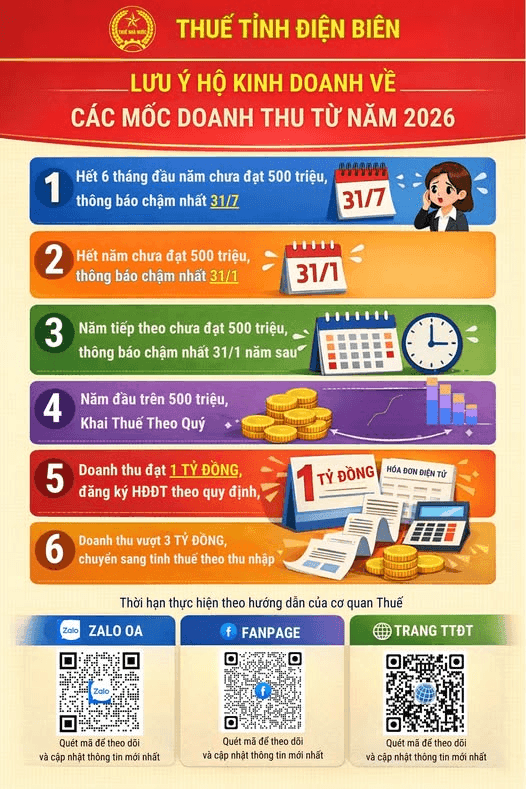
From 2026, the Dien Bien Province Tax Authority will apply specific revenue thresholds to households and individual businesses, determining how they declare and comply with tax obligations.
For revenue under 500 million VND per year, taxpayers must notify revenue as directed by the tax authority. After the first six months of the year, if revenue still does not reach 500 million VND, households must file a revenue notification (currently due before July 31). At the end of the calendar year, if total annual revenue remains below this threshold, taxpayers should file a revenue notification again (currently due before January 31 of the following year).
In subsequent years, if business activity continues to remain under the 500 million VND threshold, revenue notifications will be carried out annually in accordance with the tax authority’s guidance.
When revenue exceeds 500 million VND per year, households and individual taxpayers must switch to quarterly tax declarations as prescribed. The change in the method of fulfilling tax obligations applies from the moment the threshold is reached, so taxpayers are advised to monitor business activity closely to implement the switch in a timely manner.
If revenue reaches 1 billion VND per year or more, the taxpayer is required to register and use electronic invoices in accordance with Decree 123/2020/ND-CP and related amendments. The rule is intended to improve transparency in business activities and support tax administration.
For households with larger revenue scales—roughly 3 billion VND per year or more—taxpayers must adopt an accounting regime and determine taxable income in line with tax and accounting law. As revenue increases, bookkeeping and the recording of costs and revenue must be more complete and rigorous.
The Dien Bien Tax Authority says that correctly identifying these revenue milestones helps taxpayers select the appropriate declaration method and comply with invoicing and accounting rules according to business scale. The authority also notes that deadlines and procedures for fulfilling these obligations may be updated in the future, and households and individual businesses should regularly monitor announcements from the tax authority to ensure compliance.






Premium gym chains are entering a “golden era” that is ending or already in decline, as rising operating costs collide with shifting consumer preferences toward more flexible, community-based ways to exercise. Long-term memberships are shrinking, margins are pressured by higher rents and facility expenses, and competition from smaller, more personalized…




