•
•
•
•
•
•
•
•
•
•
•
•
•
•
•
•
•
•
•
•
•
•
•
•
•
•
•
•
•
•
•
•
•


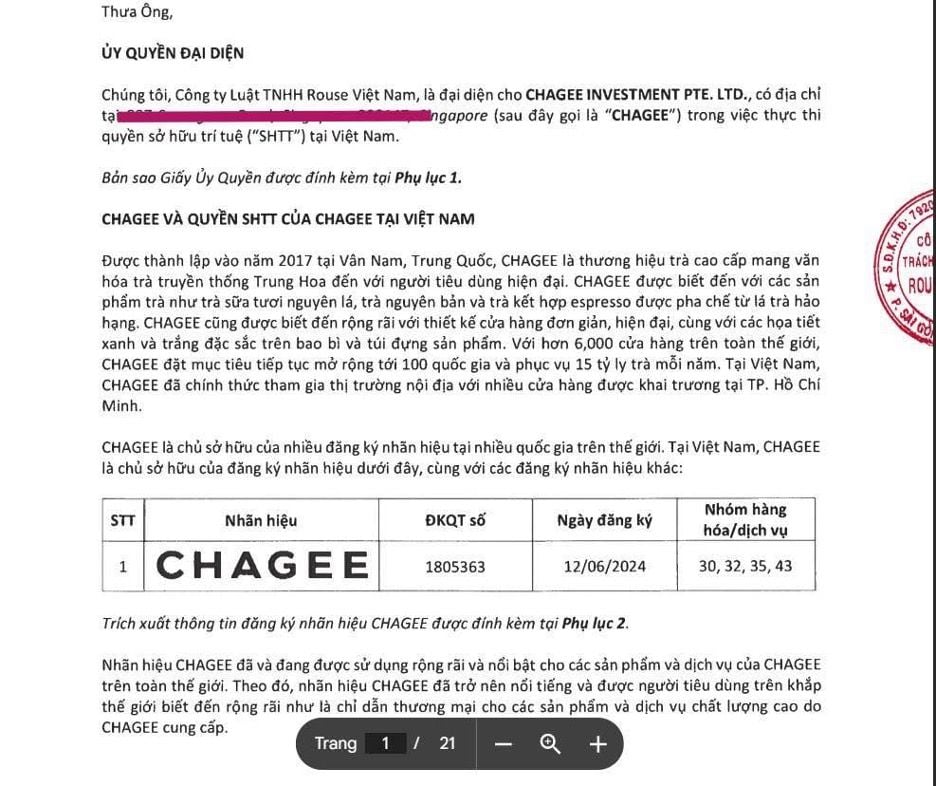
On April 27, a Facebook post by Louis Nguyen, a representative of team 5VN, brought attention to a dispute over the CHAGEE.vn domain. Nguyen said that 5VN holds the domain and had just received a 21-page legal letter from an international law firm representing the CHAGEE tea brand. The letter demands that the domain be returned or cancelled within 10 working days. 5VN stated that it refuted all legal arguments and rejected the request.
The legal letter is issued by CHAGEE INVESTMENT PTE. LTD., a Singapore-based entity. It states that the company is authorized to enforce CHAGEE trademark rights in Vietnam.
According to the letter, CHAGEE is a premium tea brand originating in China, founded in 2017. The brand says it has over 6,000 stores and aims to be present in 100 countries.
CHAGEE’s representative argues that CHAGEE owns the trademark in Vietnam for goods and services related to beverages, food, and hospitality, and points to the brand’s international use. Based on these grounds, CHAGEE contends that another party holding and using the CHAGEE.vn domain could create confusion about commercial origin and infringe the trademark owner’s rights.
The demand made to the current domain holder is to return the domain free of charge or to cancel it within 10 working days.
5VN, as the current owner of CHAGEE.vn, said it has rebutted all legal arguments and refused the demand.
In the online environment, a domain is treated as a digital asset. The article notes that domain ownership is often protected under the principle of “first registered, first rights”. Under this approach, rights to a registered domain can be protected independently of trademark rights, unless there is evidence of specific infringement.
This separation can create a “gray area” in disputes. A company may hold rights to a registered trademark, but another party may still lawfully hold a domain that is identical or similar if it was registered first and did not infringe at the time of registration.
The article also highlights that dispute resolution cannot rely only on a name match. It may need to consider how the domain is actually used. If the domain is used for content or services that could cause confusion with a registered mark—particularly within the same business field—then infringement risk can arise.
In cases where infringement is alleged, the trademark owner may seek measures such as removal of content, administrative penalties, or domain transfer through a competent authority.
However, if the domain is held as an asset or used in a way not clearly tied to the protected field, reclaiming it may be not straightforward and may require a clear legal process.




Premium gym chains are entering a “golden era” that is ending or already in decline, as rising operating costs collide with shifting consumer preferences toward more flexible, community-based ways to exercise. Long-term memberships are shrinking, margins are pressured by higher rents and facility expenses, and competition from smaller, more personalized…