•
•
•
•
•
•
•
•
•
•
•
•
•
•
•
•
•
•
•
•
•
•
•
•
•
•
•
•
•
•
•
•
•


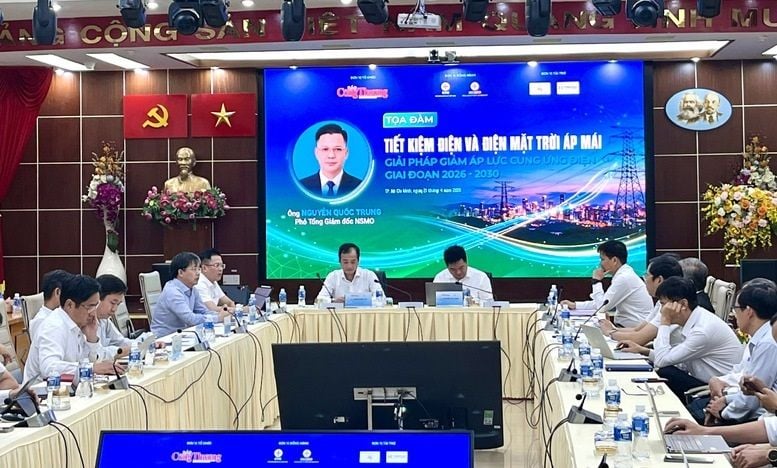
Electricity Plan VIII sets a target by 2030 for rooftop solar installations on 50% of government office buildings and households. To achieve this target, the Ministry of Industry and Trade is developing and submitting to the Prime Minister a mechanism to promote rooftop solar on households. Panel discussion: “Electricity savings and rooftop solar: Solutions to reduce the electricity supply pressure for the 2026-2030 period” was held on April 21 in Ho Chi Minh City, organized by Viet Nam’s Ministry of Industry and Trade in cooperation with EVN and EVNSPC. Ensuring electricity supply for the 2026 dry season ahead of rising demand Currently the country is entering the hot season, with particularly high demand in the south. Electricity demand is forecast to rise sharply during peak dry-season months, placing significant pressure on supply nationwide. Statistics show that in the first three months of the year, electricity demand in southern provinces continued to rise year-on-year, with increases mainly in industrial, service, and urban areas. Localities recording notable gains include Tay Ninh (8.20%), Ca Mau (6.54%), and Lam Dong (6.03%). In early April 2026, early and widespread heat waves in the Southeast region saw temperatures above 36°C on many days. Harsh weather conditions drove cooling devices to operate at full capacity. On 7/4/2026 the citywide electricity output reached 185.67 million kWh with a peak of 8,888 MW. On 8/4, outputs rose to 190.69 million kWh and 9,107 MW, surpassing the 2025 record by 6.63%. Not only weather, electricity supply also faces factors such as geopolitical fluctuations and risks in global energy supply chains, underscoring urgent needs for operational planning and enhanced resilience of the system. Trịnh Quốc Vũ, Deputy Director of the Department of Power (MoIT), noted that based on a GDP growth target of 2026 and projected load growth, three scenarios for load growth were approved: base 8.5%; operating 11.7%; contingency up to 14.1% for peak months. Nevertheless, with coordinated actions from state agencies and power utilities, public participation in energy saving remains essential. “If people unite and participate actively, electricity supply to support production, business, and citizens’ daily life in 2026, especially during peak periods, can be basically ensured,” he said. Directive 10/CT-TTg (30/3/2026) provides a basis to implement nationwide energy saving and rooftop solar deployment, enabling demand-side response and leveling the load curve, reducing the risk of overloading and the need for dispatch adjustments. It also encourages rooftop solar and on-site generation to supplement capacity during daytime peaks. Encouraging rooftop solar development Nguyễn Quốc Trung, Deputy General Director of NSMO (National Power System Operations and Market Operator), stated that total rooftop solar capacity is around 19,000–20,000 MW, with rooftop solar roughly 8,400 MW (about 9% of total system capacity). “In recent days, rooftop solar has supplied the national grid more than 50 million kWh per day, accounting for about 5–7% of daily output. The figure is expected to rise further,” Trung said. Trung expects rooftop solar to continue expanding rapidly as it is a green energy source with positive environmental impact. It also offers fast deployment, as households can bring it online in about a week. Moreover, rooftop solar is less exposed to global market fluctuations, offering more supplier autonomy. Trịnh Quốc Vũ noted that the Power Plan VIII sets a target that by 2030, 50% of roofs on government offices and households will be equipped with rooftop solar. To achieve this goal, MoIT is preparing and presenting to the Prime Minister a mechanism to promote rooftop solar on households. “We expect the supporting mechanisms to remove barriers and strongly promote rooftop solar in the near future,” Vũ said. [Nhat Quang] [FILI] - 14:35 21/04/2026
Premium gym chains are entering a “golden era” that is ending or already in decline, as rising operating costs collide with shifting consumer preferences toward more flexible, community-based ways to exercise. Long-term memberships are shrinking, margins are pressured by higher rents and facility expenses, and competition from smaller, more personalized…