•
•
•
•
•
•
•
•
•
•
•
•
•
•
•
•
•
•
•
•
•
•
•
•
•
•
•
•
•
•
•
•
•


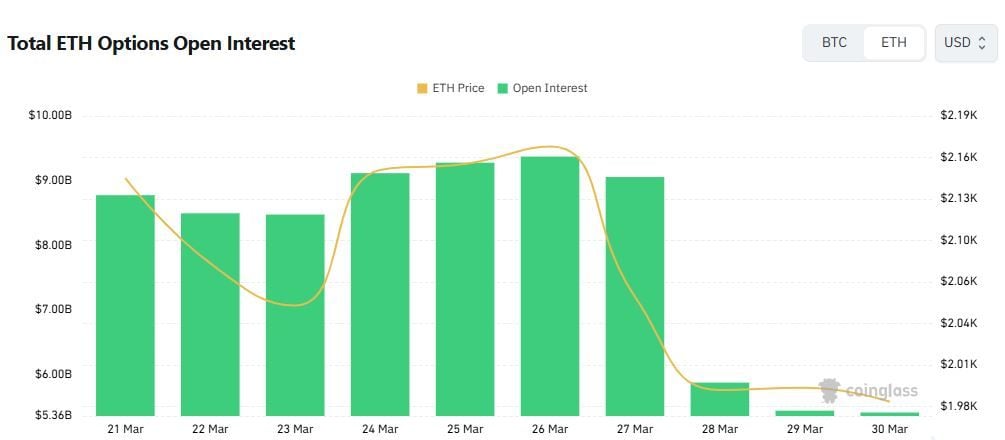
Ethereum options positioning remained call-heavy on Monday, even as total open interest slipped slightly, suggesting traders continued to favor upside scenarios while concentrating activity around select strike levels.
As of 12:00 a.m. ET on March 30, data compiled by CoinGlass showed total Ethereum options open interest (OI) at $5.42 billion, down about 0.55% from $5.45 billion a day earlier. Despite the modest decline, the market’s structure stayed skewed toward calls: calls accounted for 62.65% of open interest versus 37.35% for puts.
Notional options trading volume over the previous 24 hours totaled roughly $526 million. By venue, activity was led by Bybit at $245 million, followed by Deribit at $116 million, Binance at $86 million, OKX at $68 million, and CME at $11 million. On a 24-hour basis, calls dominated flow, representing 60.84% of volume compared with 39.16% for puts.
For longer-dated contracts, the largest concentrations of open interest were clustered in call options on Deribit. The $3,200 call expiring Dec. 25, 2026 ranked first, followed by the $2,500 call and the $2,000 call—both expiring June 26, 2026. The distribution indicates traders were maintaining exposure to higher price targets over an extended horizon, even as aggregate OI edged lower.
Shorter-term trading showed a sharper focus on particular strikes. The most active contract by 24-hour volume was the $2,750 call expiring April 3, 2026 on Bybit. Other high-volume contracts included the $8,400 call expiring June 26, 2026 and the $1,900 put expiring March 30, 2026—also on Bybit—reflecting simultaneous demand for upside participation and downside protection across different timeframes.
The latest figures point to an options market that remains structurally tilted toward calls. At the same time, the slight pullback in open interest and the presence of actively traded put exposure suggest traders may be balancing bullish conviction with hedging demand as they navigate changing volatility and liquidity conditions.







Premium gym chains are entering a “golden era” that is ending or already in decline, as rising operating costs collide with shifting consumer preferences toward more flexible, community-based ways to exercise. Long-term memberships are shrinking, margins are pressured by higher rents and facility expenses, and competition from smaller, more personalized…




