•
•
•
•
•
•
•
•
•
•
•
•
•
•
•
•
•
•
•
•
•
•
•
•
•
•
•
•
•
•
•
•
•


As short-term supportive narratives such as the shareholder meeting season and Q1 earnings fade, a veteran analyst at Pinetree says the stock market needs new drivers to maintain momentum.
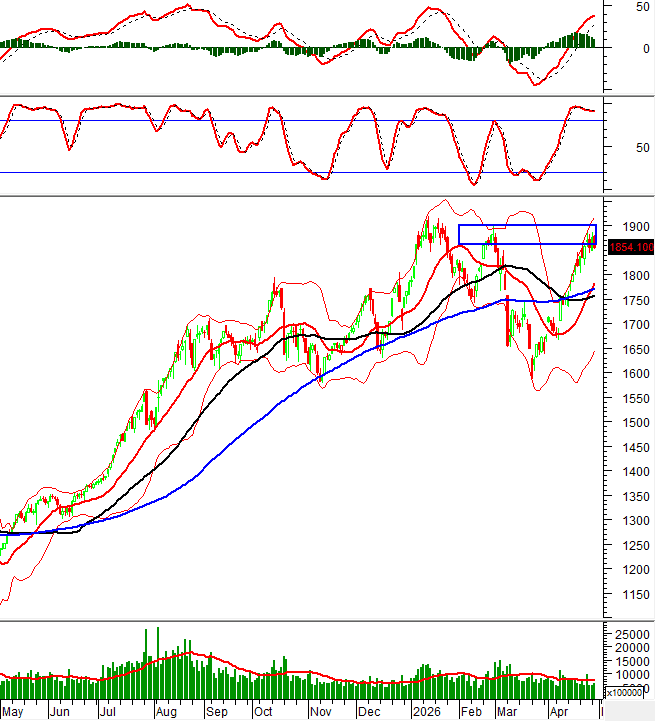
Nguyen Duc Khang, Head of Equity Analysis at Pinetree, cautioned investors about the risk of a correction, particularly because the VN-Index’s recent rise has been driven largely by a handful of leading stocks.
Khang said the index has climbed, but there is no broad consensus from market money, making it more vulnerable to profit-taking. When only a small group of large-cap stocks spikes over a short period while most other stocks do not participate, technical correction risks increase.
He noted that the influence of the leading group extends beyond the index level. If these stocks reverse, psychological pressure could spread across the market. Investors may sell other holdings to protect gains or manage risk when the overall index falls sharply, raising the chance of a broader down move.
Technically, Khang pointed to an unfilled upside gap on the VN-Index around 1,175 points, described as deeper support than current levels. In a scenario where leading stocks face profit-taking, the index could revisit this support region.
More important than whether the gap is filled is how other stock groups behave during any correction. If many sectors maintain a base, the market may experience only a technical pullback. If selling pressure spreads and other stocks are dragged down by the leading names, it would be a more meaningful test of liquidity and investors’ portfolios.
With near-term supportive stories fading, Khang argued the market’s next momentum drivers may come from foreign capital and macro policy.
After a period in which domestic investors faced sustained selling pressure, the market is now looking for a reversal. Khang said exchange-rate stability and a narrowing of interest-rate differentials could support a return of foreign buying, which would likely improve domestic investor sentiment.
While domestic retail capital remains important for liquidity, Khang said it cannot sustain enthusiasm without broader participation from international financial institutions. A decline in foreign selling or a shift back to net buying would therefore be a positive signal, especially as sentiment remains sensitive to near-term fluctuations.
Beyond foreign capital, Khang highlighted domestic macro fundamentals as a key backbone for the medium- to long-term outlook. He cited the government’s ambitious growth targets for 2026 and said supportive policies could be reinforced through drivers such as public investment disbursement, removal of legal bottlenecks for real estate, measures to boost production and business activity, and expansionary fiscal steps.
The stock market is often viewed as a barometer of the economy. If GDP growth remains strong, corporate earnings for listed companies could improve, which may make valuations more attractive.
Khang said that in a market showing clearer sectoral divergence, investors should not focus solely on the index narrative. Instead, the prudent approach is to monitor money flows, prioritize companies with solid fundamentals, resilience to macro shocks, and clearer earnings visibility.
He concluded that May may be a period when information is limited and risks of correction and sentiment swings rise. Still, if foreign capital improves and macro policies continue to support the economy, the market may have a basis to stay on pace—making risk management and stock-picking discipline more important than trying to forecast the exact VN-Index level.
Premium gym chains are entering a “golden era” that is ending or already in decline, as rising operating costs collide with shifting consumer preferences toward more flexible, community-based ways to exercise. Long-term memberships are shrinking, margins are pressured by higher rents and facility expenses, and competition from smaller, more personalized…