•
•
•
•
•
•
•
•
•
•
•
•
•
•
•
•
•
•
•
•
•
•
•
•
•
•
•
•
•
•
•
•
•


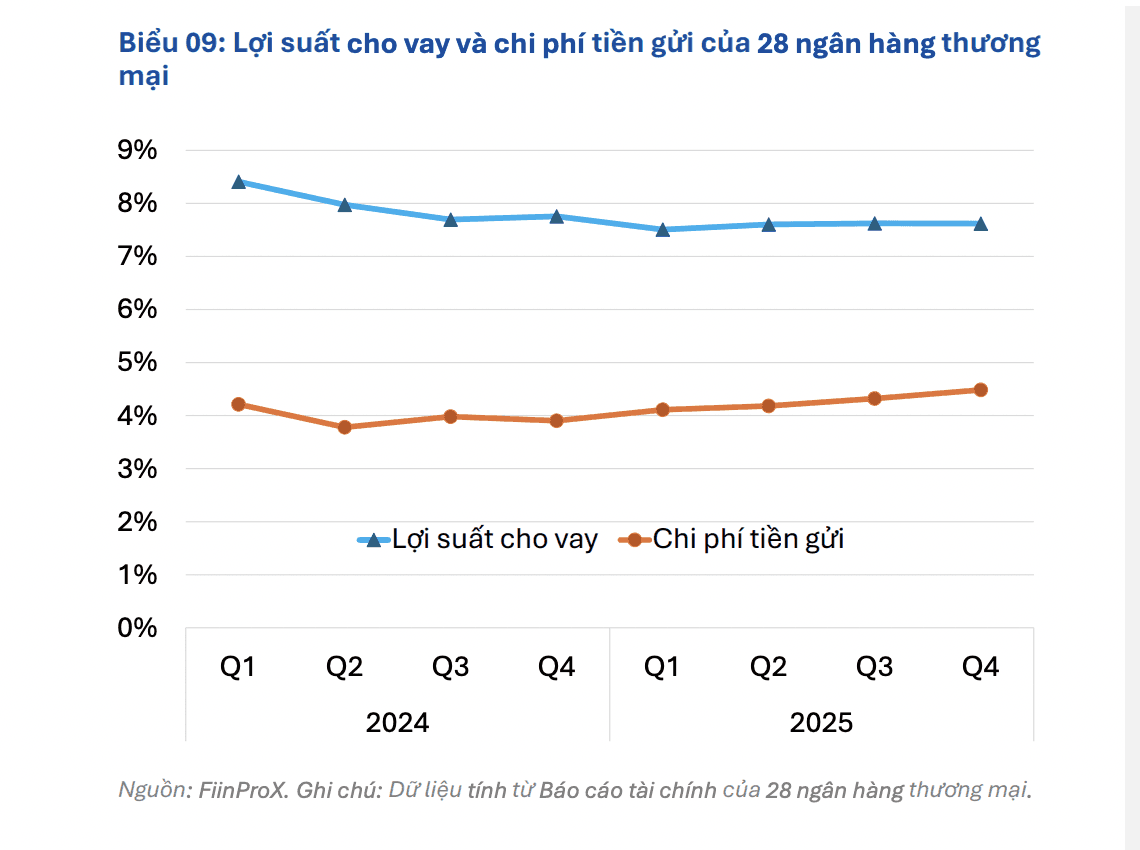
Fiingroup said lending rates in Vietnam are likely to be difficult to reduce in the near term, citing clear pressure on banks’ net interest margins. The outlook comes as deposit rates rose steadily in Q1 2026, peaking in March, with liquidity strain during the quarter pushing up funding costs and forcing banks to compete for deposits through higher interest rates.
After an early-April meeting with the State Bank of Vietnam (SBV), some credit institutions began to modestly cut deposit rates by about 0.1–0.5% per year, aiming to stabilize system-wide interest rate levels.
Fiingroup expects the potential for a sharp drop in rates in the near term to remain limited. Liquidity pressure is expected to extend into Q2 as disbursement demand rises, particularly at banks with rapid credit growth.
Externally, geopolitical uncertainties in the Middle East are continuing to pressure inflation and exchange rates, reducing the SBV’s room to maneuver. If the SBV continues to closely monitor the interest-rate level and the Middle East situation stabilizes, Fiingroup sees a strong likelihood that deposit rates will not change much before a reduction in Q2, which would then create conditions for lending rates to decline.
Even so, Fiingroup forecasts lending rates will be hard to reduce soon because banks’ net interest margins are under pressure. Funding costs rose quickly, while lending rates could not rise correspondingly due to firms’ debt-servicing burdens and SBV policy guidance supporting economic growth—tightening the ability to cut lending rates.
Fiingroup also pointed to the transmission mechanism: lending rates typically lag deposit rates by several months because input funds are “locked” at earlier rates, delaying reductions. As a result, firms are likely to continue facing high funding costs, and bank lending rates—especially for medium- and long-term loans—cannot fall quickly.
For the corporate bond channel, high interest rates keep issuance costs high, which may slow corporate funding plans. For banks, the current average yield on bond issuances is above 7% per year, approaching lending yields and narrowing profit margins.
Although bonds remain an important tool to supplement mid- to long-term capital, Fiingroup expects issuance pace in Q2 to remain cautious rather than rising sharply as in previous years, reflecting pressure on funding costs and net interest margins.
Fiingroup said cost advantages are most evident in the non-financial corporate bond segment. Similar tenor structures often around 3 years are used for production or project execution. Private placements can offer higher coupon rates because many issuers have weaker credit profiles and are harder to access through public channels.
By contrast, private placements of bank bonds are typically distributed to institutional investors seeking higher-quality fixed-income assets and accepting lower yields. Publicly issued bank bonds generally require higher coupon rates to attract retail investors.
Despite these dynamics, the private placement channel still dominates in both volume and value, accounting for over 90% of 2025 issuance value. Fiingroup attributed this to issuers’ preference for speed and flexibility: private placements are filing-based, while public issuance requires detailed approvals, with actual issuance timelines potentially lasting months.
This affects firms’ access to capital and also limits investment activity for institutions restricted from investing in private placements, including investment funds and pension funds.
Fiingroup added that the lack of activity in public issuance is also linked to the absence of a transparent pricing mechanism and a sufficiently liquid secondary market, which can hinder efficient market operation.









Premium gym chains are entering a “golden era” that is ending or already in decline, as rising operating costs collide with shifting consumer preferences toward more flexible, community-based ways to exercise. Long-term memberships are shrinking, margins are pressured by higher rents and facility expenses, and competition from smaller, more personalized…



