•
•
•
•
•
•
•
•
•
•
•
•
•
•
•
•
•
•
•
•
•
•
•
•
•
•
•
•
•
•
•
•
•


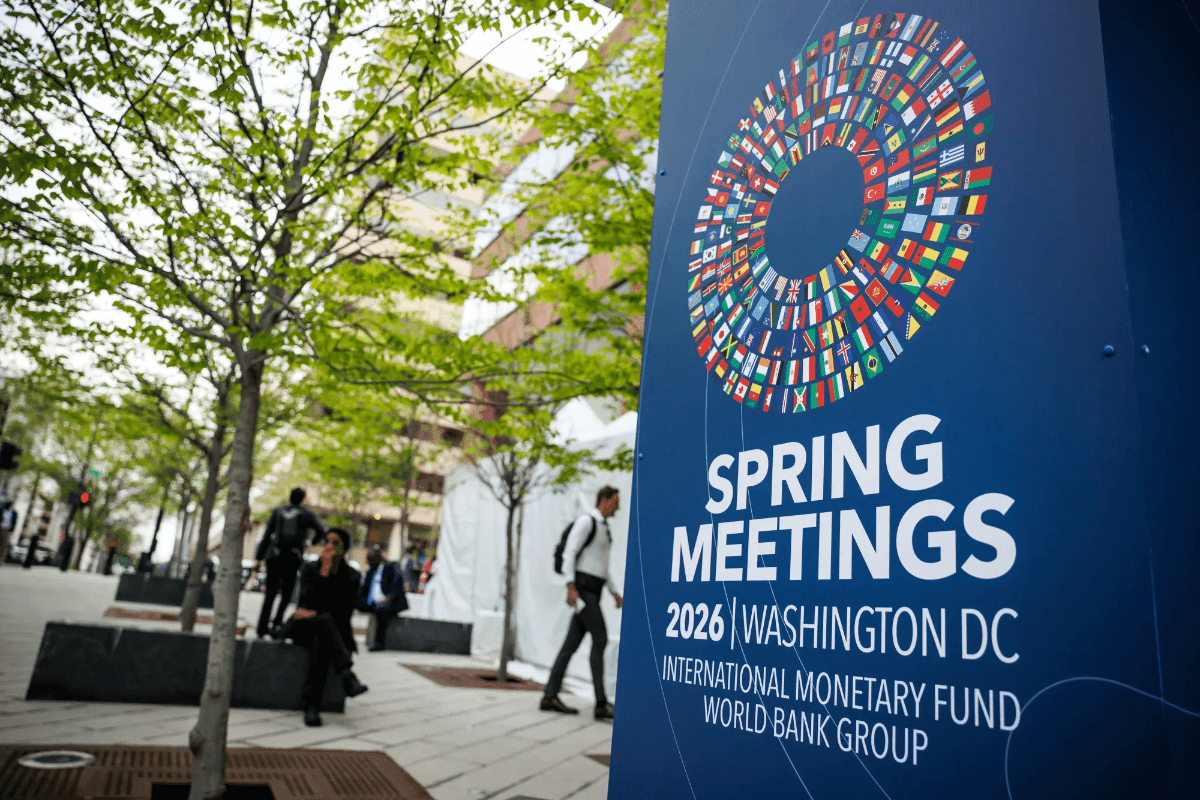
The war between the United States and Iran has become a central focus for policymakers worldwide as they assess the economic fallout from the conflict.
At the IMF-World Bank Group annual meetings in Washington, D.C. last week, CNBC interviewed more than 30 central bank chiefs, politicians and policymakers about their top concerns for the global economy. The discussions took place before Iran said at the end of last week that it opened the Strait of Hormuz and then closed it, arguing that the United States had not fulfilled its commitments.
One of the first concerns raised was the possibility that the conflict could drag on. The war has lasted more than seven weeks, but uncertainty remains high. President Trump said the conflict “will end soon,” while messages from Washington and Tehran have differed, leaving the outlook unpredictable.
Pierre Gramegna, Executive Director of the European Stability Mechanism (ESM), said the war has already affected inflation and energy prices, quoting Gabriel Garcia Marquez: “Starting a war is easy; ending it is hard.”
Francois Villeroy de Galhau, Governor of the Bank of France, said policymakers “cannot just bet on the most favorable scenario,” warning of unprecedented uncertainty and the risk that the conflict could last longer and spread beyond energy to other goods. He added: “We forecast inflation will be higher and growth lower.”
Elisabeth Svantesson, Sweden’s finance minister, cautioned that policymakers “still have not seen all aspects of this crisis,” and that conditions could worsen.
Another major worry is the risk of stagflation—high inflation alongside weak economic growth. Several interviewees highlighted inflation transmission as a key concern if the conflict persists.
Gramegna warned that if the Strait of Hormuz is fully or partially blocked within two months, global inflation could rise by 1–2.5 percentage points this year, potentially triggering stagflation. He pointed to recent inflation data and gasoline prices worldwide as evidence of the impact.
Energy security was also a prominent topic. Kyriakos Pierrakakis, Greece’s finance minister, warned that the world could be facing the largest energy crisis in history. He said one-third of global fertilizer, sulfur, helium and downstream products pass through Hormuz, and that continued disruption would have significant consequences.
He added that the April situation could be worse than March, explaining that shipments leaving the Gulf on February 28 would arrive on April 20, after which supply disruptions would become more evident.
Nicola Willis, New Zealand’s finance minister, said that if the conflict continues, the worst-case scenario could occur: Gulf oil would not reach refineries across Asia, leading to shortages. She said authorities are preparing for such scenarios and expect inflation to remain above target.
Roland Lescure, France’s finance minister, said Europe needs to invest more in electricity to strengthen resilience in energy markets. He said France plans to invest in nuclear energy and renewables, adding that the crisis underscores the need for greater independence and for viewing climate change as an opportunity rather than a threat.
Krishna Srinivasan, Head of the IMF’s Asia Department, urged “all Asian countries” to diversify their energy supply chains.
Policymaking remains difficult due to sustained uncertainty about the conflict, including when it might end. Olli Rehn, Governor of the Bank of Finland and an ECB Governing Council member, said there is no clear view yet on major policy issues related to the conflict and that the ECB has “no predetermined direction for rates,” even as markets price in a potential rate rise this year.
Joachim Nagel, President of the Bundesbank and an ECB Governing Council member, described the situation as “very unclear.” With the next ECB monetary policy meeting in two weeks, he said the ECB will decide “on a meeting-by-meeting basis” depending on upcoming developments.
While concerns about the real economy are mounting, the market outlook was described as comparatively resilient. Global equity markets have largely withstood the impact of the Iran conflict, with U.S. equities repeatedly reaching new highs last week. As of the close last Friday, the MSCI World ex-US index had fallen about 1% from pre-war levels but had risen more than 8% over the past month.
Verena Ross, chair of ESMA, said the key question is how long markets can withstand rising volatility. Martins Kazaks, Governor of the Bank of Latvia and an ECB Governing Council member, said the market reaction has been unexpectedly resilient so far, noting that financial markets have returned to pre-war levels. He added that the real impact of supply disruptions on the economy will become clearer, with “genuine supply disruptions” and their effects on the real economy.






Premium gym chains are entering a “golden era” that is ending or already in decline, as rising operating costs collide with shifting consumer preferences toward more flexible, community-based ways to exercise. Long-term memberships are shrinking, margins are pressured by higher rents and facility expenses, and competition from smaller, more personalized…




