•
•
•
•
•
•
•
•
•
•
•
•
•
•
•
•
•
•
•
•
•
•
•
•
•
•
•
•
•
•
•
•
•


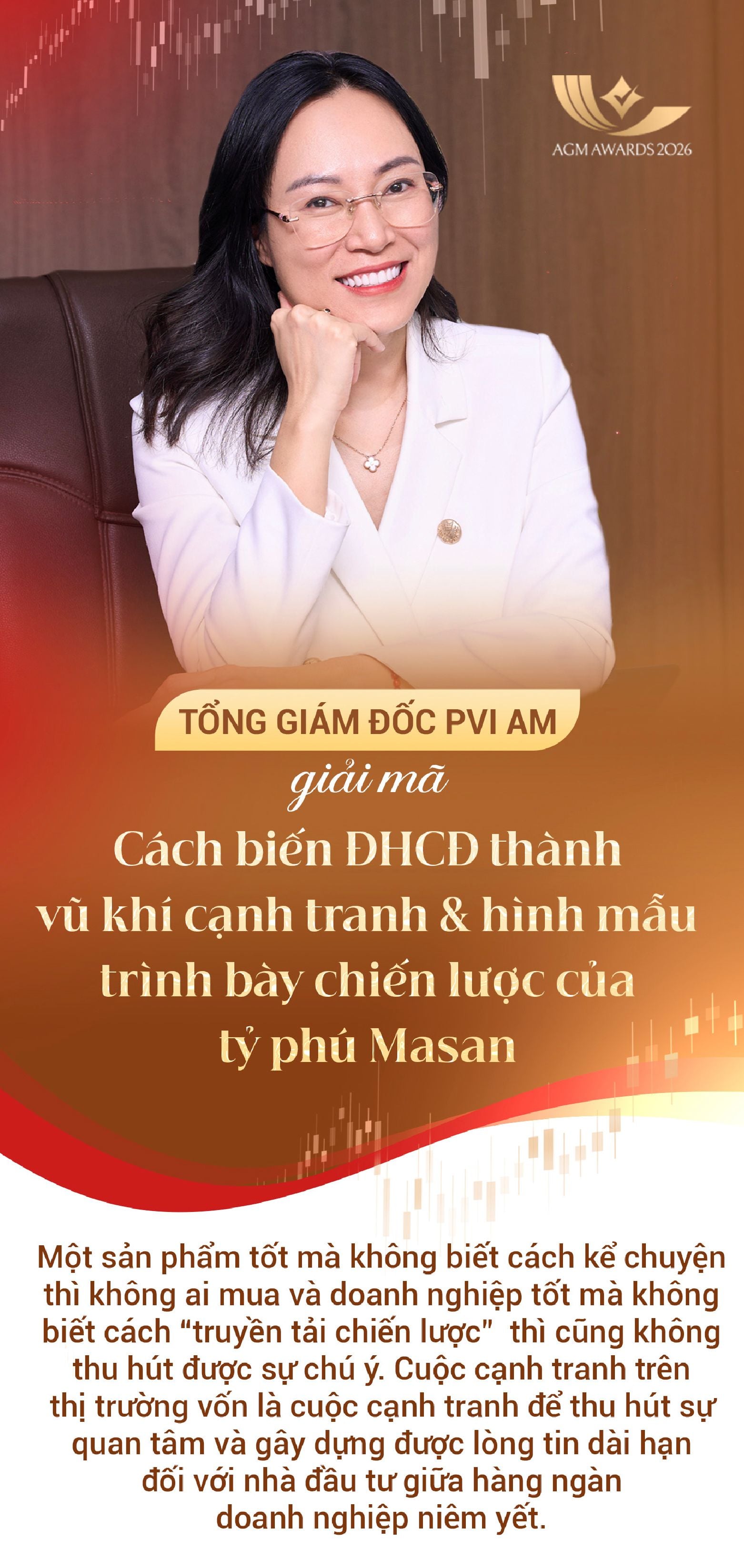
Ms. Trịnh Quỳnh Giao, CEO of PVI Asset Management (PVI AM), says the biggest bottleneck in today’s annual general meetings (AGMs) is not the disclosure of financial figures, but the governance culture and the quality of dialogue with shareholders.
In her view, AGMs in Vietnam are often too ceremony-heavy, with time spent reciting dry numbers rather than enabling open interaction. She contrasts this with Berkshire Hathaway’s annual meeting, where Warren Buffett spends less than an hour reading the report but dedicates 5–6 hours to dialogue, turning the event into a high-profile platform for communication and engagement.
With more than 20 years in the market, Ms. Trịnh Quỳnh Giao notes that corporate governance standards have improved, and that this has shaped the quality of AGMs today. In the past, shareholders had fewer channels to access information, and the AGM was often the only annual opportunity to meet leaders, observe company performance, and invest with confidence.
Today, stricter disclosure rules mean financial data is largely available. As a result, what shareholders expect at the meeting has expanded beyond numbers to include the company’s next strategy, the risks ahead, and—most importantly—how leadership steers the business and engages with shareholders. Investors, she says, use these signals to decide whether to commit long-term capital.
Ms. Trịnh Quỳnh Giao argues that leadership mindset has also changed. Around two decades ago, when the market was still early-stage, the concept of shareholder rights was limited. If a fund or journalist asked many questions, management sometimes responded awkwardly or even hostilely.
As the market matured and shareholder rights became more clearly codified, leadership increasingly understands the need to respect investors and be accountable. While not every question can be answered fully, she says there is now a more deliberate effort to provide information to shareholders—raising professional standards across the market.
Even with relatively complete disclosure, she says the AGM still matters because numbers do not reveal the full picture. From an investment fund perspective, the key non-financial signals include how leadership presents strategy, justifies decisions, communicates risks, and demonstrates execution capability through how the board discusses and resolves issues as a collective.
She adds that funds may already verify figures through investor relations meetings, but they still attend AGMs in person to observe leadership behavior and transparency during the dialogue.
Ms. Trịnh Quỳnh Giao says there are cases where a company appears strong on paper and at the AGM, yet a fund still changes its view after the meeting and decides not to invest. She describes two common scenarios.
She says the AGM is a clear test of how leadership confronts controversial issues and sensitive resolutions. Funds watch whether leadership defends all shareholders’ rights fairly or shows bias toward a particular group. If there is evasion and a lack of transparency, funds pull back, which she identifies as the greatest governance risk.
She also highlights leadership’s ability to respond and its confidence. Even if a strategy is set for 3–5 years, it must be updated annually to adapt to a fast-changing environment. In her assessment, the core factor is leadership resolve.
In investments, she refers to “information asymmetry.” When bonds are issued with limited information, investors price in risk at higher levels and demand higher coupons or tighter covenants to compensate for uncertainty. The outcome is a higher cost of capital for the company.
From a fund manager’s perspective, Ms. Trịnh Quỳnh Giao believes AGMs are not only regulatory obligations but can function as a strategic tool to compete for capital. She says many leadership teams assume that because they are leaders in their field, “everyone knows what we do.” However, capital markets contain thousands of listed companies worldwide, and competition for investor attention and long-term trust is real.
Therefore, she argues, a good product or business that cannot convey its strategy may fail to attract attention. In this context, the AGM is positioned as the ideal place to communicate and market the company’s value to the capital markets.
She also emphasizes that trust built through confident communication can shift short-term traders into long-term owners willing to stay through ups and downs. Once reputation is established, capital raising becomes easier because existing shareholders—who already know and trust the company—are often the first to support expansion needs.
Ms. Trịnh Quỳnh Giao hopes Vietnam’s AGM format becomes more substantive. She suggests shortening ceremonial parts and consolidating reports so shareholders can focus on answers about the future and how the company will handle volatility.
She cites Masan’s leadership as an example, recalling that Nguyễn Đăng Quang delivered a passionate, clear view of Masan’s vision and strategy. She describes an international standard where major financial institutions focus on quality dialogue and shareholder engagement, and where leaders are willing to acknowledge past mistakes, present difficulties, and outline contingency plans directly to shareholders.
She also notes that Berkshire Hathaway’s AGM resembles a festival, with thousands of people meeting and networking before the meeting, and the broader ecosystem showcased—an approach she characterizes as top-tier PR and branding.
Ms. Trịnh Quỳnh Giao says some Vietnamese companies are already broadening dialogue, but building an AGM ecosystem that spreads corporate value and connects investors remains relatively new. She attributes part of the shift to a new generation of shareholders, including young individuals, who are becoming more professional.
In her view, market pressure will push leadership to act: transparency and strategic dialogue are no longer optional but prerequisites for survival in capital markets, supporting a more professional and substantive governance culture.
Regarding the AGM Award 2026 by CafeF, she says its significance lies in contributing to a shift in mindset and awareness. The awards, she notes, emphasize not only “on-paper” criteria but also experiential, real-world evaluation.
She argues that polished documents and solid-looking numbers are not enough; what matters most is what happens in practice—whether leaders answer questions transparently and respect shareholders during the meeting. She also suggests using data from shareholder surveys to capture the true picture.
She adds that the 2026 AGM Awards are the first edition and that criteria may not be perfect, but raising awareness is vital for long-term trust in the capital markets.






Premium gym chains are entering a “golden era” that is ending or already in decline, as rising operating costs collide with shifting consumer preferences toward more flexible, community-based ways to exercise. Long-term memberships are shrinking, margins are pressured by higher rents and facility expenses, and competition from smaller, more personalized…


