•
•
•
•
•
•
•
•
•
•
•
•
•
•
•
•
•
•
•
•
•
•
•
•
•
•
•
•
•
•
•
•
•


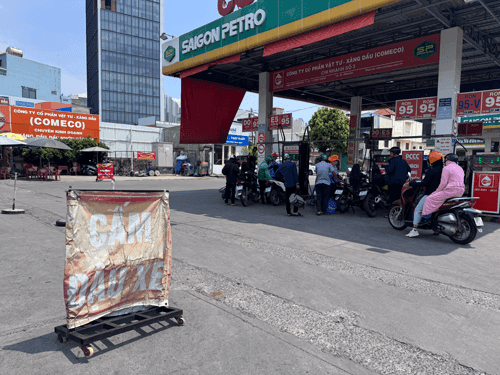
Retail gasoline and oil retailers say the draft Decree on gasoline and oil trading (the 10th draft) reiterates the principle of market-based operation with state supervision, aiming to balance interests among participants and reduce intermediaries in the supply chain. However, they argue that several specific provisions do not match how the market operates in practice—particularly in the retail segment.
The draft grants bulk suppliers and distributors authority to determine and publish wholesale and retail prices within the distribution system. Retailers not included in the system are still required to follow the published prices in the same area and time.
According to Mr. Giang Chan Tay, director of Boi Ngoc Co., retailers cannot set purchase prices independently because they depend on wholesalers or distributors. As a result, retailers have limited ability to add costs and profits, since they are bound by the published prices. “In direct competition, two nearby shops will not sell above the common price unless the market accepts it. Then pricing rights remain largely nominal,” he said.
Retailers also cite recent difficulties linked to wholesalers’ zero-discount policies. They argue that if both sides could adjust prices freely to cover costs, the market mechanism would function more effectively. In their view, wholesalers and distributors control inputs, while retailers face restricted outputs but still bear operating, financial, labor, premises, depreciation, and loss costs.
Mr. Nguyen Xuan Thang, director of Hai Au Phat Co., said that when the market does not allow individual price increases and policy does not permit full cost pass-through, retailers—whether as agents, franchisees, or independent traders—can face a “two-headed” squeeze and risk losses.
He argued that the rules do not reflect competitive market principles and need adjustment to be feasible. While the draft appears to grant price-setting rights, he said it effectively imposes tighter controls in practice.
Mr. Dao Ba Tho, director of Tuyen Tien Co., added that if the policy prevents retail prices from exceeding the published prices from wholesalers or distributors without a mechanism guaranteeing a minimum margin, retailers may sell but cannot cover costs. “Retailers have costs but no mechanism to cover them, so stable operation is difficult,” he emphasized.
Retailers propose that they be allowed to set retail prices based on input prices, with a minimum margin of 8% relative to the wholesale price.
If pricing remains determined by wholesalers or distributors, retailers also suggest specifying a minimum discount of at least 7% to protect their interests and ensure business viability.
Mr. Tran Quang Khanh, secretary-general of the Vietnam Petroleum Association, recommended allowing traders to buy for retail at their own stores (not part of the distribution system) from multiple suppliers, and to set retail prices but not exceed wholesalers’ prices.
He also said that if retailers price higher than wholesalers, competition would be difficult and tax authorities would review the reasonableness of declared prices.
On discounts, he noted that import price fluctuations can affect wholesalers’ costs and lead to losses, meaning discounts may be high or low depending on supply-demand and world prices. “This is a bilateral arrangement depending on supply-demand and world prices. Discounts can be high at times and low at others,” he said.
He further stated that retailers can now buy from more than three sources to seek better discounts.
Dr. Tran Anh Tung, head of the Business Administration department at the University of Economics & Finance Ho Chi Minh City, said the core issue is not simply whether retailers are allowed to set prices, but whether that right comes with the ability to generate margins.
If retailers can publish prices but cannot sell above wholesalers’ or distributors’ prices, he argued the right is economically nominal. He said the upstream ceiling price is set upstream, leaving retailers to choose between discounting or price-matching while still bearing all operating costs.
Dr. Tung cited an example of a gas station selling about 300,000 liters per month at a retail price of around 20,000 VND per liter, which would generate about 6 billion VND per month. He said fixed costs (including staff, electricity, losses, fire safety, land rent, depreciation, and working capital) range from 150–300 million VND per month depending on location.
He argued that if the supplier discount is 0 VND per liter, retailers have almost no margin to cover costs. “As long as operating costs are around 700 VND per liter, retailers would need about 210 million VND per month to break even,” he explained. He added that selling more under low discounts increases cash-flow pressure.
Dr. Tung also said raising prices risks losing customers due to sensitivity to price differences of 200–300 VND per liter. Conversely, selling at the same price as the supplier without a minimum discount means retailers are effectively subsidizing the whole system.
Dr. Tung said that while a proposed 8% margin could be enforced, doing so rigidly may push retail prices up sharply at times in a price-sensitive market.
For example, with a purchase price of 19,000 VND per liter, adding 8% would equal 1,520 VND per liter. He argued a more reasonable approach would be to set a minimum discount sufficient to cover costs and generate profit.
He suggested that if average costs are around 600–800 VND per liter and some profit is needed for reinvestment, a floor discount of about 1,000 VND per liter or a flexible mechanism tied to a base price could be more suitable.
Dr. Tung concluded that the fundamental solution is for the state to redesign the distribution chain so that costs and profits are transparently shared among upstream participants, distributors, and retailers—rather than granting only nominal pricing rights. Otherwise, he warned, the market may continue to see sellers throttling prices or closing down.







Premium gym chains are entering a “golden era” that is ending or already in decline, as rising operating costs collide with shifting consumer preferences toward more flexible, community-based ways to exercise. Long-term memberships are shrinking, margins are pressured by higher rents and facility expenses, and competition from smaller, more personalized…