•
•
•
•
•
•
•
•
•
•
•
•
•
•
•
•
•
•
•
•
•
•
•
•
•
•
•
•
•
•
•
•
•


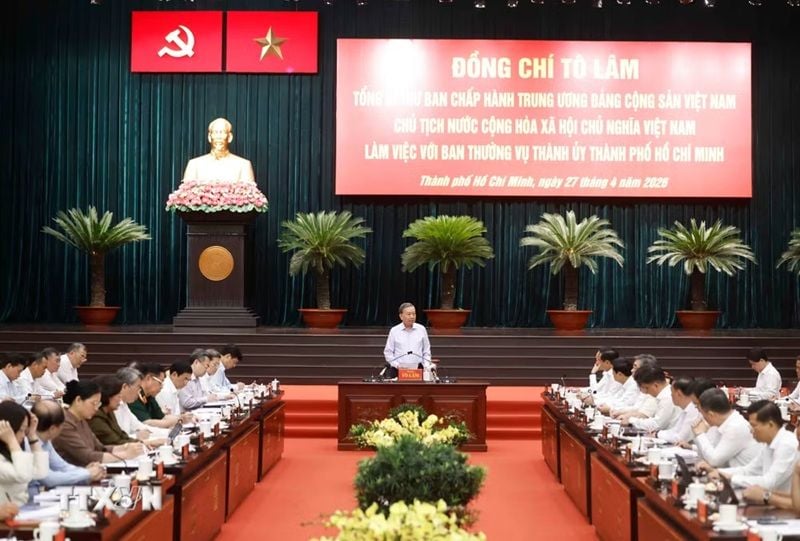
General Secretary and State President To Lam urged Ho Chi Minh City to further concretize central strategic resolutions, not stopping at action programs but shaping them into a development model. At the meeting, after listening to reports from city leaders and responsible voices from central ministries, To Lam largely agreed with many points raised and commended the city’s efforts, sense of responsibility, and political resolve. He noted that the city has begun to operate a stable two-tier local government model and called for a prompt review of the model, leveraging suitable aspects and proposing adjustments to content that does not meet requirements, especially institutionalizing a governance framework appropriate for the forthcoming Special City Law. Regarding the direction and tasks ahead, To Lam asked the city to be more proactive, more courageous, and to have a longer-term vision to develop a self-reliant, self-sustaining economy that can adapt flexibly and ensure strategic autonomy. He stressed that strategic autonomy is not only the responsibility of the central authorities; Ho Chi Minh City must enhance its resilience in the face of global volatility, with a long-term security of development. The city should proactively prepare scenarios to respond to oil price fluctuations, supply-chain disruptions, inflationary pressures, and production costs; adopt energy security in a broad sense, ensuring not only immediate power sufficiency but building a safe, flexible, and sustainable energy structure with strategic reserves. Initial steps toward diversifying supply, promoting renewable energy, and using electricity efficiently should be elevated into a comprehensive, systematic strategy. The city also needs to recognize that its two-digit growth target must be tied to leading development in the economy, not merely chasing growth numbers at the expense of quality; avoid bottlenecks in capital, land, and projects; continue to decisively remove legal, planning, and investment obstacles; and accelerate disbursement of public investment. Agreeing with the proposal to issue a new Politburo resolution soon to replace Resolution 31 and suited to the new context, To Lam urged focusing reform on development institutions, and drafting and enacting a Special City Law for Ho Chi Minh City. The resolutions and laws should reflect the city’s stature and mission, focusing on breakthroughs in institutional and governance reforms, strengthening fiscal autonomy and modern financial tools, enabling the city to retain more resources and actively mobilize capital; allowing testing of new institutions; and empowering decentralization and policy-design rights for this mega-urban center. It should foster top-tier talent recruitment mechanisms to propel development in the coming period. The city must concretize central resolutions more deeply in practice, not merely in rhetoric, and transform them into a concrete development model. Resolutions on science and technology should enter the innovation ecosystem—high-tech industries, urban data, digital government, AI, and semiconductors. The resolution on international integration should link to the international financial center, free-trade zones, ports, and international services. The constitutional and legal framework must be specified in the Special City Law, reforming administrative procedures, decentralization, and substantive delegation. The private economy should turn citizens’ wealth aspirations into reality, promote free enterprise, accelerate the transformation of household businesses into enterprises, help small enterprises grow into large ones, and spur more technology-driven companies. In short, Ho Chi Minh City must lead in turning central resolutions into dynamic, tangible development, not letting words outpace action. Horizon toward a sustainable, creative, livable mega-city was emphasized, including accelerating planning with a new mindset, integrating planning across infrastructure, digital infrastructure, and green corridors; ensuring a coherent ecosystem with space for future growth; placing people at the center to build a smart, ecological, culturally rich city with security. The 2025–2050 master plan with a 100-year vision aims for a multi-centered city anchored by international finance, free-trade, and modern logistics. Ambition must be scientifically grounded; planning must avoid dispersion and ad hoc adjustments and serve as a robust development tool. Resources should focus on strategic infrastructure, digital infrastructure, and innovation infrastructure as a foundation for the next development phase. The growth model should be based on productivity, science and technology, innovation, digital transformation, and efficient resource allocation; deep AI adoption across sectors should drive productivity gains and higher growth quality; strong incentives should attract private capital to science and technology. Ho Chi Minh City should strengthen regional linkages and reorganize southern development space, working with neighboring localities on a coherent development framework with appropriate functional roles. The city’s competitiveness should be enhanced through complementarity rather than competition, improving regional and national strength. To Lam urged urgent action on prior directives, especially addressing traffic bottlenecks, floods, pollution, and environmental issues; accelerate urban upgrading along canals; ensure balanced interests and higher-quality development within the current term. He also called for strengthening cadre leadership, ideological work, public support, inspection and anti-corruption efforts. Attendees and leaders expressed confidence that Ho Chi Minh City will remain a national growth engine and a leading hub for new models and initiatives in Vietnam’s development era.








Premium gym chains are entering a “golden era” that is ending or already in decline, as rising operating costs collide with shifting consumer preferences toward more flexible, community-based ways to exercise. Long-term memberships are shrinking, margins are pressured by higher rents and facility expenses, and competition from smaller, more personalized…


