•
•
•
•
•
•
•
•
•
•
•
•
•
•
•
•
•
•
•
•
•
•
•
•
•
•
•
•
•
•
•
•
•


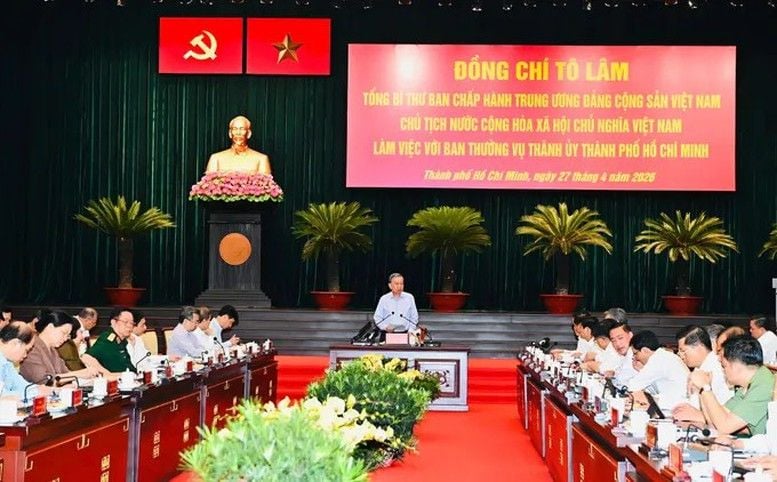
On the afternoon of April 27, during a working session with General Secretary and President To Lâm and the central delegation, the Standing Board of the Ho Chi Minh City Party Committee, comrade Tran Luu Quang, Politburo member and Secretary of the Ho Chi Minh City Party Committee, pledged that Ho Chi Minh City will achieve two-digit growth in 2026.
In remarks at the working session, Tran Luu Quang, on behalf of the city leadership, expressed gratitude for the attention from General Secretary, President To Lâm and other Party and State leaders. He said the directives will serve as a crucial basis to finalize the city’s program and action plan and ensure effective implementation of development tasks.
According to the Ho Chi Minh City Party Committee Secretary, although the Q1 2026 results were modest, they carry significant meaning as the city operates a new development model and expands its development space.
In the near term, the city will focus on resolving long-standing issues and proactively responding to external risks, while enhancing governance and administrative efficiency.
Secretary Tran Luu Quang said the city will leverage the completion of the Politburo’s resolution on developing the city in the new era, the approval of comprehensive development planning, and the National Assembly’s passage of the Special Urban Area Law, together with existing action programs, to create conditions for breakthrough development.
“The remaining matter is action — action that is effective, sustainable, with measurable results,” Quang said.
Before General Secretary, President To Lâm and other Party and State leaders, the Ho Chi Minh City Secretary pledged that the city would meet its targets at the highest level and achieve two-digit growth in 2026.
Economic and social indicators for Ho Chi Minh City in Q1 2026 showed signs of improvement:
The city started many large projects with total capital of nearly USD 20 billion and resolved obstacles for 831 of 838 projects, with total capital over 205 trillion dong, freeing up resources for development.

Premium gym chains are entering a “golden era” that is ending or already in decline, as rising operating costs collide with shifting consumer preferences toward more flexible, community-based ways to exercise. Long-term memberships are shrinking, margins are pressured by higher rents and facility expenses, and competition from smaller, more personalized…