•
•
•
•
•
•
•
•
•
•
•
•
•
•
•
•
•
•
•
•
•
•
•
•
•
•
•
•
•
•
•
•
•
Over the past two years, the Hong Ngoc bánh mì chain has faced multiple food-poisoning incidents that authorities punished, along with a newer suspected case under investigation. The repeated nature of the episodes has raised questions about whether the brand’s quality-management system is addressing root causes or merely responding after harm occurs.
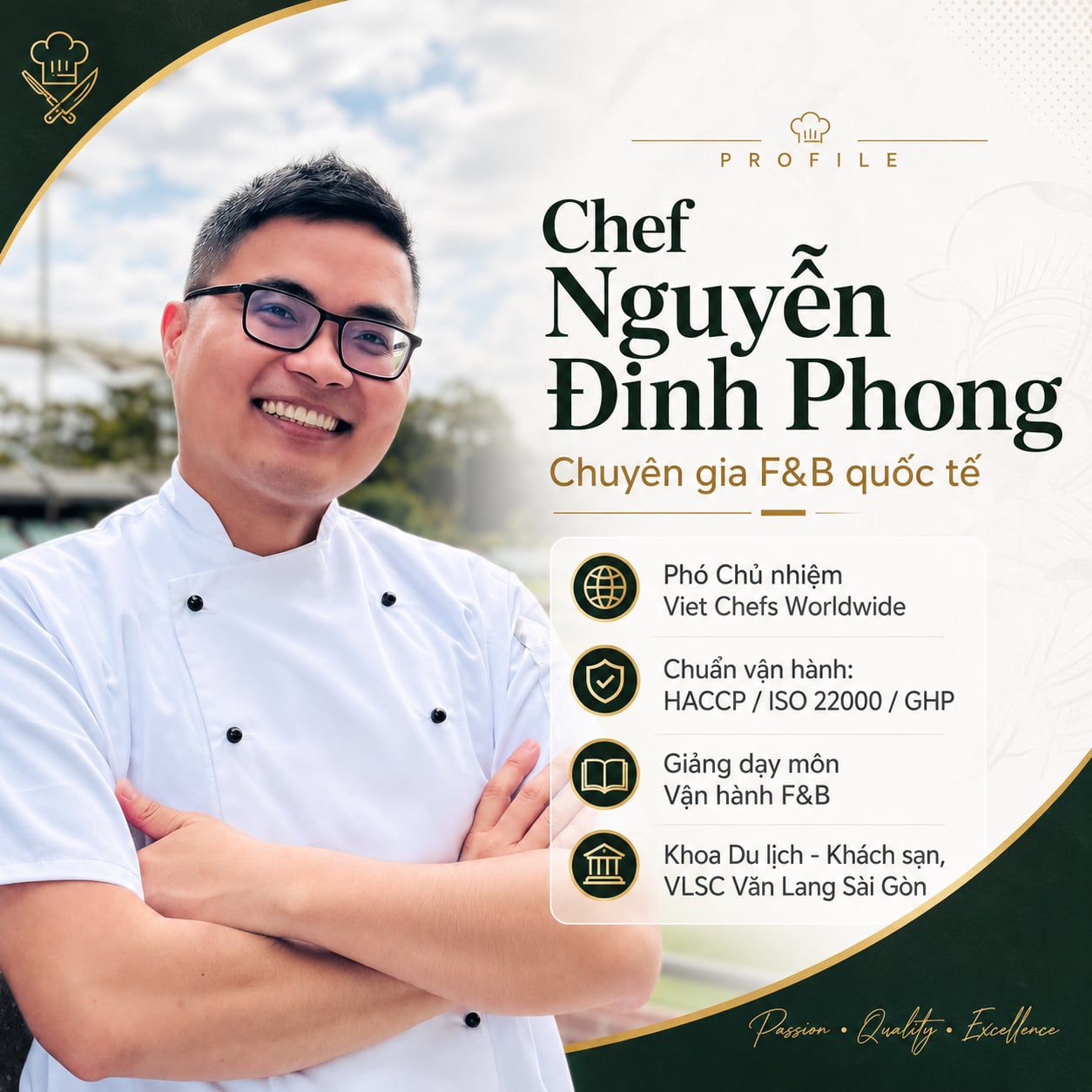
Chef Nguyen Dinh Phong, an international F&B expert and deputy head of Viet Chefs Worldwide, said he has not directly audited the Hong Ngoc facility and has not inspected its kitchen. His comments are based on publicly available information and reflect professional judgment from the food-safety operations field.
According to information reported by the press and conclusions from authorities:
If the ongoing case is included, hospitalizations across the episodes total more than 400.
Chef Nguyen Dinh Phong said that while a single incident can occur by chance, repeated failures point to deeper operational problems.
“One incident could be an accident. Two incidents is a problem. If a scenario repeats three times, it’s unlikely to be mere luck; it likely reflects a system that continually creates risk without addressing root causes,” he said.
He described two recurring categories of gaps: a capability gap (“not knowing how to do it”), which can be addressed through knowledge, training, and procedures; and a cultural/incentive gap (“knowing but not doing”), which is harder to fix because it involves mechanisms that fail to enforce compliance.
From his perspective, when a facility is inspected, penalized, and still experiences similar incidents, it often indicates that food safety is not truly embedded into daily operations—only reflected in outward paperwork. He warned that if suspension, fines, and compensation are treated as hurdles rather than signals to redesign operations from the ground up, the same failures can recur.
Chef Nguyen Dinh Phong highlighted first-in, first-out (FIFO) as a basic control that can fail during busy periods.
He said FIFO must operate throughout the day: items in storage should be labeled with entry date, expiry date, and opening date, and organized so older stock is used first. Without labeling, staff are left with guesswork. He also noted that high-risk items such as pâté, sausage, cold cuts, and egg sauces should be separated from raw items.
During preparation, he said staff should work in batches sized to a safe selling window. Egg sauces, which he described as the riskiest dish, should be prepared in small quantities, labeled with dates, and discarded when expired. During service, he said staff should not add new sauce on top of old sauce; instead, one jar should be used fully before opening another. At day’s end, ready-to-eat items that have exceeded the safe temperature range of 5–60°C should be discarded, documented, and labeled for the next day.
He attributed FIFO failures during rush hours to what he called a “discipline tax”—the extra seconds required to do the correct action when lines are long. In his view, the rule breaks not only due to laziness, but because the system does not make the correct action the easiest action in the moment.
Chef Nguyen Dinh Phong said sample retention does not prevent poisoning by itself, but it is a critical control for investigation and accountability.
He referenced Decision 1246/QD-BYT, which requires facilities to store food samples, keep them cold at 2–8°C for at least 24 hours, and maintain a tripartite control log. Retained samples can help identify causal agents such as Salmonella, E. coli, or Staphylococcus toxin, and pinpoint the specific item responsible.
He said sample retention can support correct treatment, enable learning by revealing the precise source of failure, and provide evidence to limit liability. In his view, skipping sample retention signals that the organization may lack a feedback loop or mechanism to trace failures back to their source.
Chef Nguyen Dinh Phong said the most frequently neglected critical control points in the industry are storage temperature management and egg sauce handling.
He described a “danger zone” of 5–60°C and said pâté, sausage, deli meats, and egg sauces are often left at room temperature for long periods, sometimes due to lack of counter refrigeration, electricity costs, habitual behavior, or the belief that “it’s always been fine.”
He also emphasized egg sauces as the riskiest element, noting that mayonnaise or homemade egg sauces can be vehicles for Salmonella and Staphylococcus. He said the common pattern is making large batches, leaving them out, and continuously replenishing them.
Other neglected areas he cited include receiving raw meats and cold cuts at warm temperatures due to informal supply chains or lack of thermometers, and cross-contamination from shared knives or boards used for raw and ready-to-eat components, along with insufficient washing of greens.
On how quality control can fail when a chain expands beyond 100 outlets, Chef Nguyen Dinh Phong said risk does not grow linearly—it varies by location.
He explained that if each store operates independently, each one can become a “small plant” with its own pate recipe, sauce setup, refrigeration arrangements, and hygiene habits. Without a single standardized control point, the chain effectively creates many independent risks, and a bad batch in one location can damage the brand across other stores.
He said centralizing standardized kitchen inputs can push risk upstream and make it easier to manage, through mechanisms such as HACCP-based sauce production, coded batches, cold-chain distribution, and stores that assemble rather than fully prepare. However, he noted that central kitchens can concentrate risk if a batch fails, making testing, traceability, and auditable governance essential.
Chef Nguyen Dinh Phong said deterrence depends on whether the expected cost of an incident is higher than the cost of redesigning operations and maintaining compliance.
He warned that penalties can become “a toll to pay” if they are cheaper than fixing the system. He argued that penalties should escalate with repeat offenses, potentially including license or brand-level suspension rather than only outlet-level penalties. He also said personal accountability for managers—including possible criminal liability for severe consequences—should be considered, rather than focusing only on corporate penalties.
He suggested public disclosure of violations and conditional reopening after independent third-party verification of corrective actions as additional levers. The governing principle, in his view, is to make the cost of repeating violations higher than the benefit of maintaining the old approach.
Chef Nguyen Dinh Phong said the gap between procedures on paper and real adherence often appears in the moment—when employees are exhausted during busy shifts.
He said procedures on paper are necessary but hollow unless they are translated into design, training, and accountable execution. He identified common failure points: procedures written for inspection rather than for workers, overly complex SOPs not aligned with workflow, procedures introduced once and never re-evaluated, and systems where doing the right thing is not the easiest option. He also cited the absence of accountability or consequences for skipping steps, and cultures that prioritize speed and customer volume over safety.
To build a safety culture that does not depend on one person, he recommended designing environments where safety is the easiest option—such as color-coded cutting boards, time-stamped labels, properly sized refrigerators, and single-use sauce containers—along with governance that makes compliance the path of least resistance. He also emphasized repeated training, capability measurement, daily temperature logs, checklists, and a named shift owner, plus encouraging reporting of near-misses without blame so issues surface before becoming incidents.
“Culture, in the end, is what leaders tolerate,” he said, adding that SOPs are hypotheses and culture is whether those hypotheses survive a crowded Saturday morning.
If asked to rebuild a large chain’s food-safety system, Chef Nguyen Dinh Phong said the first steps should focus on immediate risk control, centralization of high-risk components, and strengthening traceability and accountability.
First: stabilize immediate risk by placing egg sauces and ready-made items under strict temperature control, keeping them cold or discarding them by time, and stopping the practice of leaving egg sauces at room temperature and refilling them. He said the root cause should be traced and the risky practice shut down.
Second: centralize high-risk components by moving production of sauces and ready-to-eat items to a centralized kitchen using HACCP, coded lots, and cold-chain distribution, so stores mainly assemble rather than fully prepare.
Third: establish traceability and accountability by implementing labeling and FIFO, retaining samples at all points, maintaining temperature logs, defining shelf-life, assigning a named person for each shift, and ensuring training with verification. He also said the system should include an audit trail with internal audits and corrective cycles, and that recall capability must be strong enough to remove a batch quickly from the system.
For a minimal framework in a Vietnamese F&B chain, he said the focus should be on prevention through design and the ability to trace, recall, and learn—arguing that a poisoning incident becomes a repeat event only if these elements are missing.

Bitcoin (BTC) investors who use steady dollar-cost averaging (DCA) may be underperforming versus strategies that adjust exposure to the market’s cycle, according to new research arguing that Bitcoin’s behavior differs from traditional long-duration assets.
In a report cited by Markus Thielen of 10x Research, Bitcoin’s market…