•
•
•
•
•
•
•
•
•
•
•
•
•
•
•
•
•
•
•
•
•
•
•
•
•
•
•
•
•
•
•
•
•
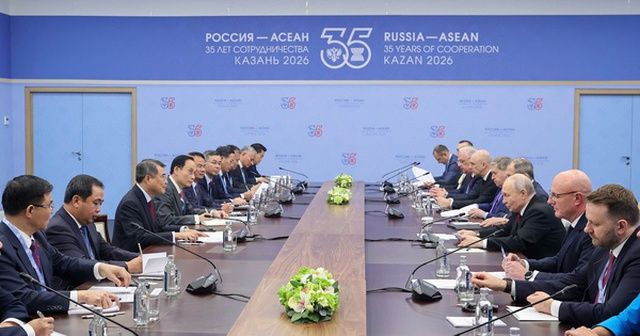
Vietnam is confident in its role as a bridge between ASEAN and the Russian Federation, aiming to reposition and further elevate the comprehensive Vietnam–Russia relationship. Prime Minister Le Minh Hung and a high-level Vietnamese delegation attended the ASEAN–Russia Summit marking the 35th anniversary of relations in Kazan, Russia, from June 17 to 18, 2026, at the invitation of Russian President Vladimir Putin.
The trip is described as a particularly meaningful mission and the first high-level Vietnamese leadership visit to Russia since the successful 14th National Party Congress and the recent national and local elections to strengthen leadership.
Politburo member and Foreign Minister Le Hoai Trung said the summit delivered positive and comprehensive outcomes. He noted that the meeting reaffirmed the position, vitality, and strategic significance of ASEAN–Russia relations amid a volatile international and regional environment.
He added that the summit established a framework and strategic orientation for ASEAN–Russia cooperation in the new period, creating what was described as a qualitative shift in cooperation. The Kazan 2026 Joint Statement sets out the strategic framework and guiding principles, while the ASEAN–Russia Action Plan 2026–2030 outlines priority areas, solutions, and implementation mechanisms.
Energy cooperation was highlighted as a new pillar of cooperation, following the signing of an energy cooperation joint statement. The foreign minister also said this was the first time ASEAN and Russian leaders held a private exchange on Asia–Europe integration, with cooperation moving toward more substantive engagement, supported by a focused agenda and clearer implementation mechanisms.
The Vietnamese delegation, led by Prime Minister Le Minh Hung, said it contributed significantly to the conference outcomes. The delegation’s role included helping shape a more stable, balanced, and sustainable strategic environment and repositioning ASEAN–Russia relations toward a more strategic, self-reliant, substantive, and mutually attentive trajectory.
Vietnam’s proposals—particularly promoting ASEAN–Russia energy cooperation and measures to strengthen Asia–Europe connectivity—were reported as receiving strong support from participating nations.
Prime Minister Le Minh Hung also announced that Vietnam will host the ASEAN–Russia Young Diplomats Summit in 2027, signaling interest in strengthening ties between the two regions through the next generation of diplomats.
While the visit was multilateral, Prime Minister Le Minh Hung reportedly spent substantial time on bilateral engagements. Discussions with the Russian side focused on concrete directions and measures to implement senior-level agreements, while leaders from Vietnamese ministries met with Russian partners to discuss implementation of commitments.
According to the account provided, Russia accorded a highly special reception to the Prime Minister and the Vietnamese delegation, with President Putin allocating substantial time for discussions, reflecting Russia’s special regard for Vietnam and for ASEAN.
The visit produced several notable outcomes. First, both sides reaffirmed a special emphasis on strengthening high-level political trust and committed to repositioning and elevating the Vietnam–Russia Comprehensive Strategic Partnership.
Six major directions for developing Vietnam–Russia relations in the new period were reaffirmed: political trust as the foundation; defense–security as a strategic pillar; energy, oil & gas, and nuclear power as strategic breakthroughs; maximizing potential to boost economic, trade, and investment cooperation; advancing cooperation in mining, shipbuilding, railway modernization, and transport connectivity; and strengthening cooperation in science, technology, education, and training.
Second, both leaders agreed that Vietnam–Russia relations are on the right track with notable results. The report cited that political cooperation remains highly dynamic, with several Vietnamese government-level delegations visiting Russia in the first five months of 2026, and more senior Russian delegations expected to visit Vietnam in the second half of 2026.
Defense–security cooperation was described as continuing to strengthen, while economic cooperation was said to be advancing with a positive trade trend. Energy cooperation was highlighted by the signing of an agreement to build the Ninh Thuan 1 Nuclear Power Plant, described as a historic milestone and a new symbol in Vietnam–Russia relations and as laying groundwork for Vietnam’s nuclear energy sector.
The two sides also agreed on arrangements related to exploration and oil & gas exploitation in Vietnam and Russia. Negotiations are reported as underway to expand cooperation into new areas including clean energy, renewables, oil & gas trading, LNG, and energy-storage infrastructure in Vietnam.
Third, both sides agreed to actively implement existing mechanisms and agreements across political, defense–security, energy–oil–gas, nuclear power, and other sectors. The report said many bottlenecks have been resolved and cleared to facilitate continued cooperative projects, especially in key areas, enabling long-term cooperation between Vietnam and the Russian Federation.
Prime Minister Le Minh Hung attended a working lunch chaired by President Vladimir Putin. The bilateral activities with Russia were described as reaffirming the leadership’s determination to position and elevate the Vietnam–Russia Comprehensive Strategic Partnership for a new era, enhancing the depth and breadth of bilateral cooperation.
Bitcoin (BTC) investors who use steady dollar-cost averaging (DCA) may be underperforming versus strategies that adjust exposure to the market’s cycle, according to new research arguing that Bitcoin’s behavior differs from traditional long-duration assets.
In a report cited by Markus Thielen of 10x Research, Bitcoin’s market…