•
•
•
•
•
•
•
•
•
•
•
•
•
•
•
•
•
•
•
•
•
•
•
•
•
•
•
•
•
•
•
•
•


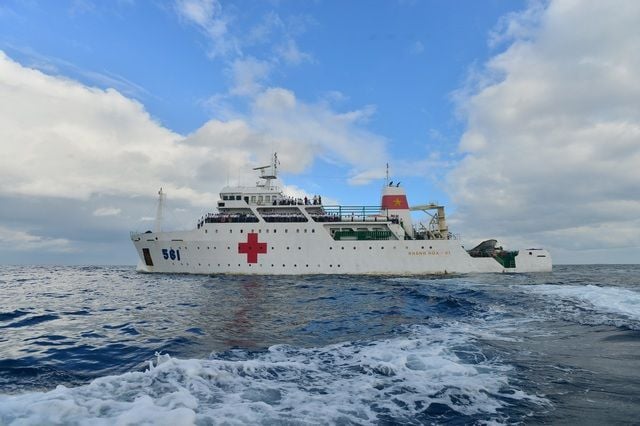
With the onset of the monsoon season, offshore trips to distant fishing grounds carry greater risks. In rough seas, when a workplace accident or a sudden medical emergency occurs, timely access to medical care becomes a life-or-death race. In this context, HQ-561—the mobile hospital at sea in the South China Sea—continues to operate as an emergency center, providing timely treatment for soldiers and civilians at sea.
HQ-561 hospital ship was built at the Z189 (Ministry of Defense) shipyard, launched on 26 April 2012, and officially entered operation at the start of 2013. The ship is described as one of the most modern hospital ships in the region, designed with Dutch technology and meeting international IMO standards.
The Red Cross emblem is painted on the hull and the foredeck, reflecting the ship’s humanitarian mission.
The main deck is dedicated to hospital functions, including fully equipped rooms for resuscitation, cardiology, laboratories, ultrasound, endoscopy, X-ray, operating rooms, and dental–maxillofacial facilities, as well as stores for medicines, supplies, and patient wards.
The ship is equipped with 15 hospital beds, multiple treatment rooms, and medical equipment comparable to a land hospital, enabling it to handle complex emergencies during long sea voyages.
Operating and consultation rooms on HQ-561 are connected by a live satellite link to the 175 Central Military Hospital via VINASAT. This allows doctors at sea to receive specialist advice from the mainland for difficult surgical cases.
To reduce the impact of heavy seas, HQ-561 has two anti-rolling fins designed to provide a more stable working environment for medical staff during rough conditions.
A distinctive feature of HQ-561 is its decompression chamber, a specialized device in marine medicine capable of treating 8–10 people simultaneously.
The chamber is described as critical for treating diving-related injuries. When an accident occurs at sea, transporting a patient to shore is often not timely, and delays of a few hours can lead to severe consequences or loss of life.
Before each monsoon season, voyages out to sea carry greater risks, including accidents caused by waves, collisions, lacerations while hauling nets, diving accidents, fatigue, sudden drops in blood pressure, and strokes or acute illnesses in settings with limited medical facilities.
In recent years, HQ-561 has repeatedly braved heavy seas and strong winds to reach vessels in distress and bring fishermen back for treatment. Crew members report that some voyages in bad weather can last for days, with the vessel pitching and meals limited to instant noodles, but the ship mobilizes immediately when a distress signal is received.
After decades of service, HQ-561 has examined patients, dispensed medicines, and organized emergency care for thousands of officials, soldiers, and civilians. The ship is described as more than a “floating hospital” for the armed forces, functioning as a pillar of support for fishermen and helping protect fishing grounds.
With its mobility, multi-specialty resuscitation capabilities, and remote consultation network, HQ-561 is presented as a symbol of presence and responsibility, aimed at ensuring welfare at sea.
Premium gym chains are entering a “golden era” that is ending or already in decline, as rising operating costs collide with shifting consumer preferences toward more flexible, community-based ways to exercise. Long-term memberships are shrinking, margins are pressured by higher rents and facility expenses, and competition from smaller, more personalized…