•
•
•
•
•
•
•
•
•
•
•
•
•
•
•
•
•
•
•
•
•
•
•
•
•
•
•
•
•
•
•
•
•


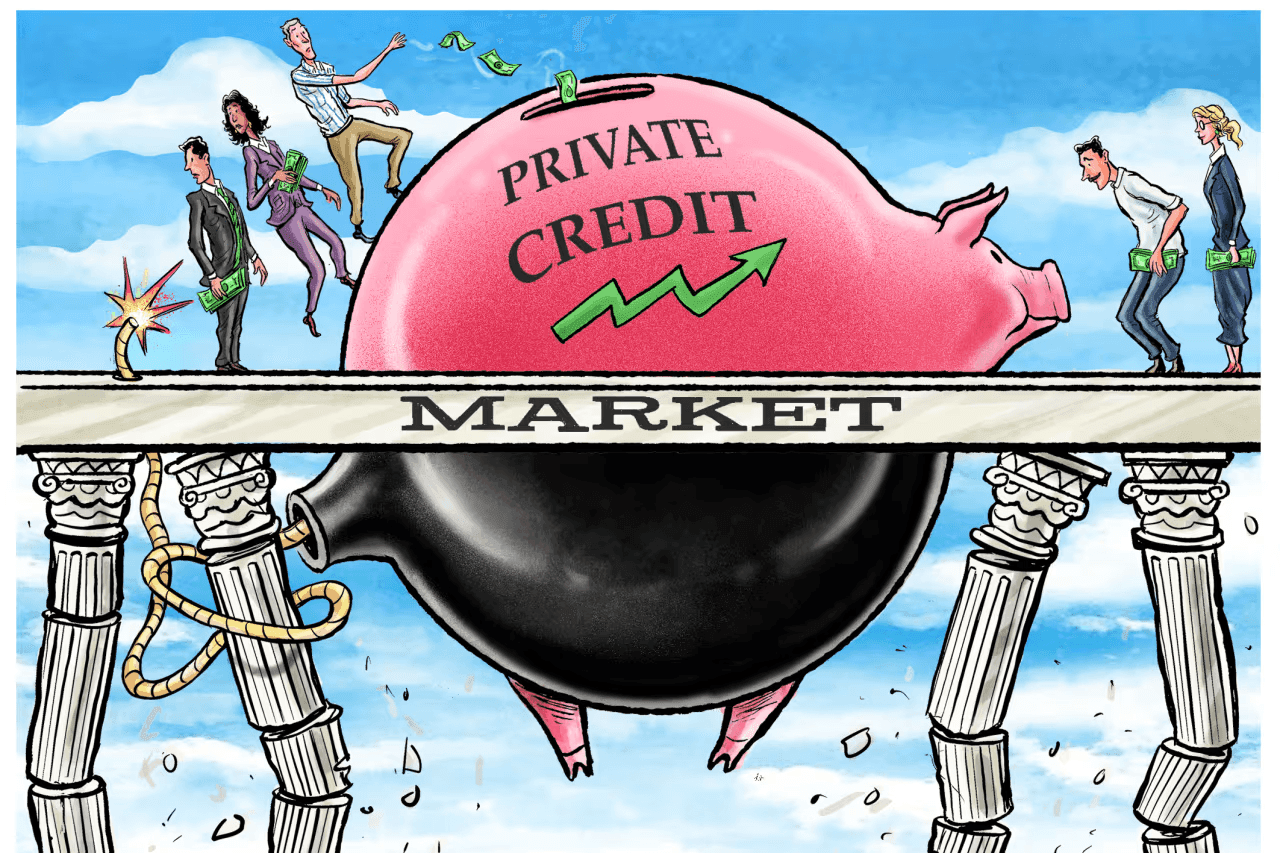
The rapid rise of private credit has played a key role in global mergers and acquisitions activity over more than a decade. However, signs of stress in this $3 trillion market raise a bigger question: how deep will the negative spillovers extend into the private equity sector?
Over the past decade, the two pillars of the private capital market have become more tightly linked, as direct lenders emerged as the main source of financing for buyouts after banks pulled back in the wake of the global financial crisis, according to industry experts.
“Most of the private equity fund ecosystem is financed by private credit,” says Kyle Walters, a senior private equity analyst at PitchBook. “The two sides are structurally tied in deal activity.”
For PE funds, direct lenders offer faster funding and bespoke, flexible financing structures, making them preferred partners in leveraged buyouts. About 80% of PE-backed leveraged buyouts are financed by private credit, according to Professor Jeffrey Hooke, Senior Finance Lecturer at Johns Hopkins Carey Business School.
Stress in private credit is expected to affect both new deals and existing portfolio companies, as lenders become more cautious and borrowing costs rise. Tightening lending standards—higher margins and more stringent covenants—are making financing for deals expensive and more limited, according to PitchBook.
For companies already owned by PE funds, the impact is more pronounced: higher interest burdens, stricter refinancing terms, and covenant-driven cash flow pressure, especially for highly leveraged businesses.
This dynamic leaves firms that benefited from abundant, low-cost financing during the low-rate environment of the 2010s and early 2020s more vulnerable, as weaker companies struggle to roll over debt or exit.
As portfolio loans in private credit decline in value, it reflects strain in the companies, forcing PE funds to mark assets down and accept lower returns, according to Mr. Hooke.
“This will also slow capital raising for new PE funds,” he says. “Highly leveraged deals are the riskiest group. Most investors have no choice but to wait.”
Greysparks consultancy estimates that more than 81% of assets under management in private credit sit within organizations that also operate PE funds, indicating a high concentration of the market in the hands of large managers. This tight linkage is amplifying risk.
Experts warn of the risk of a negative feedback loop: deteriorating lending conditions put pressure on portfolio companies, depress valuations, and curb exits, further weakening fundraising and deal activity.
“Portfolio companies owned by PE funds were already fragile,” Walters notes, pointing to long-hold assets and value creation strategies such as cost cuts, financial engineering, and multiple expansion that have gradually exhausted their room. “Credit pressure now adds another meaningful headwind.”
Tightening lending conditions are directly affecting deal effectiveness. As lenders grow more cautious, PE funds are forced to use less leverage in buyouts, pushing down bid prices and compressing valuations across the market.
Refinancing risk also rises. Firms that relied on flexible debt during the low-interest period now face greater refinancing challenges, especially those in sectors undergoing structural changes.
Companies in PE portfolios are already under pressure from the current wave of credit stress. Many were bought in 2019–2022 at high valuations and with high leverage—assumptions now being tested in a higher interest-rate environment.
Lucinda Guthrie, Mergermarket chief, notes that global PE-backed buyouts fell 14% year over year in Q1 due to geopolitical instability, concerns about private credit markets, and tighter AI-related scrutiny by investment committees.
A deeper concern for investors is that the current dynamics reveal structural weaknesses in the private market model.
“The core argument of private credit is high yields with low risk,” says Dan Rasmussen, founder of Verdad Advisers. “For the first time, investors are facing the possibility that private investments may not be better.”
“Private equity and private credit have lost their ‘glamour’,” he adds.
Large alternative asset managers—who run both private credit and PE—remain cautious, acknowledging tensions but stressing the market’s resilience. CEO of Ares, Michael Arougheti, is believed to have stated that “there are no signs of a systemic default cycle,” arguing that current pressures are cyclical rather than systemic, though some funds have restricted withdrawals to manage outflows.
Jamie Dimon, CEO of JPMorgan, has also voiced cautious views on private credit risk, noting that the sector is not a systemic threat to the broader financial system, despite rising defaults, outflows, and AI-related sector pressures.
Speaking at an analyst briefing, Dimon also highlighted loose underwriting standards across credit markets, not just in private credit. “There has been some softening of underwriting standards, and it is not confined to private credit,” he said.
The bank had about $50 billion of exposure to private credit in Q1, within its broader nonbank lending portfolio, according to Reuters.



Premium gym chains are entering a “golden era” that is ending or already in decline, as rising operating costs collide with shifting consumer preferences toward more flexible, community-based ways to exercise. Long-term memberships are shrinking, margins are pressured by higher rents and facility expenses, and competition from smaller, more personalized…