Interest-rate pressures ease as markets await a new pace of declines
The money market last week recorded notable signals as the interbank rate environment trended downward, while deposit rates at many commercial banks began to ease after a period of continual increases.
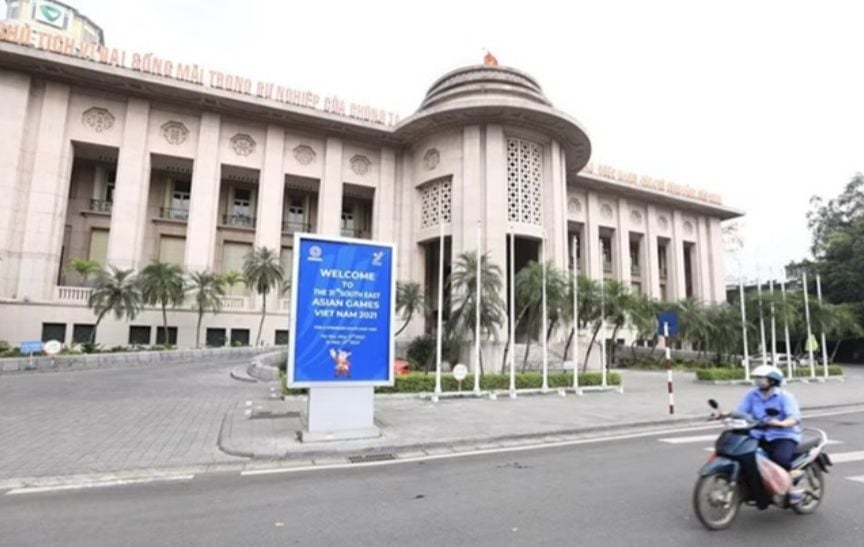
The State Bank of Vietnam headquarters (Photo: TTXVN)
The money market last week recorded notable signals as the interbank rate environment trended downward, while deposit rates at many commercial banks began to ease after a period of continuous increases.
This development clearly reflects the State Bank of Vietnam’s efforts to manage liquidity in the system and also raises expectations about the trajectory of interest rates in the coming period.
According to Le Ngoc Lam, CEO of BIDV, the level of interest rates in recent times has been under heavy pressure given the system’s liquidity was tight at times.
The main reason is that credit growth outpaced deposit mobilization, raising funding costs and squeezing net interest margin (NIM).
Similarly, Le Thanh Tung, a member of VietinBank’s board, assessed that the current liquidity pressure is short-term but requires the State Bank to operate flexibly using tools such as interest rates,
exchange rates, open market operations (OMO), or refinancing to ensure macroeconomic balance.
Data from the State Bank shows that in the week of April 13–17, VND interbank rates fell across most tenors. The overnight rate dropped to 4.52% per year; the 1-week tenor to 5.25% per year; and the 1-month tenor to 6.82% per year.
This development reflects an improvement in system liquidity, with demand for short-term borrowing among credit institutions easing compared with before.
On the deposit market, the downtrend has appeared but is not uniform.
Most recently, VietBankNeo, a subsidiary of Vietcombank, cut deposit rates by 0.5% per year across tenors of 6–60 months, bringing the top rate down to 6.5% per year.
This is the 32nd bank to cut rates since a meeting between the State Bank’s governor and commercial banks on April 9, signaling that the easing trend is spreading.
Vietcombank leadership said the State Bank is actively guiding to stabilize the rate level and prevent a ‘deposit-rate race’. State-owned banks continue to lead by keeping a low rate environment to support the economy.
However, the market still shows clear dispersion. Some banks rolled out special rate packages from 8% to over 10% per year, but with very large minimum deposit requirements.
Among them, VietBank leads with 10.7% per year for a 13-month tenor, while PVcomBank applies 10% per year for a 12–13 month tenor with a minimum balance of 2,000 billion dong.
Other banks also maintain high levels such as Cake by VPBank with a maximum realized rate of 8.7% per year; MSB around 9% per year; HDBank from 7.2–7.6% per year; and digital bank Vikki Bank around 7.9% per year for large deposits.
This shows that medium- and long-term funding demand remains high, making deposit competition not fully over. From a banking perspective, the interest-rate problem has become more complex than ever.
According to Phan Dinh Tue, a member of Sacombank’s board, if lending rates rise, it will affect the ability to absorb capital by enterprises; conversely, deposit rates face downward pressure following the policy direction. Therefore, optimizing funding costs and diversifying sources of funding, including from abroad, is becoming a crucial solution.
Regarding outlook, BIDV’s leadership expects the rate level to gradually stabilize and possibly ease slightly compared with the start of the year, thanks to liquidity-support measures from the State Bank.
Meanwhile, Nguyen Duc Vinh, CEO of VPBank, said rates may continue to stay high in the short term, before easing from Q2 to early Q3.
A common thread in assessments is that the State Bank’s policy actions will be decisive in guiding the market. Yet external factors remain variables to watch.
Geopolitical tensions, especially in the Middle East, could raise inflationary pressures via energy prices and logistics costs. If inflation rises again, the room to cut rates could shrink.
Overall, interest rates in the coming period are likely to stay relatively high in the short term, then stabilize and gradually ease as liquidity improves sustainably.
This process is expected to unfold gradually and with control to balance the goals of supporting growth and maintaining macroeconomic stability.
Lê Phương
Vietnamplus
- 16:24 26/04/2026