•
•
•
•
•
•
•
•
•
•
•
•
•
•
•
•
•
•
•
•
•
•
•
•
•
•
•
•
•
•
•
•
•


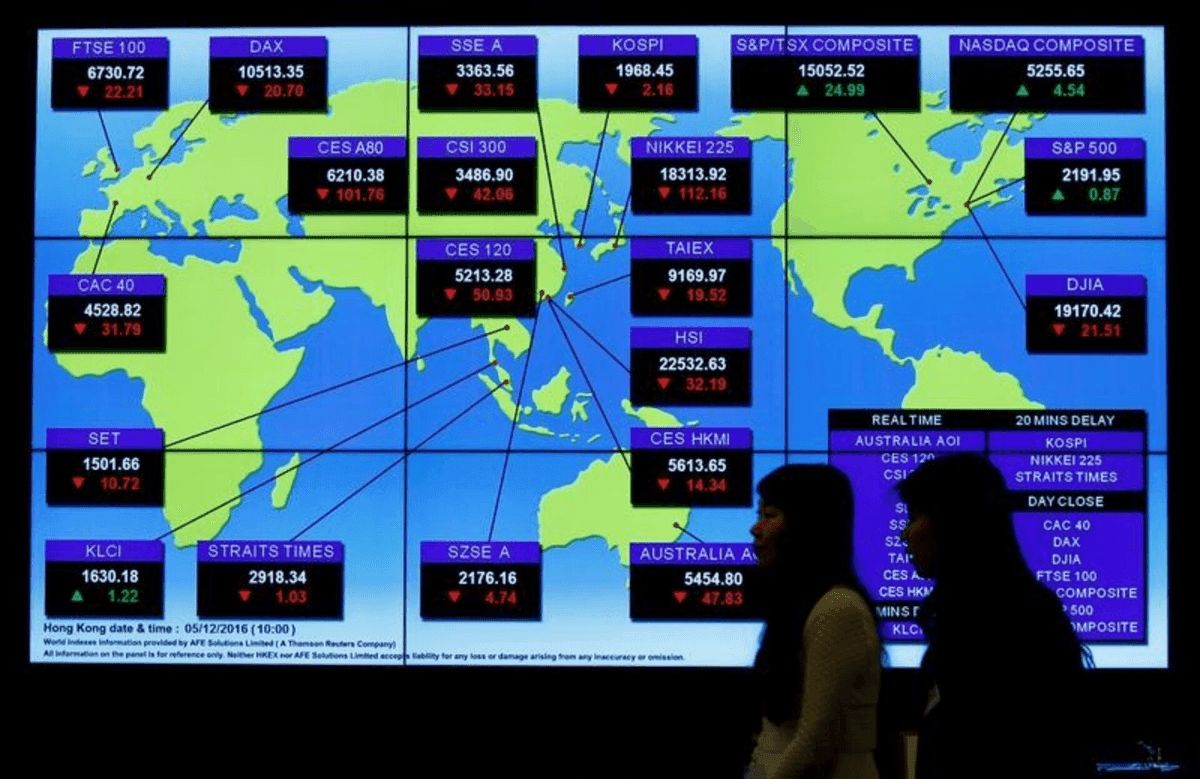
Asia-Pacific and European stock markets fell sharply on Monday, March 2, as the Middle East conflict showed no sign of easing. Iran refused to sit back down at the negotiating table, and a Saudi Aramco oil refinery facility was attacked. Alongside the sell-off in risk assets, investors increased demand for safe-haven assets including gold, the US dollar, the Japanese yen, the Swiss franc, and US Treasuries.
As the new week opened in the afternoon in Vietnam time, major European stock indices were deep in the red, down about 1% to 2%. At 16:00 Vietnam time, the Stoxx 600 fell more than 1.7%, Germany’s DAX slipped over 2%, Britain’s FTSE fell over 1%, and France’s CAC 40 dropped 1.8%.
Earlier, most major Asia-Pacific markets closed lower. Japan’s Nikkei 225 fell nearly 1.4%, India’s Nifty 50 declined 1.6%, and Hong Kong’s Hang Seng dropped more than 2.1%. The MSCI Asia Pacific ex-Japan index fell nearly 1.7%.
Shares of gold miners and oil producers rose, helping Australia’s S&P/ASX 200 avoid the regional downturn and close slightly higher. The energy sector led gains, with Woodside Energy and Inpex both up about 5%. China National Offshore Oil Corp (CNOOC), listed in Hong Kong, rose more than 3%.
Defense stocks also helped cushion markets in Asia and Europe. In Europe, Avio rose 8.4%, BAE Systems rose 6.8%, and Saab gained 7%.
The escalation of the US-Israel-Iran conflict entered its third day, with signs of further tensions. Iran’s top national security official Ali Larijani said in a post on X that Tehran “will not negotiate with the United States,” responding to reports that Iran had approached Washington via intermediaries to restart talks.
Earlier, former President Donald Trump said the conflict could last four weeks.
Saudi Aramco said one of its refineries had been targeted in attacks from Iran. The attack caused a small fire, which has been brought under control.
The conflict began on February 28 after the US and Iran concluded the third round of nuclear talks in Geneva without results. US and Israeli airstrikes killed Ayatollah Ali Khamenei, Iran’s supreme leader, on the first day of the conflict, triggering retaliatory strikes from Tehran.
Concerns that Iran could retaliate by potentially closing the Hormuz Strait pushed crude oil prices higher. Brent crude futures rose to around $82 a barrel at times, while WTI rose more than 8%, approaching $73 a barrel.
Safe-haven assets rose across the board. By 4:00 p.m. Vietnam time, spot gold was up about 2.2% to around $5,400 per ounce, after touching near $5,420/oz earlier. Silver was up more than 1.6%, above $95 per ounce, after briefly exceeding $100/oz.
The US Dollar Index strengthened to over 98.2. The Japanese yen hovered around 155.9 per USD. The Swiss franc strengthened against both the USD and the euro, with the USD down about 0.3% against the franc and the euro down about 0.6% against the franc.
In the United States, stock index futures pointed to a lower session. Dow Jones futures were down 1.2%, S&P 500 futures down 1.1%, and Nasdaq futures down nearly 1.5%.







Premium gym chains are entering a “golden era” that is ending or already in decline, as rising operating costs collide with shifting consumer preferences toward more flexible, community-based ways to exercise. Long-term memberships are shrinking, margins are pressured by higher rents and facility expenses, and competition from smaller, more personalized…




