•
•
•
•
•
•
•
•
•
•
•
•
•
•
•
•
•
•
•
•
•
•
•
•
•
•
•
•
•
•
•
•
•


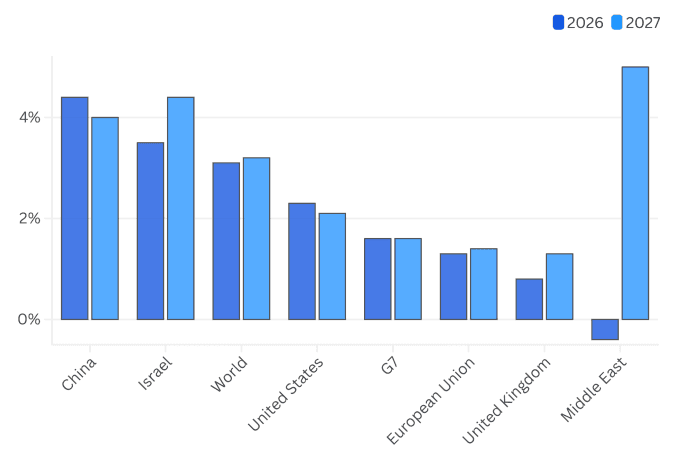
Despite the conflict, Israel’s economy is forecast to grow 3.5% to 3.8% in 2026, outperforming many G7 peers, supported by high-tech exports and strong capital inflows.
Earlier this month, the Bank of Israel cut its 2026 GDP forecast, citing the impact of the conflict in the Middle East. Even after the revision, the economy is still expected to expand up to 3.8%, after trimming 1.4 percentage points.
The International Monetary Fund (IMF) projects Israel’s economy will grow 3.5% this year, compared with 2.3% for the United States and 1.3% for the European Union. In 2027, the IMF forecasts growth of 4.4%.
Bank of Israel governor Amir Yaron said that if conflicts end, the economy could recover to 5.5%.
Israel’s growth is also supported by the development of natural gas resources and defense exports. Keren Uziyel said the energy sector is expected to see substantial investment flows in 2026-2027, including domestic renewables and expanding natural gas production and export capacity.
Demographics are another tailwind. The average annual population growth rate has been close to 2% over the past two decades, and Israel’s population is relatively young by developed-country standards. If ceasefire agreements hold, the economy is expected to recover fairly strongly by mid-year and reach around 3% growth this year.
Funds continue to flow into Israel’s capital markets. The Tel Aviv 35 index (the 35 largest companies listed on the Tel Aviv Stock Exchange) has risen 20% year-to-date, following a 51.6% rise last year. The performance outpaces many major developed markets, including the three main U.S. indices.
Keren Uziyel said foreign capital is returning, focusing on technology, finance, and defense sectors. The Tel Aviv 125 index has risen 17% year-to-date.
She and others cited the drivers attracting funds as a strong economy, favorable demographics, and large deals, alongside expectations that Israel’s defense industry will continue to boom due to international contracts.
Israel’s shekel has strengthened by about 4% against the U.S. dollar over more than two months of conflict and nearly 7% year-to-date. Schwok said the return of foreign capital reflects investor confidence and has helped the shekel appreciate, describing a “clear shift from shock to normalization.”
Joao Gomes, a finance professor at Wharton, University of Pennsylvania, said the economy is beginning to feel the impact of the conflict. He pointed to a labor shortage due to mobilization and softer consumer spending tied to security concerns. He also said tourism has been hit hard, weighing on growth and revenue.
Gomes added that public debt has risen significantly, but could be managed if a peace agreement is reached, which would help reduce and sustain defense spending and support foreign investor confidence and a high-quality workforce. Without such an agreement, he warned of greater challenges from risks including a weaker currency, higher inflation, and capital outflows.
EIU’s Keren Uziyel said that while macro fundamentals remain strong, the conflict is expected to affect many aspects of Israel’s economy. She noted that the government recently lifted restrictions on non-essential services due to concerns about growth and tax receipts.
Uziyel said the forecast includes a substantial drop in consumer spending in March-April, coinciding with the peak tourism season.




Premium gym chains are entering a “golden era” that is ending or already in decline, as rising operating costs collide with shifting consumer preferences toward more flexible, community-based ways to exercise. Long-term memberships are shrinking, margins are pressured by higher rents and facility expenses, and competition from smaller, more personalized…