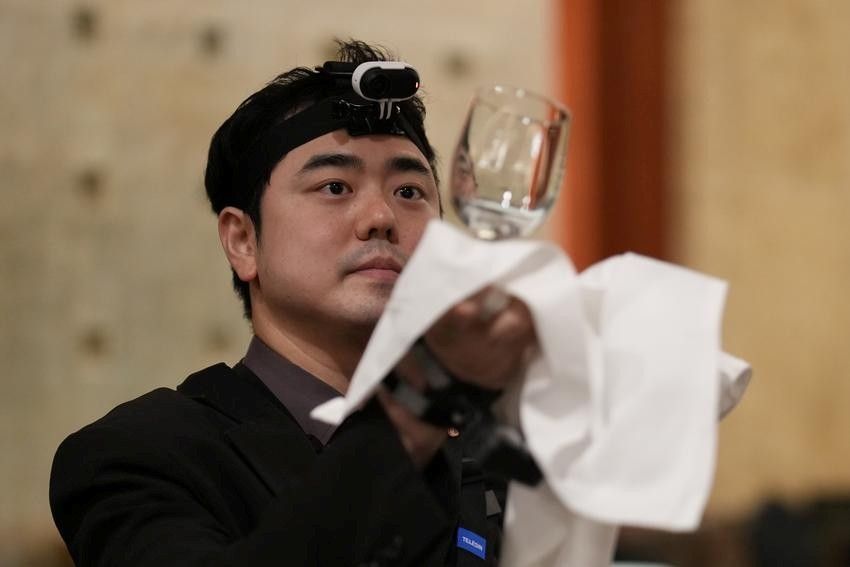
South Korean startups are accelerating the digitization of human skills to train the AI brains of humanoid robots, with the aim of deploying humanoid robots in factories, hotels, and even homes in coming years. RLWRLD, a Korean AI startup, is building a large-scale labor-skill data library by capturing data from workers—from hotel staff to CJ Group’s logistics personnel and Lawson’s store employees in Japan—to train an AI foundation model that can power humanoid robots. The effort is led by RLWRLD, a Korean AI startup, which collaborates with major corporations to create a large-scale data library of human labor skills to develop a “robot AI brain” for humanoid robots. RLWRLD’s data collection extends beyond the hotel sector to include logistics workers at CJ Group and staff at Lawson convenience stores in Japan, aiming to turn recorded movements into training data for advanced robotics. The goal, according to RLWRLD engineers, is to create a software layer that can operate across different robot types in factories and other work environments within a few years, before expanding to civilian and domestic domains. KOREA BETS ON “PHYSICAL AI” RLWRLD is part of a wave of Korean tech firms and manufacturers competing in the so-called physical AI—an area focused on machines that can perceive their environment, make decisions, and act in the real world. Unlike traditional industrial robots that perform repetitive tasks, the new generation of humanoid AI robots is expected to handle more complex duties by learning from human behavior. Although the market is still in early development, Korea views this as a strategic opportunity to leverage its strengths in manufacturing and semiconductors to become a global AI power. However, competition is intensifying. American tech giants like Tesla and numerous Chinese firms are investing billions of dollars in humanoid robots and AI automation. If chatbots such as ChatGPT or Gemini are trained on vast textual data from the internet, humanoid robots require real-world data about human movements and handling to learn how to operate in physical environments. Korean experts say the country faces English-language disadvantages in chatbot development but has a clear advantage in physical AI thanks to its strong manufacturing base and skilled workforce. Last month, the Korean government announced a $33 million project to digitize the “implicit and instinctive” skills of skilled workers to build a data foundation for AI-powered manufacturing. The government hopes robots will boost productivity and offset population aging and labor shortages. RLWRLD recently introduced a robotics foundation model and forecasts industrial humanoid robots will be deployed widely around 2028. ROBOT HUMANOID RACE ACCELERATES Many large Korean groups are speeding up plans to commercialize humanoid robots. Hyundai Motor Company plans to deploy robots developed by its subsidiary Boston Dynamics in global factories, starting at its Georgia facility in 2028. Samsung Electronics aims to transform all production sites into “AI-operated factories” by 2030, with humanoid robots and specialized robots on the assembly line. According to Billy Choi, a professor at Korea University’s Human-Inspired AI Center, Korea is focusing on humanoid robots that directly serve the manufacturing sector. A major challenge today is enabling robots to replicate the dexterity of human hands. Most robots currently use two- or three-finger grippers, but RLWRLD belongs to a small group developing AI for five-finger hands to mimic natural grasp and tactile sensation. Experts say this capability is crucial if robots are to enter home environments that require closer, more flexible human interaction. In RLWRLD’s lab on the 34th floor of Lotte Hotel Seoul, engineers continue training robots using virtual reality headsets, sensor gloves, and motion-tracking devices to reproduce human actions. The data collected include minute details such as joint angles and grip forces. In a recent trial, RLWRLD’s humanoid could carefully lift and place a cup on the minibar, though it occasionally spilled objects. In a newer version, the humanoid could open a box, place a computer mouse inside, close the box, and put it on a conveyor belt. LABOR CONCERNS AND THE FUTURE OF WORK The rapid development of humanoid AI is raising concerns among Korean workers. Unions warn robots could replace parts of the skilled workforce, historically a competitive advantage for Korea’s economy. After Hyundai’s union voiced concerns about a potential “jobs shock” earlier this year, President Lee Jae Myung said AI is an irreversible trend and urged workers to adapt to changes that are coming faster than expected. Kim Seok, policy director at the Korean Confederation of Trade Unions, says that while AI can imitate existing skills, the process of skill development remains a distinctly human value. He warns that widespread robot deployment could disrupt training and the maintenance of a skilled workforce if adaptive policy support is not provided. Nevertheless, many companies believe robots will not fully replace humans in roles requiring direct human interaction. Lotte Hotel notes that robots currently still require many hours to clean a hotel room—roughly 40 minutes for human staff—yet the hotel expects robots to handle backstage tasks such as event preparation or transporting items by around 2029. According to David Park, humanoid robots could take on about 30–40% of backstage work; the remainder would still involve direct human interaction. While commercialization of humanoid robots still requires time to mature, Korea is signaling its ambition to become one of Asia’s leading centers for “physical AI” by converting human labor skills into core data for future robot generations. Keywords: physical AI, robotics technology, Korea, humanoid robots