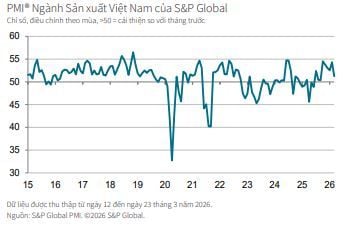
PMI for Vietnam's manufacturing sector, compiled by S&P Global, remained above the 50 threshold in March. However, the PMI eased to 51.2 from 54.3 in February, indicating that manufacturing conditions improved only marginally—the least since September last year. The war in the Middle East has pushed the rate of input-cost growth in Vietnam's manufacturing sector higher in March, which in turn led to output prices increasing at the fastest pace in nearly 15 years. Price pressures intensified, dampening demand, and as a result, the growth rate of new orders and production both slowed. Employment and purchasing activity also fell. Supplier lead times lengthened considerably. The war's impact also reduced business confidence, with optimism at a six-month low. The S&P Global Vietnam Manufacturing PMI remained above 50 in March, extending the current improvement period to nine months. Yet the PMI at 51.2 pointed to only modest improvement relative to February. A key feature of the March survey is the impact of the Middle East conflict on inflation. Oil prices rose, lifting input prices for
fuel, transport and other costs. As a result, nearly half of the survey respondents reported higher input costs in March, the fastest rise since April 2022. As higher input costs were passed on to clients, output prices rose at one of the steepest rates since the series began in 2011. Inflation in March was the strongest in almost 15 years. Higher production costs constrained demand. Total new orders continued to increase, as some firms noted customers trying to secure orders before prices rose. However, the pace of growth was modest and the weakest since September last year. Demand from the external market weakened, and new export orders fell noticeably in March after stabilizing in February. In line with the softer growth of total new orders, production rose at a slower pace in March. It was the 11th consecutive month of expansion, but the rate of output growth was the weakest since June 2025. New orders grew at a softer pace and input costs rose, causing firms to delay purchases of additional items in March. Input buying fell sharply, ending an eight-month upturn. Finished goods stocks also declined. Leading to longer supplier delivery times, the longest stretch since four years. Respondents cited higher fuel costs as contributing to transport delays. Alongside weaker input buying, firms noted signs of softer job creation; employment fell for the first time in six months. Several firms reported difficulties replacing staff who left, and there was a drop in the number of temporary workers. With weaker demand and difficulty sourcing inputs, backlogs increased in March, but the rate of backlog growth was only marginal. Some producers used finished goods to fulfill orders, leading to a notable depletion of finished goods stocks. The drop in input buying and longer supplier lead times contributed to a sharp increase in backlogs. Business confidence dipped to a six-month low due to concerns about the war in the Middle East and its effects on demand, prices, and the supply of raw materials globally. However, with expectations that demand will remain steady and support output growth next year, firms still anticipate output to rise. Andrew Harker, Economics Director at S&P Global Market Intelligence, said: “March's Vietnamese PMI for the manufacturing sector highlights the initial effects of the war in the Middle East on manufacturing firms. As nations rely on imported oil from the affected region, the impact on prices and supply chains has to be taken into account. The pace of input-cost inflation quickened, and accordingly output prices rose—at the fastest rate in nearly 15 years—reflecting immediate and meaningful costs faced by firms. Production and new orders remained in expansion territory in March, but the pace of growth slowed markedly from February, with part of the expansion explained by customers attempting to secure orders before price rises. Consequently, the near-term outlook looks subdued unless a quick resolution to the conflict and disruptions around the Hormuz Strait are found.”