•
•
•
•
•
•
•
•
•
•
•
•
•
•
•
•
•
•
•
•
•
•
•
•
•
•
•
•
•
•
•
•
•


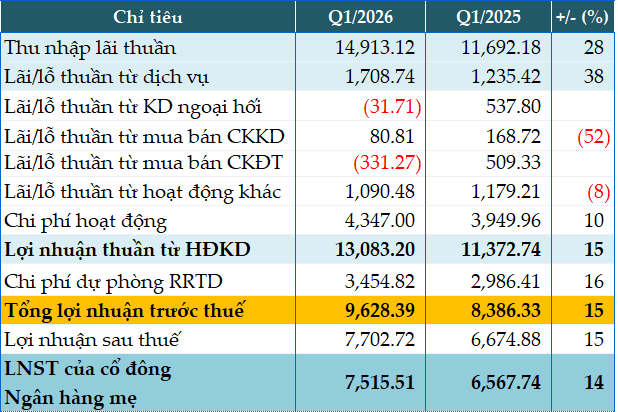
Military Bank (MB, HOSE: MBB) reported a 15% year-on-year increase in pre-tax profit in Q1 2026, driven by growth in its core business and service activities.
According to MB’s consolidated Q1 2026 financial statements, the bank posted pre-tax profit of over 9,628 billion VND. The result was supported by higher net interest income and a strong contribution from non-interest income.
In Q1, MB’s net interest income reached over 14,913 billion VND, up 28% year-on-year.
Non-interest income also rose, increasing 38% to nearly 1,709 billion VND. The growth was supported by banking fees and insurance services, which brought in 2,118 billion VND, along with brokerage fees of 241 billion VND. While some non-credit business lines such as trading and foreign exchange were affected by market volatility, gains in core segments helped lift total revenue.
Operating expenses increased by 10% to 4,347 billion VND, slower than revenue growth. As a result, net profit from operating activities rose 15% to 13,083 billion VND.
MB continued a prudent risk management approach by increasing loan loss provisions by 16% to nearly 3,454 billion VND. The bank said this strengthens its defensive capacity against potential risks while supporting pre-tax profit growth of 15% to 9,628 billion VND.
Against an annual pre-tax profit target of about 39,408 billion VND, MB achieved 24% of the target after Q1.
By the end of Q1, MB’s total assets were around 1.6 quadrillion VND. Loan outstanding rose 3% to 1.12 quadrillion VND, while customer deposits declined slightly by 2% to 905,918 billion VND.
Non-performing loans increased. As of 31/03/2026, non-performing loans rose 14% from the start of the year to 15,947 billion VND. The NPL ratio rose from 1.29% to 1.42%, in line with market fluctuations.

Source: VietstockFinance

Source: VietstockFinance






Premium gym chains are entering a “golden era” that is ending or already in decline, as rising operating costs collide with shifting consumer preferences toward more flexible, community-based ways to exercise. Long-term memberships are shrinking, margins are pressured by higher rents and facility expenses, and competition from smaller, more personalized…