•
•
•
•
•
•
•
•
•
•
•
•
•
•
•
•
•
•
•
•
•
•
•
•
•
•
•
•
•
•
•
•
•


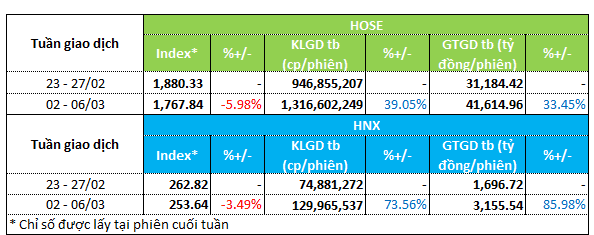
Money flow continued to move into the oil and gas sector as market sentiment turned negative in the first week of March amid geopolitical tensions, while cash flow remained active—particularly into groups expected to benefit from the current environment.
Price action in the first week of March was broadly negative. The VN-Index fell 6% to 1,767.8 points, and the HNX-Index declined 3.5% to 253.6 points. Despite the weaker index performance, market liquidity improved sharply.
On HOSE, daily turnover rose about 40% to over 1.3 billion shares per session. Turnover value increased by more than 33% to 41.6 trillion VND per session.
On HNX, average turnover rose nearly 74% to around 130 million shares per session. Turnover value climbed 86% to more than 3.1 trillion VND per session.
Geopolitical tensions in the Middle East were cited as the main driver of a more cautious market mood during the week 02–06/03.
Oil and gas stocks saw liquidity surges, including GSP, POW, PVG, PVB, PVS, and PLC. GSP and PVG recorded liquidity increases of more than 500% versus the prior week.
Several shipping and oil-and-gas transportation names also posted strong liquidity gains, such as VTO, VIP, PVP, and DXP, appearing among the top liquidity movers on both exchanges.
In contrast, construction and real estate stocks faced money outflows. Weaker liquidity was reported for TLD, RYG, TNT, VTV, TAL, SGR, LHG, and NRC.
The article notes that charts accompany the liquidity overview for the week 02–06/03, along with lists of the Top 20 stocks with the largest liquidity increases and decreases on both HOSE and HNX.
Overall, investors remained cautious, with turnover and liquidity influenced by a mix of domestic and international factors. Even with negative price action, the flow of funds into oil and gas-related names helped keep liquidity active.







Premium gym chains are entering a “golden era” that is ending or already in decline, as rising operating costs collide with shifting consumer preferences toward more flexible, community-based ways to exercise. Long-term memberships are shrinking, margins are pressured by higher rents and facility expenses, and competition from smaller, more personalized…




