•
•
•
•
•
•
•
•
•
•
•
•
•
•
•
•
•
•
•
•
•
•
•
•
•
•
•
•
•
•
•
•
•


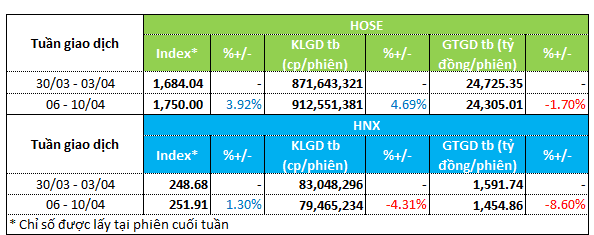
Liquidity diverged across sectors during the trading week of 6–10 April, even as the market rebounded on multiple positive signals. The VN-Index rose nearly 4% to around 1,750 points, while the HNX-Index gained 1.3% to 251.91 points. The weekly advance was particularly driven by the session on 8 April, when the VN-Index increased 4.7% and the HNX-Index rose by about 2.7% following factors including FTSE’s confirmation of Vietnam’s uplisting/upgrading trajectory and easing Middle East tensions.
Despite the market’s rebound, liquidity did not improve. HOSE turnover fell to 24.3 trillion dong, down 1.7% on the week. On HNX, turnover dropped 8.6% to 1.45 trillion dong.
The week’s money-flow dynamics showed broad differentiation across sectors, with liquidity rising in some groups while falling in others. This pattern suggests that the direction of capital flow was not consistent across the market.
In the construction sector, CDC surged, with turnover exceeding 1 million shares per session—about ten times the prior week. Other construction stocks also recorded stronger liquidity, including DC4, HHV, LIG, and C69. In contrast, several construction names saw liquidity decline sharply, including HTN, PC1, CTD, S99, VC2, and MST.
Finance–banking also reflected divergence. BMI, TCB, OCB, TCI, LPB, MSB, and SHS recorded higher liquidity compared with the prior week. Meanwhile, MIG, EVF, VFS, BVS, and MBS experienced outflows.
Real estate liquidity was similarly split. QCG, EVG, NVL, NRC, DTD, NDN, CEO, and TIG saw strong liquidity gains. By contrast, VPI, VRE, IDC, AAV, and IDJ faced liquidity declines of 37–45%.
After an initial phase of attracting funds, electric stocks began to see outflows. HID, TV2, PPC, and REE recorded sharp drops in liquidity.
The article also references “Top 20 stocks” by liquidity increases/decreases on HOSE and by liquidity changes on HNX, based on average trading volume over 100,000 shares per session.
Note: The list counts stocks with the largest liquidity changes based on average trading volume over 100,000 shares per session.
Premium gym chains are entering a “golden era” that is ending or already in decline, as rising operating costs collide with shifting consumer preferences toward more flexible, community-based ways to exercise. Long-term memberships are shrinking, margins are pressured by higher rents and facility expenses, and competition from smaller, more personalized…