•
•
•
•
•
•
•
•
•
•
•
•
•
•
•
•
•
•
•
•
•
•
•
•
•
•
•
•
•
•
•
•
•


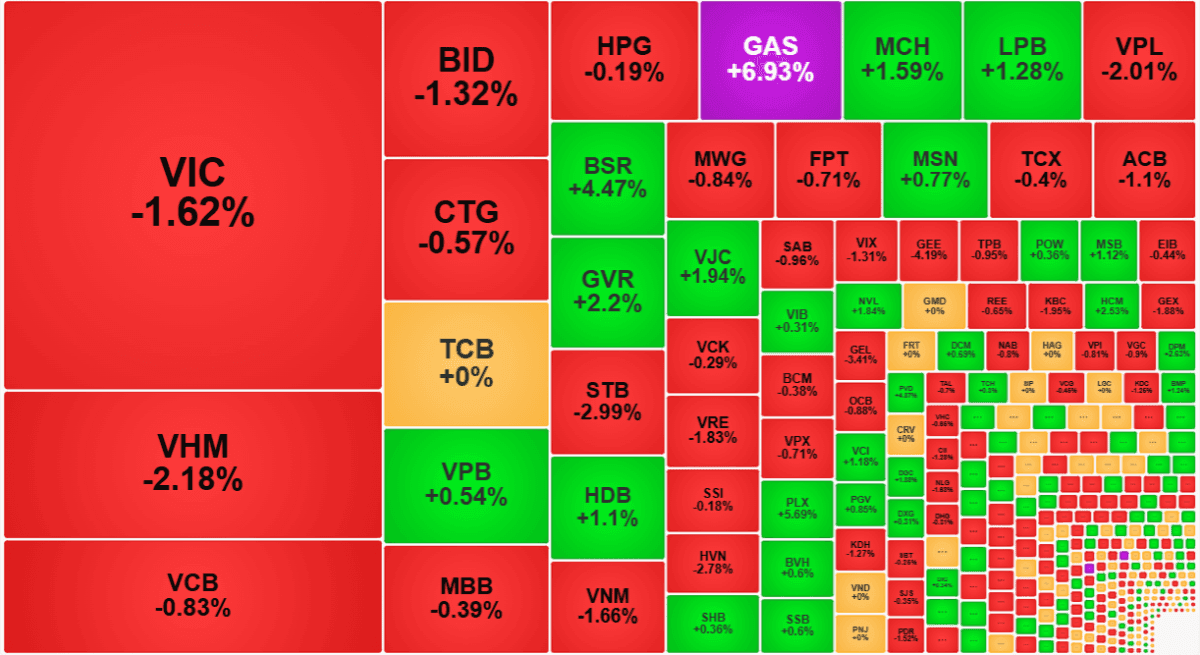
Oil and gas stocks rebounded sharply as GAS hit the ceiling price, helping stabilize the market despite ongoing weakness in the leading stock group. The VN-Index closed the session down 0.44% (down 8.35 points), while market breadth remained relatively balanced with 120 gainers and 168 decliners.
Cash flow skewed toward decliners, with 54% of matched value concentrated in red stocks versus 42% in green. The morning’s price action showed clearer differentiation and index stability, which encouraged short-term capital to rotate more aggressively—particularly into oil and gas as the sector continued to recover.
Oil prices have risen in recent days, with futures for both main crude benchmarks trading above $100 per barrel. Oil and gas stocks also followed through after a sizable correction from the peak earlier in March.
GAS was the standout mover, surging to the ceiling price in the final minutes of the morning session. The stock still had a ceiling order volume of 624,500 shares. GAS recorded an all-time intraday high on March 4, closing at 128,700 dong, before correcting nearly 43% until two sessions ago. Buying interest lifted trading activity, with GAS reaching the highest liquidity in two months at 350.7 billion dong during the morning.
BSR led liquidity among oil and gas names, with 402.9 billion dong and a price increase of 4.47%. The stock also began entering the VN30 basket today. BSR extended gains for a third consecutive session, rising about 17.3% over the period, after a prior drawdown of up to 38%.
Other oil and gas stocks generally moved higher, including PVD (+4.87%), PVT (+4.42%), PLX (+5.69%), PTV (+7.55%), OIL (+6.29%), PVC (+4.83%), PVB (+4.07%), and PVS (+3.75%).
GAS and BSR were among the best supporting stocks for the VN-Index, contributing more than 4 points. This came as several large constituents were in the red during the morning, including VIC (-1.62%), VHM (-2.18%), BID (-1.32%), VCB (-0.83%), and CTG (-0.57%). The five largest HoSE stocks together accounted for more than 10 points.
VN30 performance was also mixed but not severely negative, with 12 gainers and 17 losers and the index down 0.39%. Most green stocks rose modestly. Besides oil and gas, notable gainers included GVR (+2.2%), VJC (+1.94%), LPB (+1.28%), and HDB (+1.1%).
With heavy trading in oil and gas, liquidity in the VN30 group rose by nearly 24% versus yesterday morning and accounted for 57% of total matched value on HoSE. By contrast, total HoSE market liquidity rose by less than 10%, suggesting money flow was retreating from mid-cap and small-cap names.
Among the 120 stocks advancing on the VN-Index, 55 gained more than 1%, but liquidity remained concentrated in the top 25. Thirteen of those traded above 100 billion dong, with oil and gas dominating. Other notable gainers included HCM (+2.53%), EVF (+4.14%), NVL (+1.84%), MSB (+1.12%), and VCI (+1.18%).
On the downside, selling pressure was not described as particularly intense. Although breadth showed many decliners, liquidity was generally low or only slightly lower. The market had about 20 stocks down more than 1% with liquidity above 10 billion dong. The Vin group accounted for much of the liquidity, alongside banks ACB, STB, and BID. Mid-cap names highlighted by liquidity included VIX (-1.31%), GEX (-1.88%), CII (-1.28%), and GEL (-4.19%).
Foreign investors bought little but sold heavily, resulting in a net outflow of 938.3 billion dong on HoSE — the largest in 16 sessions. Major net sellers included FPT (-197.1 billion), ACB (-130 billion), VHM (-124.6 billion), STB (-95.7 billion), and VIX (-66.6 billion). On the buy side, the most notable net purchases were MSN (+73.8 billion) and PLX (+36.4 billion).
Premium gym chains are entering a “golden era” that is ending or already in decline, as rising operating costs collide with shifting consumer preferences toward more flexible, community-based ways to exercise. Long-term memberships are shrinking, margins are pressured by higher rents and facility expenses, and competition from smaller, more personalized…