•
•
•
•
•
•
•
•
•
•
•
•
•
•
•
•
•
•
•
•
•
•
•
•
•
•
•
•
•
•
•
•
•


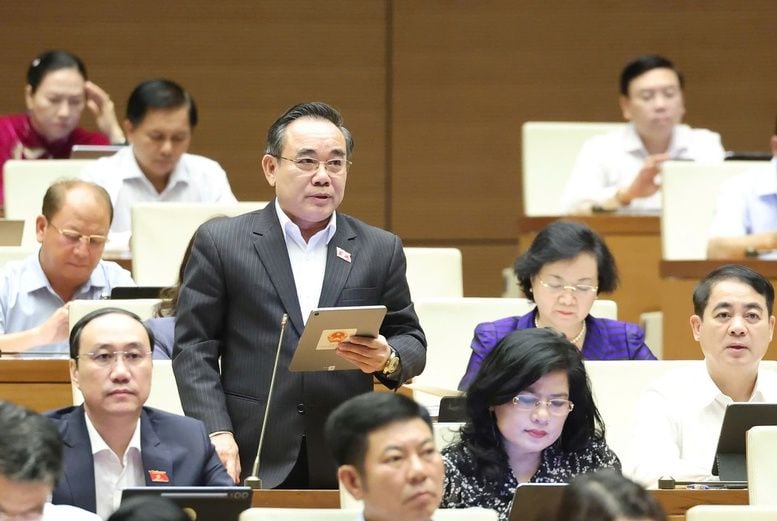
On the afternoon of April 21, during the continued program of the First Session, the 16th National Assembly discussed the mid-term public investment plan for 2026–2030, the national five-year financial plan for 2026–2030, and the plan for borrowing and debt repayment for 2026–2030.
Representative Lê Hữu Trí (Khánh Hòa Province) said the draft Resolution on the mid-term public investment plan clearly sets the core objective of enhancing public investment efficiency, leveraging leadership to attract maximum private resources. He noted that the plan aims to support faster growth, sustainable development, and completion of a strategic infrastructure system while ensuring social welfare and national defense and security.
He emphasized that capital allocation must comply with the Constitution and relevant laws on public investment and the state budget, align with the capacity to balance resources, and ensure debt safety. Management and use of capital should be based on economic-social efficiency, feasibility, and lessons learned from previous phases.
To meet the targets, the representative proposed continuing review and decisively removing projects that are not truly needed or do not meet conditions, focusing resources on key projects, and fundamentally reforming public investment governance. He called for abolishing the “xin-cho” mechanism, emphasizing quality over quantity, and strengthening accountability for those approving investment policy—without approving inefficient projects.
Representative Lê Hữu Trí also highlighted the challenge of reducing the ICOR (Investment Coefficient) to 4.5–4.8. He said this requires addressing issues including over-spread investment, slow progress, limited quality of consulting and surveying, and low disbursement rates.
He further urged strengthening early and remote monitoring, strictly handling violations in surveying, design, cost estimation, and bidding, and closing legal gaps to prevent corruption and waste.
Agreeing with the results of public investment in 2021–2025 and the plan for 2026–2030, Representative Đoàn Thị Lê An said that despite difficulties, the Government has implemented decisive leadership, treating public investment as a major driver of growth and achieving positive results. She noted that the development investment budget structure has shifted positively, with resources allocated more coherently and inefficiencies gradually addressed. She also said the approach increases autonomy and responsibility of levels and sectors and aligns allocations with Party guidelines and National Assembly resolutions.
However, she said current outcomes still fall short of expectations. “Disbursement is slow and uneven across ministries, sectors, and localities; where there is capital, it cannot be spent, reflecting systemic bottlenecks from institutions to execution capacity,” Đoàn Thị Lê An said.
She urged the Government to continue improving the institutional framework, streamline procedures, and raise the quality of investment preparation. She also called for removing risk-averse attitudes and empowering officials to think, act, and take responsibility for the common good.
Emphasizing ODA projects, especially in key infrastructure, Representative Nguyễn Trúc Sơn (Vĩnh Long Province) said that in 2026–2030, demand for foreign loans is expected to rise 7–9 times compared with prior levels. He said this is appropriate given the country’s need for additional resources to drive socio-economic development.
At the same time, he urged the Government and ministries to further harmonize investment procedures between domestic and donor sides to avoid projects that involve two separate processes and funding procedures, which can delay implementation. He noted that previously, ODA disbursement was about 52.7% and called for improvements through simplification of procedures, shortening processes, and better coordination.
After the discussion, Minister of Finance Hồ Văn Tuấn clarified concerns. On revenue policy, he said that given large development investment needs, the policy should be “revenue first, expenditure second.” He added that tax policy must be reviewed regularly to ensure revenue adequacy and comprehensiveness, support economic development—especially for SMEs—and encourage domestic firms to participate more deeply in global value chains and in the value chains of FDI-driven firms to raise productivity and growth.
He said revenue policy must be simple, clear, easy to implement, transparent, and designed to minimize compliance costs, while remaining flexible to respond to evolving conditions.
On expenditure, the minister said the plan aims to reduce the share of current expenditure to about 60% of total spending, as a major effort to ensure government operations with priority for defense-security, social welfare, education, health, and especially innovation. To boost savings, he said that in addition to 10% cuts in current spending in 2026, the Prime Minister directed further reductions of 5% to channel resources to development investment.
The minister said the Prime Minister will organize a national conference to review the entire process and procedures for disbursing public investment funds. In line with Party Resolution No. 18, authorities will consolidate by merging the Public Investment Law into the Budget Law, and review the Construction Law and technical standards to shorten preparation time as much as possible.
The stated aim is to select the right projects with spillover effects and deploy them quickly to create new production capacity. The Government will also review bidding regulations to address obstacles such as land clearance, material prices, settlement and execution, maintenance, and warranties.
The article was contributed by Nhat Quang (Government Information) and originally published in Vietstock.






Premium gym chains are entering a “golden era” that is ending or already in decline, as rising operating costs collide with shifting consumer preferences toward more flexible, community-based ways to exercise. Long-term memberships are shrinking, margins are pressured by higher rents and facility expenses, and competition from smaller, more personalized…