•
•
•
•
•
•
•
•
•
•
•
•
•
•
•
•
•
•
•
•
•
•
•
•
•
•
•
•
•
•
•
•
•


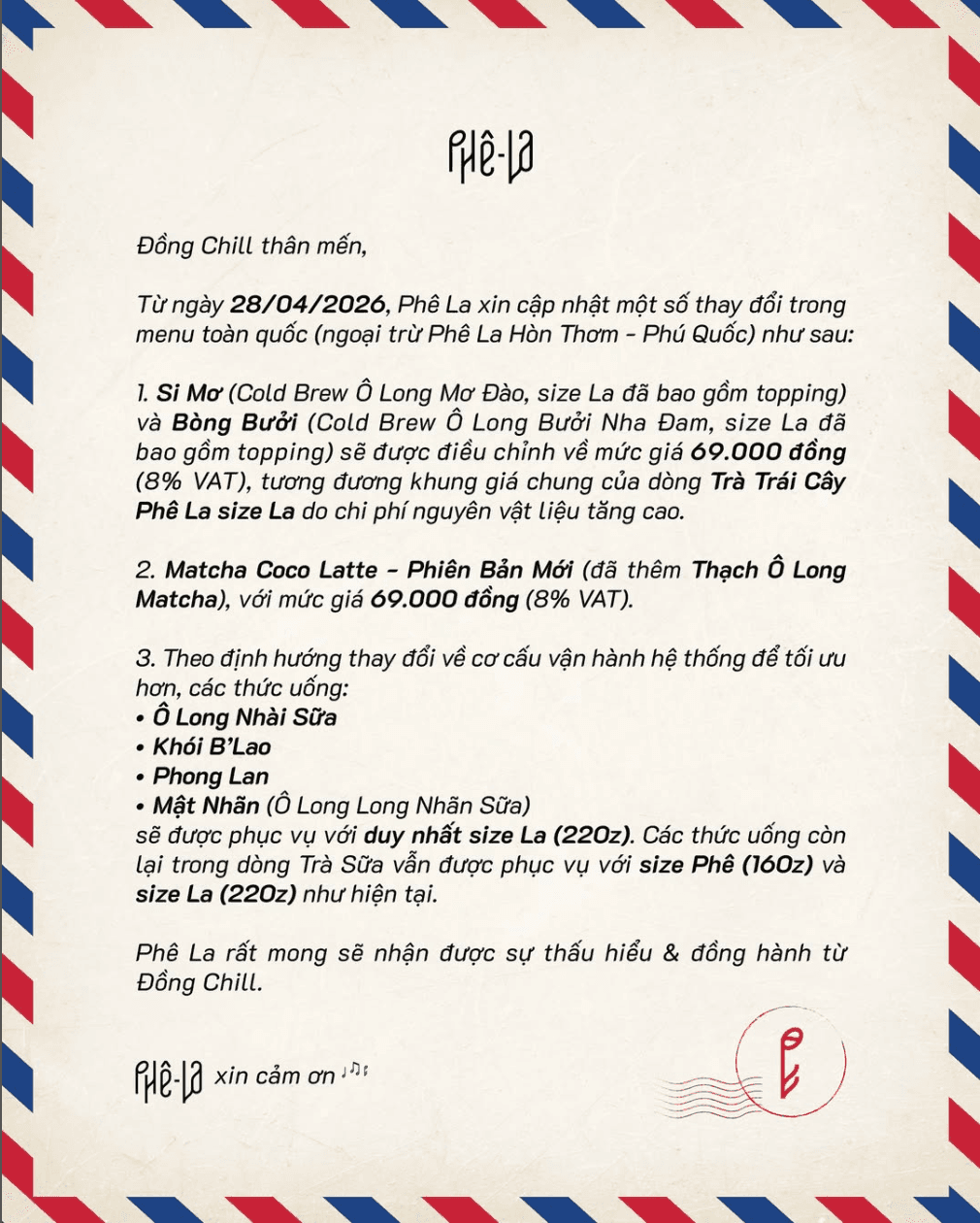
At the end of April, Vietnam’s beverage market saw a wave of price adjustments from major chains, drawing attention not only for rising costs but also for what the changes suggest about shifting consumer spending patterns. Two large brands—Phê La and The Coffee House—announced price increases and menu adjustments around the same time, prompting customers to compare the new pricing with previous levels.
Phê La announced price increases on many products starting from April 28. The brand’s common price level is around 69,000 VND per cup. Beyond changing prices, Phê La also adjusted its menu structure: some products are now offered only in large sizes, which increases the average spending per purchase.
According to consumer feedback shared online, the price increase averages about 10,000 VND per size, equivalent to more than 10%–15% depending on the product. Customers noted the change when comparing the new prices with earlier price levels.
Alongside Phê La, The Coffee House also adjusted prices on many products following its identity refresh, as reflected in menu images circulated on social media. Some drinks such as A-Me Mơ, A-Me Đào, and A-Me Yuzu are currently around 69,000 VND. Large sizes for some items can reach up to 79,000 VND, while Lotus Lychee tea in large size is around 75,000 VND.
The fact that both chains increased prices at roughly the same time indicates the market may be moving toward a new price level. Compared with the previous period, the new pricing appears to edge closer to a higher-end consumer segment. In this new range, a cup of drink is no longer positioned only against mainstream options; it is increasingly competing with premium chains such as Starbucks, Phúc Long, and other higher-end coffee and beverage models.
On social media groups, the price-increase stories of Phê La and The Coffee House quickly became topics of discussion. Many comments suggest that price changes in the context of rising costs are unavoidable, but customers are reconsidering how often they spend on beverages.
Dung, 23, an office worker in Hanoi, said she used to drink bubble tea nearly every day. When the price per cup increased by about 10,000 VND, she started to economize.
Thao, 28, a marketing professional, said the new price level is not a major barrier if the experience remains stable. She views café or bubble tea visits as more than consumption—often tied to working or meeting friends. “If the drinks are good, the space is comfortable, and service is good, a slightly higher price is acceptable,” she said.
Quang Anh, 31, self-employed, said he is more cautious. When beverage prices approach or even exceed the cost of a simple meal, he tends to consider other options more carefully.
Consumer responses appear divided. Some are willing to pay more if they feel the value matches the price, while others plan to reduce consumption frequency or look for options more aligned with their budget. At the same time, some customers interpret the increases as part of a broader market shift: as operating costs rise, price adjustments are seen as necessary to sustain operations and maintain service quality.
Premium gym chains are entering a “golden era” that is ending or already in decline, as rising operating costs collide with shifting consumer preferences toward more flexible, community-based ways to exercise. Long-term memberships are shrinking, margins are pressured by higher rents and facility expenses, and competition from smaller, more personalized…