•
•
•
•
•
•
•
•
•
•
•
•
•
•
•
•
•
•
•
•
•
•
•
•
•
•
•
•
•
•
•
•
•


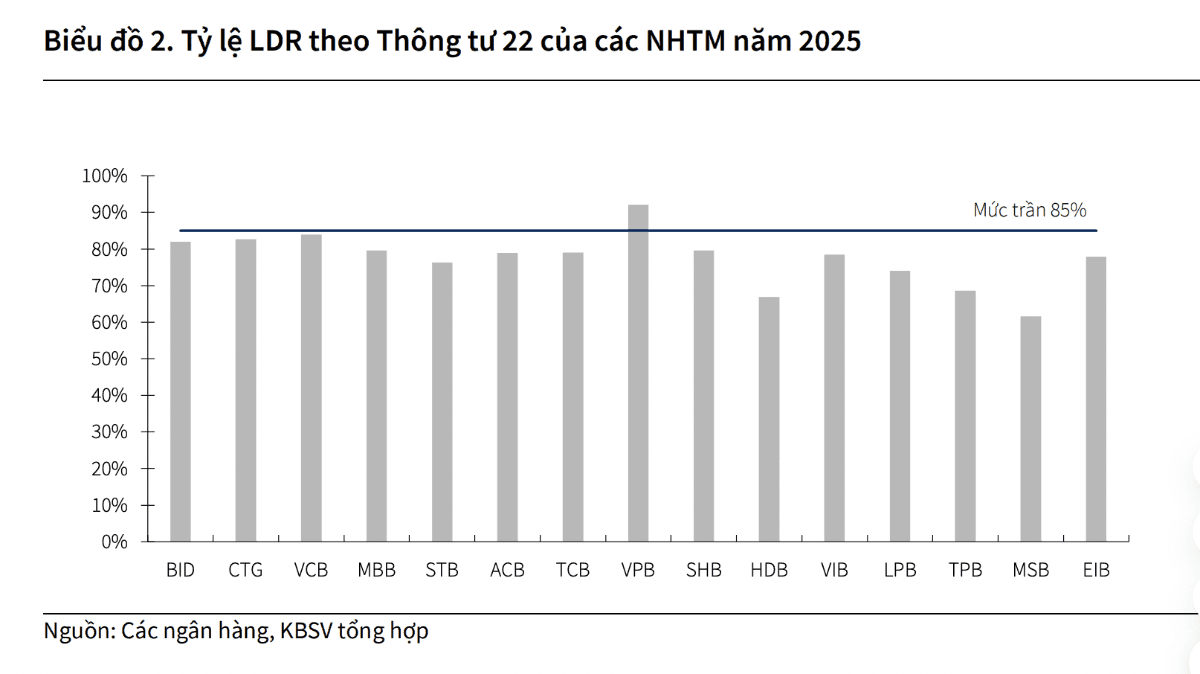
Banks are looking to ease pressure on the loan-to-deposit ratio (LDR), which is currently constrained by the full exclusion of government Treasury deposits from the LDR calculation. A proposal under consideration by the State Bank of Vietnam (SBV) would relax the deduction rate for Treasury deposits, potentially reducing the need for banks—especially state-owned lenders—to raise household deposit rates.
Under Circular 22/2019/TT-NHNN, as amended by Circular 26/2022/TT-NHNN, government deposits are included in total deposits for LDR calculation to support the banking system after the Covid-19 period, but with a gradually increasing deduction rate.
The deduction schedule is as follows: 50% in 2023, 60% in 2024, 80% in 2025, and 100% from 2026 onward. As a result, Treasury deposits are no longer counted in the LDR denominator from the current period.
At a meeting between the SBV and commercial banks on 9 April 2026, parties discussed increasing flexibility of the rule to cool deposit-rate competition and ease pressure on interest-rate increases.
According to KBSV, the 100% deduction of Treasury deposits effective from 1 January 2026 has reduced the LDR denominator (Funding) for many state-owned banks sharply. The estimated reduction is around VND 100 trillion based on end-2025 data, which has pushed the LDR higher.
To bring the LDR back to a “safe level” below 85%, banks have had to compete more aggressively for household deposits, contributing to hotter deposit-rate competition.
If the SBV approves loosening the deduction for Treasury deposits, it could reduce pressure on banks to raise interest rates in the market and help stabilize the system’s interest-rate level.
Restoring Treasury deposits into the LDR calculation would likely improve LDR metrics for state-owned commercial banks, which hold most of the Treasury deposits in the system. This could widen room for credit growth in the near term, particularly as their LDR is currently close to the 85% ceiling.
If LDR loosening options are implemented, the systemic credit room would improve, enabling banks to expand credit disbursement—especially toward key public investment projects and the manufacturing sector—supporting economic growth.

Premium gym chains are entering a “golden era” that is ending or already in decline, as rising operating costs collide with shifting consumer preferences toward more flexible, community-based ways to exercise. Long-term memberships are shrinking, margins are pressured by higher rents and facility expenses, and competition from smaller, more personalized…