•
•
•
•
•
•
•
•
•
•
•
•
•
•
•
•
•
•
•
•
•
•
•
•
•
•
•
•
•
•
•
•
•


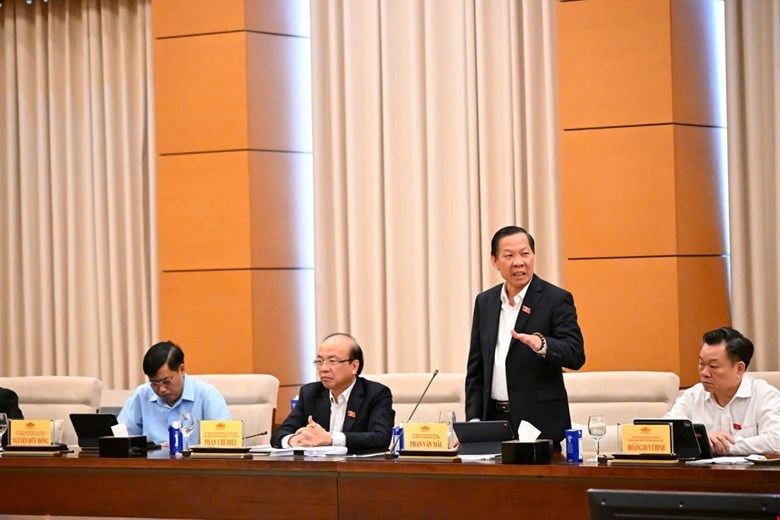
On the morning of April 20, the National Assembly Standing Committee held a meeting to solicit opinions on a draft law amending several provisions of the Personal Income Tax Law, the Value-Added Tax Law, the Corporate Income Tax Law, and the Special Consumption Tax Law.
Regarding revenue thresholds for tax exemption or relief for household businesses and small and medium enterprises (SMEs), Phan Van Mai, chair of the Economic and Financial Committee, said the reviewing agency basically agreed with the reform direction but recommended continuing to carefully consider the specific revenue levels.
He noted that the previous revenue threshold was 100 million dong. The drafting agency proposed raising it to 300 million dong, then adjusting it to 500 million dong. However, many opinions argued that 500 million dong remains too low.
In the discussion, the Small and Medium Enterprise Association proposed raising the threshold to up to 3 billion dong, while the examining agency suggested studying a minimum level of around 2 billion dong to ensure fairness and alignment with reality.
Phan Van Mai emphasized that household businesses and SMEs not only contribute to the budget but also play a major role in job creation, social safety, and maintaining the economy’s vitality. He said tax policy should provide substantive support and avoid small, piecemeal adjustments that do not fully reflect the spirit of supporting private sector development.
Presenting the report, Minister of Finance Ngo Van Tuan said that for personal income tax and value-added tax (VAT) applicable to households and individuals engaged in business, from the start of 2026 to now, global events affecting the domestic economy, rising fuel costs, weaker purchasing power, and difficulties in household business activity have created pressure on operations.
Accordingly, he said continued research and adjustments are needed to the threshold of income not subject to personal income tax for individuals in business, as well as the revenue threshold for households and individuals in business that fall under VAT, to support households—particularly those in sectors with low profit margins and those heavily affected by cost fluctuations.
Deputy Chairman of the National Assembly Nguyen Thi Hong said the Government should incorporate opinions from the Standing Committee and the supervising agency to complete the draft law for submission to the National Assembly.
The draft law will be reported for consideration by the first extraordinary session of the 16th National Assembly. The Government has officially submitted the draft amendments to the National Assembly under simplified procedures to be considered in the second phase of the first session.
Notably, the draft proposes giving the Government authority to autonomously adjust taxable thresholds to enable a flexible governance mechanism in response to urgent economic fluctuations.
Under the current framework, the tax-exemption threshold is fixed at 500 million dong per year; if annual revenue exceeds this threshold, households must pay tax.
Given economic volatility, the Government’s proposal suggests a flexible approach where the exemption threshold can be adjusted in stages so more households can remain exempt when conditions are difficult. Lu Duc Huy, Deputy Director of the Tax Policy Management Department, said: “If this bill passes and the Government is given the authority, the Government plans to raise the exemption threshold to a maximum of 1 billion.”




Premium gym chains are entering a “golden era” that is ending or already in decline, as rising operating costs collide with shifting consumer preferences toward more flexible, community-based ways to exercise. Long-term memberships are shrinking, margins are pressured by higher rents and facility expenses, and competition from smaller, more personalized…