•
•
•
•
•
•
•
•
•
•
•
•
•
•
•
•
•
•
•
•
•
•
•
•
•
•
•
•
•
•
•
•
•


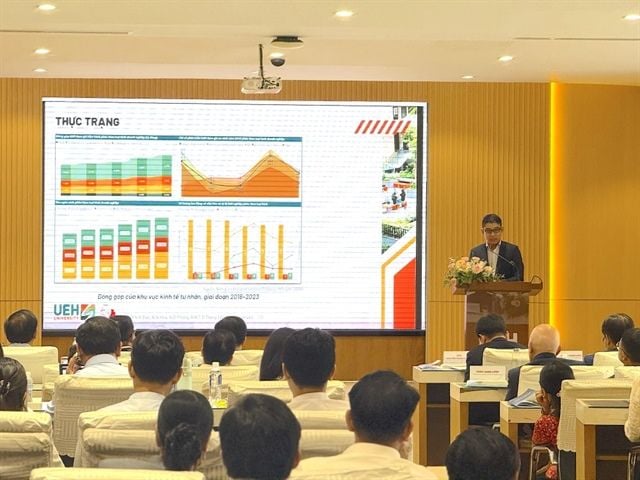
Removing bottlenecks to spur growth for the two pillars of the economy—the state and the private sector—was the focus of a scientific conference held by the University of Economics Ho Chi Minh City (UEH). Experts discussed policy directions aimed at unlocking capital and land resources and enabling both state-owned enterprises (SOEs) and the private sector to become drivers of strong growth.
On the morning of April 17, UEH organized a conference themed “State-owned economy and private sector—Two strategic pillars creating growth momentum and national prosperity,” bringing together experts, scholars, and the business community to debate measures for the current period of economic expansion.
Opening the conference, Dr. Nguyen Kim Duc, Deputy Head of the Economics faculty at UEH, emphasized the strategic direction from Politburo Resolution 68-NQ/TW, which identifies the private sector as the most important engine of the economy.
Based on SWOT analysis and enterprise surveys, Dr. Duc said the private sector’s strengths include flexibility, a strong drive for innovation, and deep market insight. However, he noted that the bloc is currently constrained by barriers to financing, land access, and limited technology.
Dr. Duc proposed that the State quickly establish a “Sandbox” mechanism for new business models and prioritize public procurement of technology products from domestic enterprises to create a practical launching pad for innovation.
From the private sector’s perspective, Dr. Tran Anh Tuan, Chairman of the Board of Tan Thuan Industrial Development, described the SOE bloc’s recent performance. He said that in 2021–2023, despite many difficulties, net profits after tax for the bloc increased by 70% to 99%, while ROE rose from 6.79% to 10.85%.
Mr. Tuan said Vietnam’s 2030 strategy requires SOEs to move away from outdated managerial mindsets, shift toward a “creation” role, and focus investment on core infrastructure. He also stressed that SOEs should avoid crowding out the private sector.
He set an ambitious target for SOEs to place at least one enterprise in the Top 500 in Southeast Asia.
International academic views were also presented on how Vietnam can achieve double-digit growth in a world facing tightening carbon constraints. Professor Hans Lööf of KTH Royal Institute of Technology highlighted a “dual objective” of 10% growth alongside an 8% emission reduction.
He argued that technology is key to overcoming diminishing returns, and said Vietnam must urgently raise its absorptive capacity, leverage spillover effects from global supply chains to upgrade the quality of growth, and avoid falling behind emerging trends.
Addressing barriers in the business environment, Dr. Nguyen Ngoc Hoa, President of the Ho Chi Minh City Enterprise Association (HUBA), said SOEs hold significant resources but are constrained by rigid administrative mechanisms. He cited an example of a four-to-five-step process for cadre appointments that he said resembles government administrative machinery.
By contrast, Dr. Hoa noted that private enterprises are highly dynamic but face capital and land constraints.
He recommended accelerating privatization to unlock land resources and restructuring the credit market so that a larger share of bank lending flows to small and medium-sized enterprises, while large corporations actively access capital markets.
Participants concluded that restoring a two-digit growth trajectory depends on removing institutional bottlenecks, repositioning roles, and unlocking resources for both state and private sectors. The discussion also covered governance reforms, Sandbox experiments, and ways to enable public procurement of domestic technology to support faster growth.

Premium gym chains are entering a “golden era” that is ending or already in decline, as rising operating costs collide with shifting consumer preferences toward more flexible, community-based ways to exercise. Long-term memberships are shrinking, margins are pressured by higher rents and facility expenses, and competition from smaller, more personalized…