•
•
•
•
•
•
•
•
•
•
•
•
•
•
•
•
•
•
•
•
•
•
•
•
•
•
•
•
•
•
•
•
•


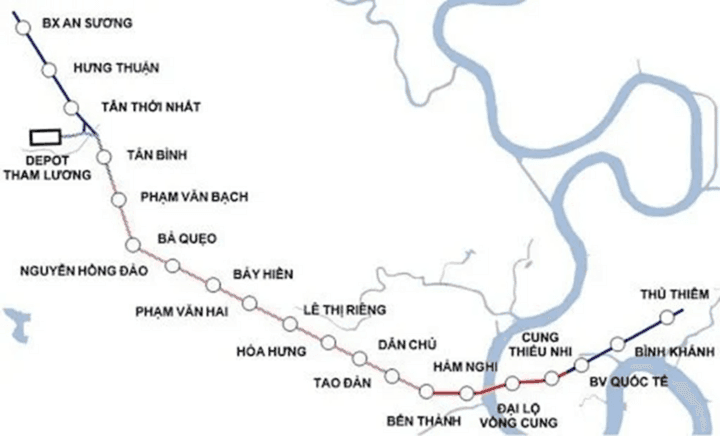
Ho Chi Minh City authorities said the Ben Thanh – Thu Thiem metro line, despite being only 6.2 km long, is strategically important as a connection between two major airports via the Thủ Thiêm axis. Among the city’s projects planned to be launched in celebration of the 51st anniversary of the Liberation of the South and reunification on April 29, the Ben Thanh – Thu Thiem section of Metro Line 2 is highlighted as a standout project with high expectations.
The 6.2 km Ben Thanh – Thu Thiem segment is planned to be built entirely underground in the city center. It will cross the Saigon River to Thu Thiem and include six stations: Ham Nghi, To Huu, Cung Thieu nhi, International Hospital, Binh Khanh, and Thu Thiem.
The segment forms part of Metro Line 2, which is expected to extend over 60 km. The line is designed to connect Ben Thanh to Tham Luong and link with other metro lines.
The project has been designated a key, urgent construction priority. A launch is anticipated in 2026, with completion targeted for 2030. The city’s People’s Committee has assigned Dai Quang Minh Real Estate Investment Joint Stock Company, a THACO subsidiary, to study and prepare the feasibility report and draft an investment contract.
In addition to the metro segment, the city’s planned projects include urban and infrastructure upgrades such as modernization of the Ho Chi Minh Museum, the central square, and the city administration center.
A privately financed project, the Berjaya International University City, is also planned to begin operations around 2035. The Berjaya project includes residential and mixed-use developments intended to serve about 135,000 residents and 60,000 students, alongside education, healthcare, cultural facilities, markets, and commercial centers.

Premium gym chains are entering a “golden era” that is ending or already in decline, as rising operating costs collide with shifting consumer preferences toward more flexible, community-based ways to exercise. Long-term memberships are shrinking, margins are pressured by higher rents and facility expenses, and competition from smaller, more personalized…