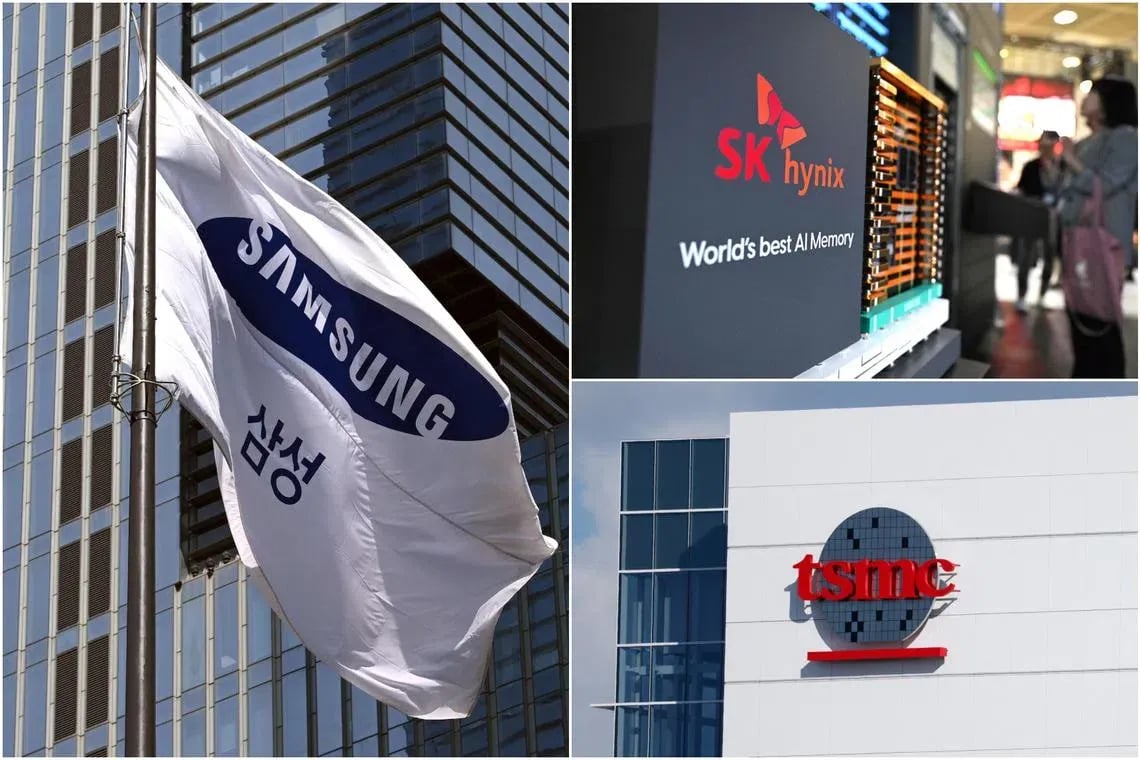
The AI boom has been transforming the global stock market order and is continuing to do so. The Taiwan and South Korea stock markets, led by fast‑growing semiconductor companies, are rising ahead of many of
Europe’s major economies. According to consolidated data from Bloomberg, Taiwan’s stock market recently reached a size of about $4.3 trillion, surpassing the United Kingdom to rank seventh in the world by market capitalization. Meanwhile, the Korean market trails closely behind, with a size only about $140 billion smaller.
Over the past seven months, these two markets have overtaken major European stock markets such as Germany and France. Bloomberg says Taiwan’s market rally has been driven mainly by the AI boom, with TSMC (Taiwan Semiconductor Manufacturing Company) playing a central role, accounting for more than 40% of the total market capitalization. In Korea, the growth drivers come from the two memory-chip powerhouses: Samsung and SK hynix.
By contrast, European stock markets remain largely led by financial firms, with technology having a much smaller share. Ian Samson, Portfolio Manager at Fidelity International, says the rise of Korea and Taiwan is the result of a long‑term trend in the semiconductor industry—often described as the “new oil”—an essential input to the economy. This is reinforced by the AI investment boom.
Asia is asserting its position as a global economic hub as AI grows stronger, even amid geopolitical tensions and tariffs. Taiwan’s March export orders rose the strongest in 16 years, while Korea’s exports rose more than 40% in the second consecutive month, driven mainly by abundant chip exports.
With market capitalizations of about $1.8 trillion for TSMC and $1.5 trillion for Samsung together with SK Hynix, these companies have risen to lead among the world’s top technology firms. Meanwhile, ASML Holding NV, Europe’s largest company, has a market capitalization of around $1.4 trillion, considerably smaller.
However, the size of Taiwan and Korea’s economies remains far smaller than the major European powers. IMF estimates Korea’s GDP at about $1.9 trillion this year, and Taiwan at $977 billion, far below more than $3 trillion for Germany, the UK, and France.
In Q1 2026, TSMC posted impressive financial results, with net income rising 40.6% year‑over‑year to $18 billion. The company also raised its full‑year revenue forecast, signaling growth above 30% and confirming plans to build additional 3nm fabrication plants to meet rising AI demand, expected to exceed supply by 2027.
Samsung and SK hynix, now two of the three memory‑chip giants dominating the global market, along with Micron Technology of the US, reported strong Q1 results. Samsung posted operating profit of 57.2 trillion won (about $37.9 billion), up 755% year over year and setting a new record. SK Hynix reported Q1 revenue of 52.58 trillion won ($35.54 billion), nearly triple the year‑ago period, with operating profit of 37.61 trillion won ($25.43 billion), up fivefold year over year and a record 72% margin.
Samsung and SK Hynix, alongside Micron, form the top three memory‑chip suppliers globally. As AI demand has surged in recent years, all three have ramped up production of High Bandwidth Memory (HBM) used in Nvidia AI accelerators, which tightens supply of standard memory chips.
Nevertheless, some investors remain cautious about the outsized impact of tech stocks on Asia’s equity markets, as Samsung and SK Hynix account for around 42% of Korea’s Kospi and TSMC accounts for a similar share in Taiwan’s Taiex.