•
•
•
•
•
•
•
•
•
•
•
•
•
•
•
•
•
•
•
•
•
•
•
•
•
•
•
•
•
•
•
•
•


The Vietnamese stock market ended the week with major blue chips providing support earlier, but selling pressure from the region and external factors increased, creating headwinds that may limit the market’s ability to retest the February 2026 highs in the near term. The rally also lacked broad participation and appeared to rely on a narrower set of leading stocks, which can raise volatility if leadership weakens.
Daily performance (24/04)
On 24/04, both major indices declined. The VN-Index fell 0.91% to 1,853.29 points, while the HNX-Index dropped 0.51% to 251.95 points.
Weekly performance
For the full week, the VN-Index rose 36.12 points (+1.99%), while the HNX-Index declined 8.05 points (-3.1%). The VN-Index continued to trend higher during the week, supported by heavyweight stocks, but market breadth remained narrow, with decliners dominating many sessions.
Index impact and support/resistance
In the final session, declines in VHM, VIC and VCB weighed on the VN-Index, removing more than 14 points. Support came mainly from TCB, VJC and GVR, contributing around 3 points overall.
Sector rotation continued, with most groups moving within narrow ranges. Real estate was the weakest sector, pressured by leading stocks including VIC, VHM, KSF and VRE. Still, several real estate-related names recorded positive moves, including NVL, VPI, TCH, DXG, DIG, TDH, which hit daily gain limits at times.
Consumer discretionary and IT also faced pressure, with multiple stocks down more than 1%: VPL, MWG, FRT, PNJ, HUT; and FPT, CMG, VEC, POT.
On the upside, media and communications led the market, rising 0.56%, supported by selective gains in VGI (+0.76%) and CTR (+1.4%).
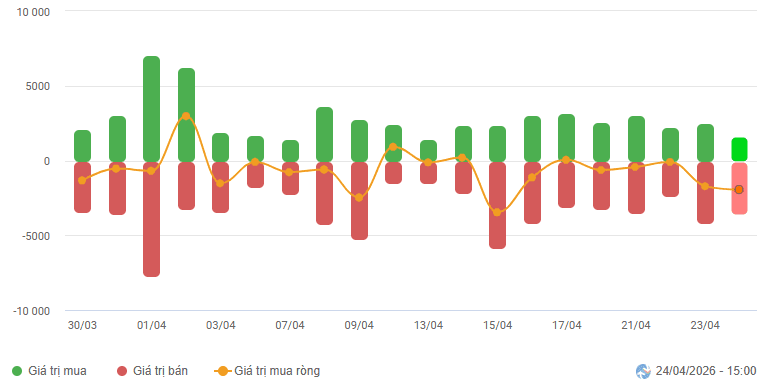
Foreign investors recorded net selling of about VND 4.8 trillion across both exchanges for the week. HOSE saw net selling of about VND 4.7 trillion, while HNX recorded net selling of about VND 123 billion.
PVP was the week’s notable gainer, up 16.88% with five consecutive up sessions. The stock moved above the Upper Bollinger Band with volume above the 20-day average, suggesting positive investor sentiment. MACD widening away from the Signal line supported the uptrend, while Stochastic indicated overbought conditions, pointing to potential consolidation in the near term.
PC1 was the largest decliner this week, down 15.76%, breaking below the 200-day SMA. The last two sessions saw full-day declines, reflecting stronger selling pressure. Short-term risk was described as elevated, with MACD continuing to slide below zero; if conditions do not improve, the price could retest the December 2025 bottom (around 20,500–21,500) in coming sessions.
Closing on 24/04
Selected weekly movers (price change)
The market showed differentiation and short-term risk remained high, particularly from foreign flows and the group of leading stocks. Balance between stock groups had not improved, and the risk of short-term correction was still considered elevated.
Premium gym chains are entering a “golden era” that is ending or already in decline, as rising operating costs collide with shifting consumer preferences toward more flexible, community-based ways to exercise. Long-term memberships are shrinking, margins are pressured by higher rents and facility expenses, and competition from smaller, more personalized…