•
•
•
•
•
•
•
•
•
•
•
•
•
•
•
•
•
•
•
•
•
•
•
•
•
•
•
•
•
•
•
•
•


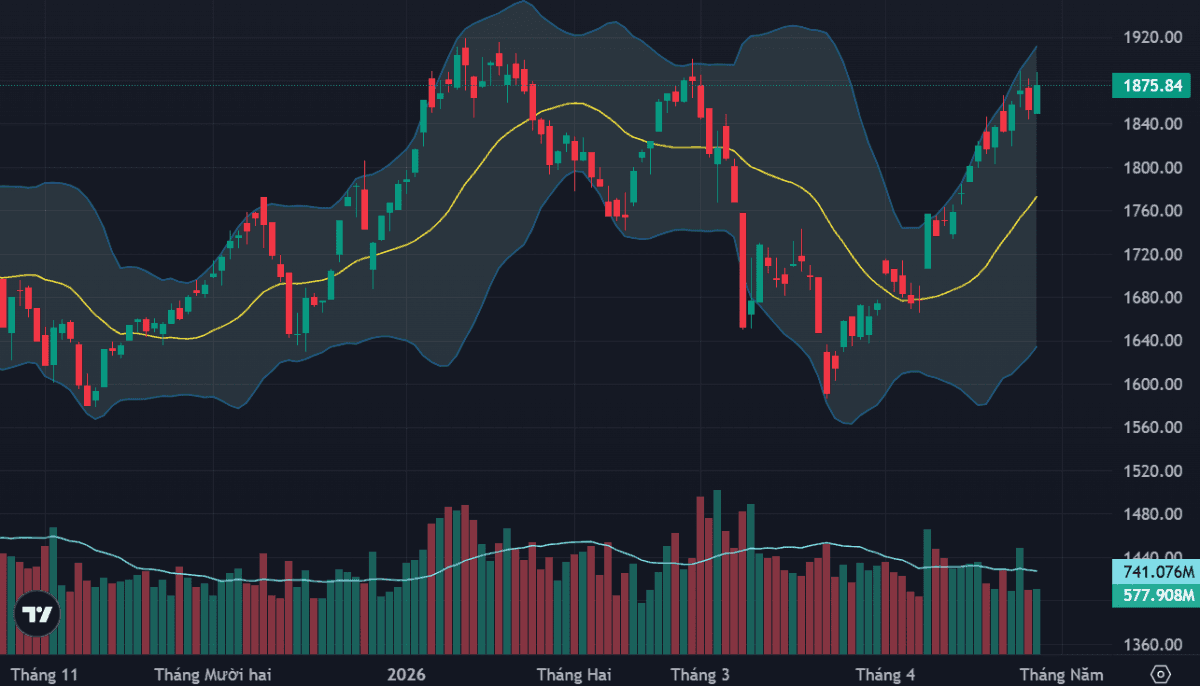
Even as VHM and VRE hit their ceiling prices in the afternoon, the VN-Index could not extend gains and instead slipped lower. Market breadth pointed to widespread declines, with several large-cap blue chips showing trading patterns that diverged from the index’s direction.
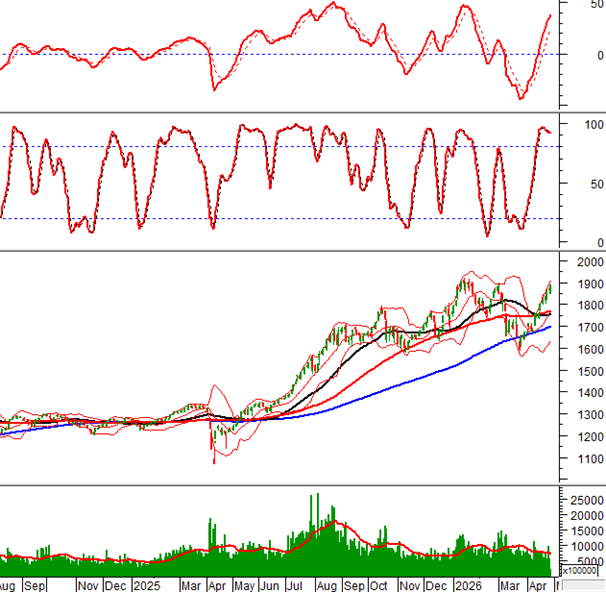
The VN-Index closed up 1.22%, equivalent to 22.55 points, but this lagged the morning session, which was up 1.77% (32.76 points). While the Vin mega-cap group remained strong, it did not provide enough support from the rest of the market to sustain momentum.
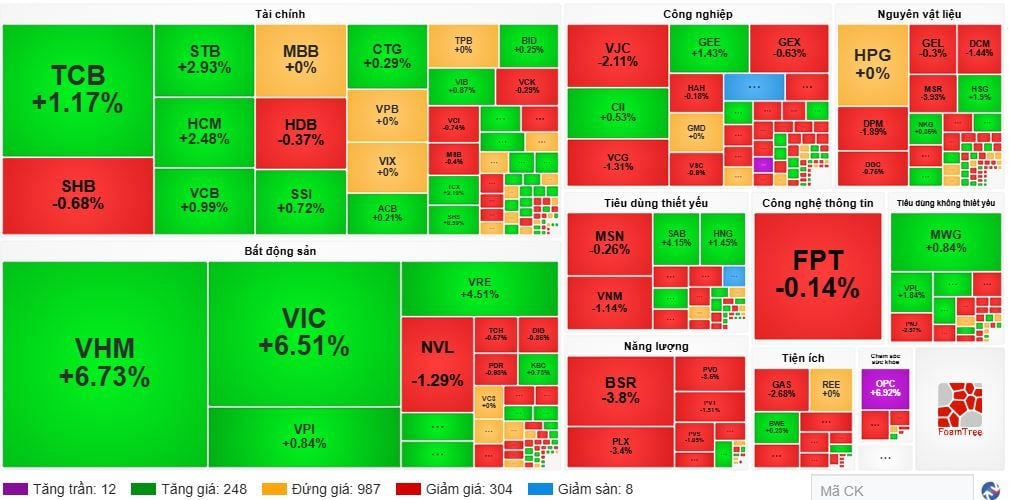
VHM rose 6.73% in the morning and pressed to the ceiling in the afternoon. VRE, the Vin group stock with the largest intraday change, added another 2.33% to close at the ceiling. VIC slipped 0.53% from its morning close but still ended up 6.32%. VPL fell 0.24% from the morning close yet gained 3.44% for the day.
Overall, the Vin group contributed more than 34 points, exceeding the VN-Index’s total gain.
Outside the Vin group, pressure was visible across several large caps. In the VN30 basket, 20 members were down versus their morning close, while only 8 were up more. PLX fell 1.73% to the floor. GAS, though not at the floor, dropped sharply—down 3.16%—and closed the day down 6.13%. In banking, VCB plunged nearly 2%, reversing to a 1.32% loss versus reference; BID also slumped 1.71% and reversed to a 1.47% loss. These were described as the two largest bank pillars on the HoSE board.
The VN30-Index closed up 1.49%, with 12 gainers and 17 losers. Outside the Vin group, FPT and MWG were highlighted as notable movers. FPT was down 0.14% in the morning and down 0.54% by the end of continuous trading, but in the ATC phase a buy order pushed it up 1.36%. MWG rose 1.32% in the morning, then added 1.18% in the afternoon, closing 2.51% above reference.
Despite these moves, the VN30’s overall score was still largely driven by VIC and VHM, contributing over 25 points out of a total gain around 30 points.
Investor sentiment turned more negative in the afternoon than in the morning, moving opposite to the index. At the HoSE close, breadth stood at 107 advancers to 210 decliners (compared with 120 advancers to 170 decliners in the morning). The number of stocks falling more than 1% also rose sharply to 125 at close (from 73 in the morning). Liquidity on HoSE increased by nearly 44% in the afternoon, indicating more selling at lower prices.
The article characterized this as a more pessimistic reaction than earlier in the day, with investors lowering selling prices to secure liquidity when exiting the market ahead of the holiday. It noted that near-term opportunities appeared fewer and that risk was elevated, making “hot money” exits consistent with the observed flow.
By the end of HoSE, 20 stocks posted gains of 1% or more with liquidity of at least 10 billion dong. Blue chips included Vin group stocks, FPT, TCB, STB, MWG, and SAB. Other gainers cited were NVL up 5.4%, VPI up 2.01%, CII up 1.33%, TCH up 2.29%, HCM up 2.1%, GEE up 1.14%, TCX up 1.59%, and FRT up 2.08%.
On the downside, the article stated that more than 20 stocks met criteria of liquidity in the “hundreds of billions” and a fall of more than 1%. It noted that only three stocks met similar conditions in the morning: SHB, BSR, VJC, and PLX. Besides PLX, PVT was pushed to the floor with liquidity around 316.7 billion. KDC, VVS, and PC1 were also cited as mid-cap stocks that fell to the floor. Other heavily fallen, high-liquidity names included BSR down 6.4%, VCG down 3.71%, GEX down 2.01%, EIB down 2.24%, PVD down 2.87%, DCM down 3.12%, and DPM down 3.02%.
Foreign investors increased selling in the afternoon by about 71% versus the morning, pushing net selling to -410.3 billion VND compared with -118.2 billion. Major sell orders included FPT (-286.1 billion), VHM (-166.5 billion), SHB (-80.8 billion), VPB (-64.9 billion), ACB (-57.9 billion), BSR (-55.3 billion), and DGC (-53.1 billion). On the buying side, the article listed VRE (+157.7 billion), NVL (+119.5 billion), VIC (+87.3 billion), STB (+65.3 billion), SSI (+63.1 billion), and MSN (+55.8 billion).




Premium gym chains are entering a “golden era” that is ending or already in decline, as rising operating costs collide with shifting consumer preferences toward more flexible, community-based ways to exercise. Long-term memberships are shrinking, margins are pressured by higher rents and facility expenses, and competition from smaller, more personalized…