•
•
•
•
•
•
•
•
•
•
•
•
•
•
•
•
•
•
•
•
•
•
•
•
•
•
•
•
•
•
•
•
•


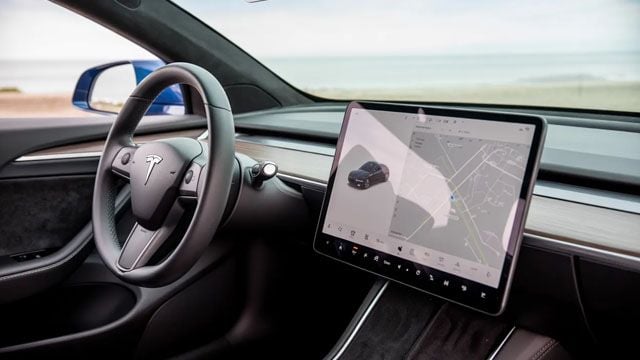
Shares of Tesla moved higher in extended trading on Wednesday after the electric vehicle company released its first-quarter update. The report showed total revenue rising 16% year over year to $22.39 billion and free cash flow of $1.44 billion. Investors also focused on management’s outlook for Tesla’s shift toward software, services, and fleet-based revenue, supported by four specific metrics highlighted in the update.
Tesla ended Q1 with 1.28 million active Full Self-Driving (Supervised) subscriptions, up from 1.10 million in Q4 and 0.85 million a year earlier. That represents 51% year-over-year growth.
By comparison, Tesla’s total deliveries rose 6% year over year to 358,023. The difference between subscription growth and delivery growth suggests Tesla may be increasing monetization per vehicle faster than it is growing volume.
Even so, adoption remains early. With 1.28 million active subscriptions, subscriptions are still only about 14% of Tesla’s 9.2 million cumulative deliveries.
Tesla’s services and other revenue—covering sales of used vehicles, non-warranty maintenance services, part sales, paid Supercharging, insurance services revenue, and retail merchandise sales—rose 42% year over year to $3.75 billion.
This growth outpaced total revenue growth of 16% and also exceeded the pace of automotive revenue growth, which was also 16% for the quarter.
Services and other revenue now accounts for nearly 17% of total revenue, up from about 14% a year earlier.
The company reported total gross margin of 21.1%, up from 16.3% in the first quarter of 2025 and up from 20.1% in Q4. Total gross profit rose 50% year over year to $4.72 billion, ahead of the 16% revenue growth.
However, the margin picture was mixed. Operating margin was 4.2%, down from 5.7% in Q4, and operating expenses rose 37% year over year.
Tesla generated $3.94 billion in operating cash flow, spent $2.49 billion on capital expenditures, and produced $1.44 billion in free cash flow. That compares with free cash flow of $664 million a year earlier.
The stronger free cash flow is notable because it comes ahead of what Tesla indicated could be a spending increase as it invests in growth initiatives. The company said it expects capital expenditures during 2026 to exceed $20 billion.
Overall, the metrics point to progress while Tesla remains in the middle of a costly transition. Management said it expects “hardware-related profits to be accompanied by an acceleration of AI, software and fleet-based profits” over time.
At the same time, the core automotive business still dominates. Automotive revenue accounted for about 73% of Tesla’s total revenue in Q1. Inventory also rose to 27 days of supply from 15 in Q4.
As of the time of writing, Tesla’s market capitalization was about $1.5 trillion, and the stock traded at more than 300 times earnings.




Premium gym chains are entering a “golden era” that is ending or already in decline, as rising operating costs collide with shifting consumer preferences toward more flexible, community-based ways to exercise. Long-term memberships are shrinking, margins are pressured by higher rents and facility expenses, and competition from smaller, more personalized…




