•
•
•
•
•
•
•
•
•
•
•
•
•
•
•
•
•
•
•
•
•
•
•
•
•
•
•
•
•
•
•
•
•


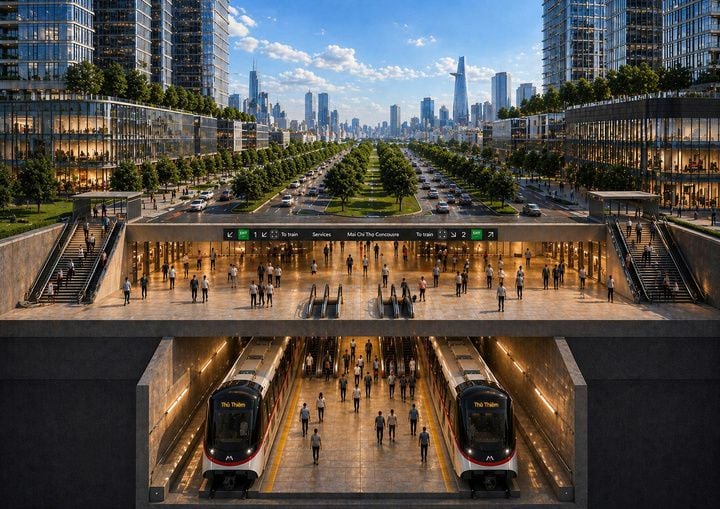
At the launch ceremony for Metro Ben Thanh – Suoi Tien and other priority infrastructure projects in Thu Thiem today, Mr. Tran Ba Duong, Chairman of THACO, said the group will implement the Metro Ben Thanh – Thủ Thiêm project using the best technology and the most reasonable costs.
The underground portion of Metro Ben Thanh – Thủ Thiêm is planned to be fully underground, with a total length of over 6 km. The route and station locations have been studied to optimize integration with existing urban space and future development.
The line includes six underground stations, with Hàm Nghi as the deepest at 33 meters. This depth is designed to support a crossing under the Saigon River at a depth of 41 meters. The route links to To Hữu station near the new city hall and continues toward the Neon/Children’s Palace area, as well as to the international hospital and Bình Khánh area. The final Thủ Thiêm station is central, integrating with the North–South high-speed railway’s main station and continuing toward Long Thành International Airport.
Mr. Duong said Metro Ben Thanh – Thủ Thiêm will be the deepest underground line in Ho Chi Minh City because of the river crossing. In the Thu Thiem area, soft ground and complex hydro-geological conditions require strict control of deformation during construction to maintain ground stability and limit tunnel boring machine (TBM) displacement during operation.
He added that advanced, integrated technical solutions are planned for each component, with soil stabilization identified as a core element to ensure safety and project success.
The project will use balanced-pressure slurry TBM tunneling for the first time in Vietnam to traverse the Saigon River and the Ben Thanh – Thánh Giá flyover section. THACO said the method is intended to create a stable “filter” layer and mitigate risks including landslides and water ingress, while protecting existing structures above.
THACO will also apply GoA4 fully automated operations for the TBM section, similar to the Bến Thành – Tham Lương segment under construction. The company will continue researching suitable technology for the E&M systems to align with project milestones and cost efficiency.
THACO has invested in a railway and general mechanical engineering complex covering about 320 hectares in Bình Cơ Ward, Ho Chi Minh City, to manufacture equipment for underground rail construction. This includes TBM machines, underpinning devices, and assembly of monolithic concrete components such as tunnel linings and sleepers, supporting domestic content in railway projects in Ho Chi Minh City and Vietnam.
THACO has also established strategic partnerships with Hyundai Rotem, a global producer of locomotives and rolling stock. The localization agreement includes technology transfer, workforce training, and technical support, described as the first step toward manufacturing locomotives and rolling stock in Vietnam.
Metro Ben Thanh – Thủ Thiêm has been designated a priority project by the City People’s Committee. It is planned as a PPP/BT contract with total investment of about 46,295 billion dong. The project is expected to be completed in 2030, aligning with other metro lines in Ho Chi Minh City’s urban rail network.
By completion, the broader urban rail network is projected to reach about 187 km by 2030, with more ambitious targets of 462 km by 2035 and 700 km by 2045 when the full urban rail system is realized.



Premium gym chains are entering a “golden era” that is ending or already in decline, as rising operating costs collide with shifting consumer preferences toward more flexible, community-based ways to exercise. Long-term memberships are shrinking, margins are pressured by higher rents and facility expenses, and competition from smaller, more personalized…



