•
•
•
•
•
•
•
•
•
•
•
•
•
•
•
•
•
•
•
•
•
•
•
•
•
•
•
•
•
•
•
•
•


HOSE will publish the results of the periodic review of the VNDiamond index for Q2 2026 on 20 April 2026, with the effective date set for 04 May 2026. MBS forecasts that there will be no changes to the stocks included in this review.
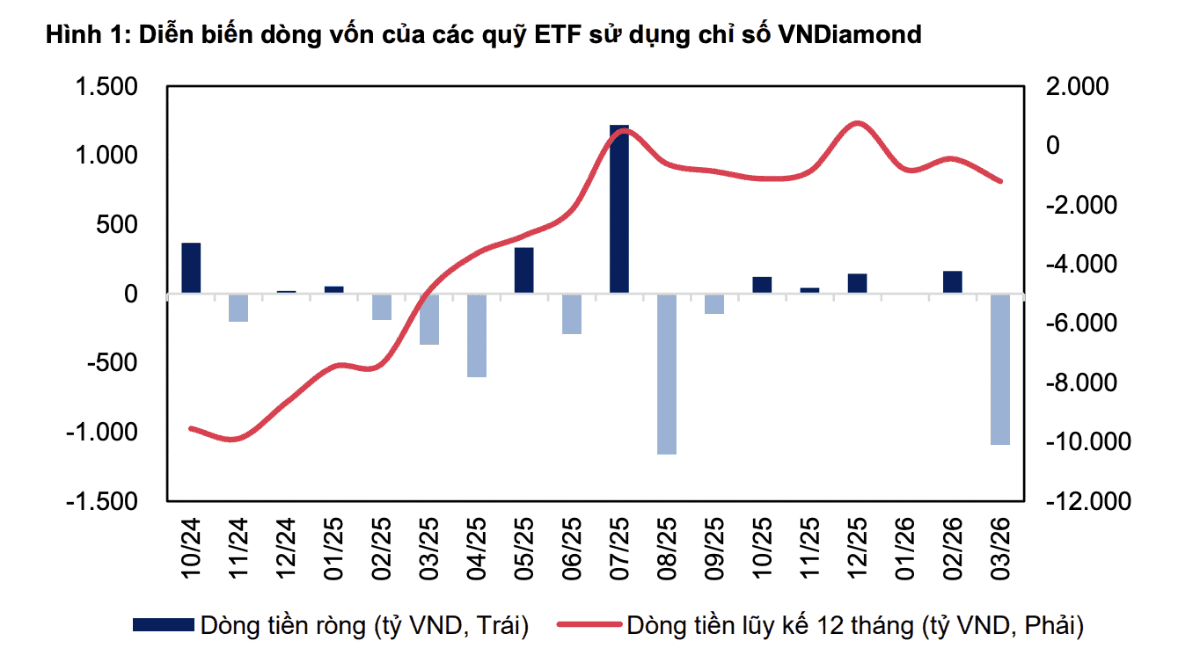
As of 31 March 2026, six ETFs use the VNDiamond index as a benchmark, with total net assets of about VND 12.3 trillion. DCVFMVN accounts for 96% of these assets.
In March 2026, ETFs recorded net outflows of more than VND 1.2 trillion. Meanwhile, total net inflows from the start of 2026 to date reached VND 426 billion.
From the start of 2026 through 31 March 2026, the VNDiamond index declined 4.2%. Over the same period, the VN-Index fell 6.2% and the VN30 declined 9.9%.
Based on MBS’s forecast of no changes to the stocks in the Q2 2026 review, the brokerage highlighted notable weight increases for several tickers. These include GMD by about 2.8 million shares, TCB by 2.55 million shares, and FPT by about 2.1 million shares.
On the other hand, stocks expected to see notable weight reductions include OCB by about 2.1 million shares, ACB by 1.5 million shares, and MWG by 1.45 million shares.
Previously, BSC projected that Nha Khang Dien (KDH) could face watch-list risk because the FOL coefficient could not maintain the minimum 65%. Under the VNDiamond Index rules, BSC also noted that KDH could face a 50% weight reduction in the portfolio.
BSC estimated that more than 4 million KDH shares could be sold by ETFs to remove them from the index. The brokerage also indicated that ETFs could trim NLG by 3.3 million shares and HDB by 1 million shares.
In contrast, BSC projected no new stocks would be added to the index. It also pointed to tickers whose weights are expected to increase, which may be bought more strongly by ETFs, including FPT (4.6 million shares), MBB (900 thousand shares), and TCB (900 thousand shares).







Premium gym chains are entering a “golden era” that is ending or already in decline, as rising operating costs collide with shifting consumer preferences toward more flexible, community-based ways to exercise. Long-term memberships are shrinking, margins are pressured by higher rents and facility expenses, and competition from smaller, more personalized…




