•
•
•
•
•
•
•
•
•
•
•
•
•
•
•
•
•
•
•
•
•
•
•
•
•
•
•
•
•
•
•
•
•


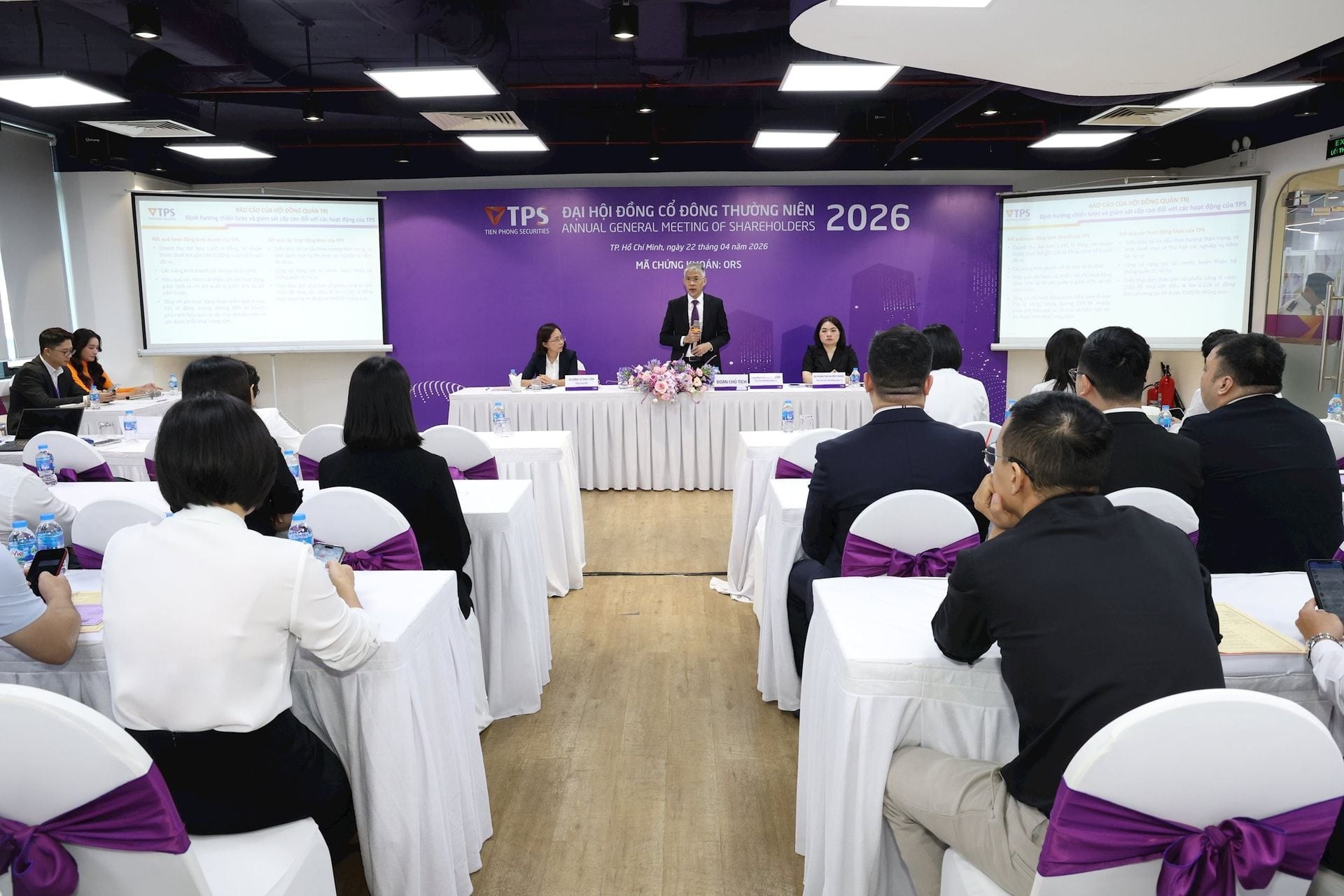
In 2026, Tiên Phong Securities (TPS) expects strong growth, targeting revenue of VND 2,250 billion (up 50%), pre-tax profit of VND 428 billion, and net profit of VND 343 billion, which management said corresponds to a 190% increase. At the company’s 2026 annual general meeting (AGM) held on April 22, TPS management said profit growth will be driven mainly by its margin lending business, supported by cooperation with TPBank.
TPS was recently upgraded to BBB+; previously it had been rated BBB and even BBB-. The rating basis cited by Visrating highlighted TPS’s potential to receive support from its parent bank, TPBank, after TPBank increased its stake to 51% on December 31, 2025 from 9% earlier. The degree of alignment in TPS and TPB’s strategy and operations is expected to increase over time.
TPBank said it will support TPS in raising credit-assessment standards in line with the bank’s credit orientation, contributing to better quality in advisory services and in distributing corporate bonds.
According to TPBank, TPS will play a key role in the bank’s long-term strategy to build a diversified financial services ecosystem. The plan is to leverage TPBank’s large customer base to offer a wide range of financial products.
TPS Chairman Nguyen Hong Quan said the brokerage sector still lags behind bank standards, which he described as a competitive advantage for TPS as it gains access to higher standards from TPBank. He noted TPBank’s resource base includes enterprises of various sizes and 16 million individual customers, and TPBank is technology-driven.
“Even activating only 5% would translate into 7–8 million customers from TPB. Our major target for 2026 is to fully tap the parent bank’s resources. Give us three years to build TPS into the Top 10 brokerage firms,” the executive said.
TPS’s strategy focuses on three pillars: brokerage, margin lending, and investment banking (IB). The company aims to lift its equity brokerage market share to about 1–1.2%, while expanding value-added products and services across client segments to improve personalization and productivity in client engagement.
Technology investment is also a priority, particularly artificial intelligence. TPS said its TPS Mobile AI platform and investment assistant T’Fox are expected to help investors access information quickly, improve data analytics capabilities, and support timely investment decisions.
In Q1 2026, TPS reported revenue of VND 270 billion and pre-tax profit of VND 42 billion. The company said operating efficiency improved due to cost controls, cutting costs by as much as 71%, contributing to better margins.
Total assets reached over VND 14,600 billion. TPS maintained cash of around VND 3,482 billion. At the end of 2025, TPS increased capital by VND 3,600 billion through TPBank’s capital injection, with leverage at 1.9x (end-2025), expected to rise as new funds are deployed to support earnings growth.
At the AGM, the board proposed issuing and/or selling bonds with a total maximum of VND 3,000 billion, with maturities up to five years, to bolster funding for operations.
The AGM also approved relocating TPS’s headquarters to Hanoi, while maintaining a presence in Ho Chi Minh City via a branch to strengthen ecosystem connectivity and expand cooperation with strategic partners.
Shareholders approved the election of new members to the Board of Directors and the Supervisory Board for the new term. The newly elected board unanimously approved Mr. Nguyen Hong Quan as Chairman.
The AGM introduced Mr. Nguyen Chi Thanh as the prospective CEO. Thanh holds an MBA from Boston University and has nearly 20 years of experience in finance and securities, with key roles at Vietcap (VCI), Everest (EVS), and most recently as CEO of Saigon–Hanoi Securities (SHS).
Thanh said management will follow the Board’s directives and commitments made at the AGM, focusing on the three pillars of Brokerage, Margin, and Investment Banking. He said proprietary trading is not a priority at this stage, but would be leveraged when market conditions are favorable.
Thanh also said the objective is not only to expand brokerage scale, but to be among the Top 10 CTCK with a solid platform that includes IB and brokerage, supported by technology and AI to enhance investment-advice quality and enable asset-management services for both individuals and enterprises.
In the Q&A session, Chairman Quan said TPS’s risks are not limited to margins, bonds, or proprietary trading. The company identified risk areas as events unfold, including margin exposure and funding conditions.
Margin exposure currently shows 0% non-performing loans. Management said that in 2025, fundraising was tight and liquidity priorities meant margin lending funding was not readily available. After the capital increase from TPBank, about VND 2,100 billion will be allocated to margin lending. TPS said it has built a new mechanism and expects margin debt to rise again, targeting VND 8,000 billion by year-end.
On bonds, TPS said it learned from past concentration risks among related issuers. It said that if some issuers face financial distress or default, risk could arise. For 2026, bonds will remain a core business, pursued as “Bond Version 2,” with bond evaluation by the parent bank and credit-assessment rigor similar to TPB loan facilities.
Earlier this year, TPS issued VND 1,490 billion in bonds and successfully distributed them, with TPBank guaranteeing. For proprietary trading, TPS said approximately VND 100 billion is planned in the capital raise, with about VND 49 billion already used. Management said the approach will be more advanced and will not rely heavily on asset deployment.
TPS said its technology plan is split into two phases: before becoming a subsidiary of TPBank (before 12/31), and after. It said that in 2025 funds were tight, but after reorganizing the team it identified gaps and began closing them. After the capital increase, TPS plans to invest about VND 79 billion.
TPS said the 50% revenue growth and 190% profit increase are driven by the three pillars: Brokerage, IB, and funding sources. Management said brokerage is expected to contribute 39% of revenue, IB about 41% due to a strong talent pool, enabling a return to bonds and Bond Version 2, while the third pillar—funding—is expected to contribute about 20%.
Looking ahead, TPS aims to be in the Top 10 CTCK within the next three years, not only by market share but by multiple criteria. Management said reaching Top 10 brokerage share requires surpassing 2.8%.
TPS said banks backing brokerage houses provide advantages, and it will leverage the bank’s client base while emphasizing a technology platform and a user-friendly interface, with AI integration advancing in 2026. It said brokerage will cover not only stocks but also bonds, and TPS is building a bond trading platform while TPB is building platforms for trading CDs. TPS said integrating brokerage with the bank will deliver a comprehensive investor experience, with asset-management solutions as a core goal rather than standalone offerings.
To grow margin lending market share, TPS said it will need capital for margin lending at scale and competitive lending rates.
TPS said it has coordinated closely with authorities on collateral handling related to Bamboo Capital. It described two main tracks: using financing to fulfill obligations and addressing collateral assets. TPS said the scale of financial remediation is sizable, and collateral management aims to prevent leakage, with positive signals. The company expects the process to complete soon to safeguard investors’ rights.



Premium gym chains are entering a “golden era” that is ending or already in decline, as rising operating costs collide with shifting consumer preferences toward more flexible, community-based ways to exercise. Long-term memberships are shrinking, margins are pressured by higher rents and facility expenses, and competition from smaller, more personalized…




