•
•
•
•
•
•
•
•
•
•
•
•
•
•
•
•
•
•
•
•
•
•
•
•
•
•
•
•
•
•
•
•
•


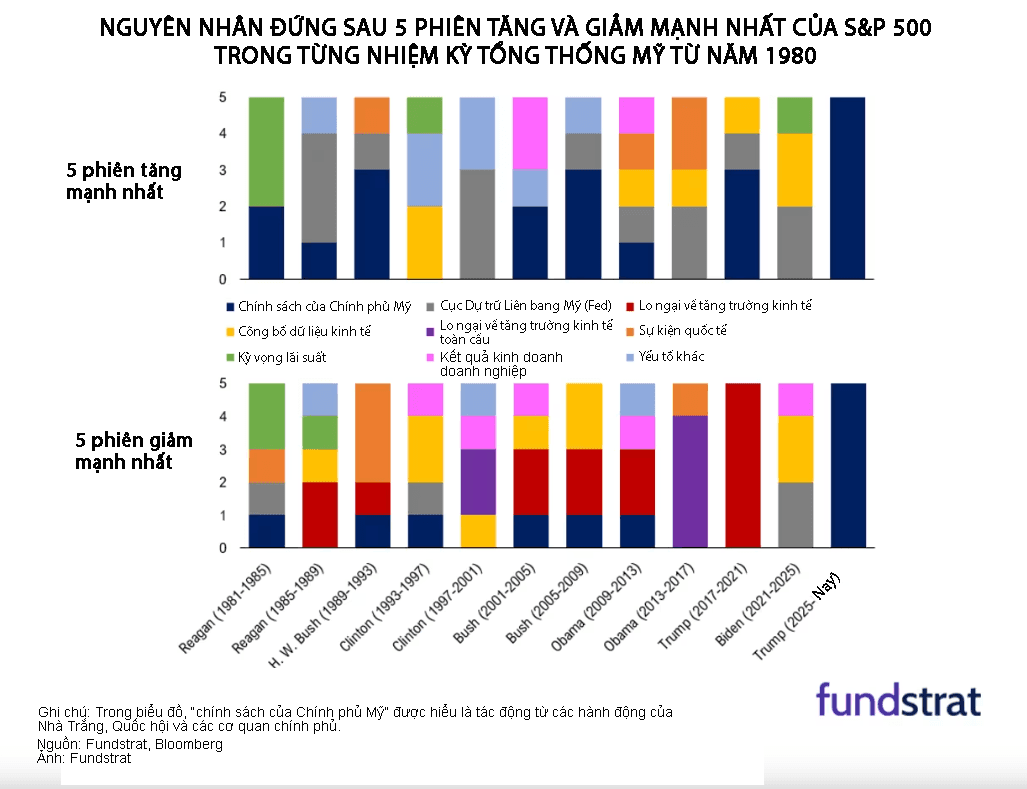
Trump’s policies have been a key driver behind both the five biggest gains and the five biggest declines in U.S. stocks since he began a second term in January 2025, according to Fundstrat analysis. The early phase of his second term has therefore differed from most U.S. presidencies over the past four decades, where market swings were typically attributed to a broader mix of factors.
Alex Wang, a macro data scientist at Fundstrat, said no president in Fundstrat’s review of market moves across 12 U.S. presidential terms had been identified as the principal factor behind as many sharp market moves as Trump.
Fundstrat’s chart groups the factors behind the five biggest up days and five biggest down days of the S&P 500 over the past 45 years. The dark blue category used to gauge the president’s influence is “U.S. Government policy.”
In a statement to MarketWatch, White House spokesperson Kush Desai said publicly listed companies have reported strong earnings and cited record-high stock valuations linked to growth-oriented policies, including tax cuts, deregulation, energy supply expansion, and fair trade agreements.
Hardika Singh, Fundstrat’s economic strategist, said that under prior administrations, the largest S&P 500 swings typically reflected a combination of factors such as economic data, Federal Reserve decisions, corporate earnings, international events, government policy, and concerns about U.S. and global growth.
Fundstrat’s analysis indicates that Trump’s policies—and policy reversals—have a particularly pronounced impact on market moves. Investors respond not only to new statements but also to signals about whether the White House is tightening, softening, or reversing course.
Singh said Trump’s approach has included repeated claims of decisions on major issues, followed by changes in stance and retractions. She described this as reflecting his negotiating style and said investors should disregard older trading rules because market dynamics have changed.
Fundstrat data show Trump’s imprint has been especially evident on the strongest rally days for U.S. stocks since the start of his second term.
Fundstrat said the impact of tariff policy was even more pronounced on the downside. All five of the biggest declines in U.S. stocks during Trump’s second term were linked to tariff actions.
The divergence between the strongest up and down days helps explain why traders remain uneasy even as the stock market generally trends higher. Fundstrat data show that most of the S&P 500’s gains have come from a small number of very strong rebounds following steep sell-offs.
Singh added that if the five strongest up days to date in Trump’s second term are excluded, the S&P 500 would be down 2.7% from the time he took office, rather than up 18.5%.
U.S. stocks closed lower on Thursday but remained near record levels. The Dow Jones Industrial Average fell 0.4%, the S&P 500 slipped 0.4%, and the Nasdaq Composite fell 0.9%.




Premium gym chains are entering a “golden era” that is ending or already in decline, as rising operating costs collide with shifting consumer preferences toward more flexible, community-based ways to exercise. Long-term memberships are shrinking, margins are pressured by higher rents and facility expenses, and competition from smaller, more personalized…




