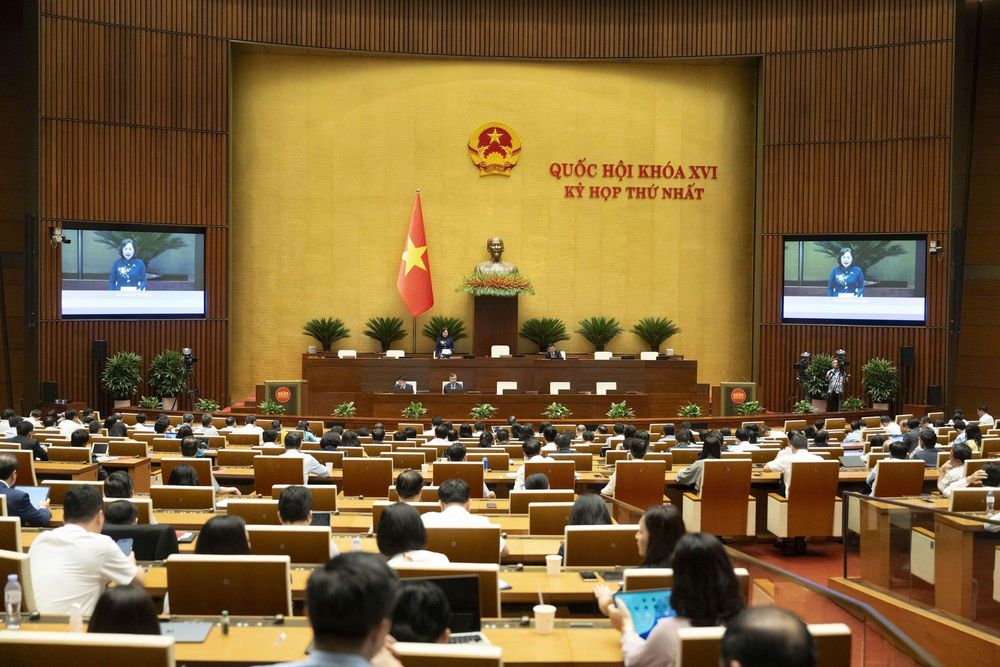
Deputy Speaker of the National Assembly Nguyen Thi Hong urged the Government to promptly finalize the draft resolution on fuel and aviation fuel taxes and to submit it to the National Assembly for consideration and formal approval on the morning of Sunday, April 12.
At the first session of the XVIth National Assembly, delegates discussed a draft resolution covering environmental protection tax, value-added tax (VAT), and special consumption tax for petrol and aviation fuel. The debate also addressed policies related to energy security, budget management, and measures to ease difficulties for people and businesses amid a volatile global environment. Nguyen Thi Hong chaired the discussion.
Delegates reached broad consensus on adopting a policy to reduce fuel taxes. They said the move is needed to help stabilize domestic fuel prices amid global energy volatility linked to regional conflicts, as well as rising logistics and insurance costs that could weigh on production and livelihoods.
Delegates also cited the experience of 2022, when Vietnam implemented tax and fee relief on fuel to help curb inflation during the Russia-Ukraine conflict.
A major focus was the duration of the resolution’s effect. The Government’s proposal would apply the measure from April 16, 2026 through June 30, 2026.
Support for the proposed window was raised by delegates including Nguyen Minh Son and Pham Van Hoa of Dong Thap province. Nguyen Minh Son said the relief would create fiscal pressure, estimating a monthly revenue shortfall of about VND 7,300 billion and a total shortfall of about VND 18,250 billion over 2.5 months, excluding VND 8,000 billion that had already been addressed. He estimated that total spending and revenue shortfall could reach roughly VND 26,250 billion.
Some delegates cautioned that extending relief for too long could dampen public investment and social welfare programs and increase long-term debt risks.
In contrast, Tran Hoang Ngan suggested extending the period to end-2026 or at least to September 30, 2026, arguing that legal certainty is important for business operations and household stability. He also referred to consumer price inertia and the CPI impact, citing an example that “a portion of a meal previously sold at 10,000 now 15,000, a 50% increase.” He argued that revenue collected in Q1 could be redirected to mitigate impacts on the public.
Beyond tax duration, delegates discussed longer-term energy security measures. Proposals included prioritizing domestic production, clearly separating commercial stocks from national reserves, and developing large-scale storage facilities to raise reserve levels to 90 days in line with international standards.
Delegates also emphasized the shift toward green energy, including continued development of biofuels (E5, E10), clean fuels, and promoting electric vehicles and renewable energy to gradually reduce reliance on mineral oil.
Policy proposals also included sector-specific support. Tran Hoang Ngan said agriculture could face negative effects from fuel price volatility, pointing to concerns about fertilizer price spikes and impacts on agricultural output. He urged targeted support for the sector.
Delegates discussed “price pass-through,” where prices rise with fuel costs and remain high even when fuel prices fall. They called for stronger market surveillance to stabilize prices and for tougher action against fuel smuggling, noting that domestic prices are currently below regional levels due to tax relief.
There was also a proposal for the Prime Minister to have authority to issue individual decisions to adjust the effectiveness or duration of each tax—VAT, special consumption tax, and environmental protection tax—depending on evolving conditions. Finance Minister Ngô Văn Tuấn said the Government would study feasible options and respond to lawmakers’ questions.
The session concluded with remarks from Deputy Speaker Nguyen Thi Hong, who stressed the importance and urgency of the issue for businesses and the public. She urged the Government to incorporate feedback and complete the draft resolution for National Assembly consideration on April 12.