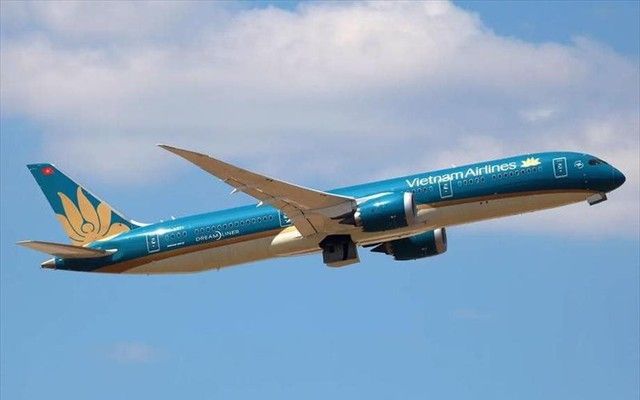
After a period of sideways movement, HVN stock surged to its daily limit for two consecutive sessions.
By the morning close on June 16, HVN continued to hit the limit up, rising to around 24,150 dong per share, the highest in more than three months.
Liquidity in this ticker also surged. After the morning session, more than 3 million HVN shares changed hands, signaling a much stronger influx of money than in the prior period.
With this rally, Vietnam Airlines' market capitalization rose above 75,100 billion dong.
The rally occurred as sentiment for the airline sector improved following the US-Iran agreement to end hostilities. This development immediately cooled global oil prices, thereby easing concerns about fuel costs — one of the largest cost components for airlines.
For Vietnam Airlines, fluctuations in jet fuel prices have a significant impact on its business results. In a period when oil prices were rising due to geopolitical tensions, the airline sector often faced cost pressure, while the ability to pass on costs to ticket prices is not always straightforward.
Thus, the decline in oil prices after the Middle East cooling is seen as a factor supporting expectations for airline
stocks in general and HVN in particular. However, the real impact depends on the durability of the US-Iran agreement, the price trajectory of jet fuel in coming months, exchange rate movements, and the recovery of demand during peak travel season.
In a separate development, Vietnam Airlines has approved a plan to organize its 2026 Annual General Meeting, scheduled for June 28, 2026, at the company's headquarters in Ba Đình, Hanoi.
According to the 2025 annual report, as of the end of last year Vietnam Airlines had 27,203 shareholders.
In terms of business performance, in Q1 2026 the company recorded total revenue from sales of goods and services of 36,946 billion dong, up 20.7% year-on-year and a record high. Net profit after tax reached more than 4,514 billion dong, up nearly 30%.
During the quarter, the airline operated nearly 43,000 flights, serving over 6.9 million passengers, up 11% and nearly 12% respectively year-over-year. Vietnam Airlines stated that these results stem from strong international demand recovery, along with flexible operational management, optimized flight schedules and cost control.
However, the company's financial picture still has notable points. As of March 31, 2026, Vietnam Airlines still posted accumulated losses of 22,303 billion dong. Short-term debt stood at 57,946 billion dong, significantly higher than current assets of 35,730 billion dong.