•
•
•
•
•
•
•
•
•
•
•
•
•
•
•
•
•
•
•
•
•
•
•
•
•
•
•
•
•
•
•
•
•


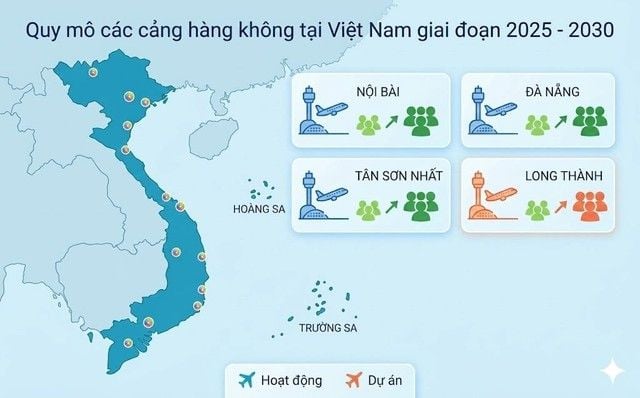
Vietnam’s aviation infrastructure is entering a pivotal development phase, described as a mega-cycle expansion for 2025–2030 with a view to 2050, as overload pressures become increasingly evident across the airport network.
According to a report from SHS Securities, by 2025 Vietnam will have 22 airports serving about 100 million passengers per year. However, the system is facing serious overcapacity, with major airports including Tan Son Nhat, Da Nang, and Cam Ranh operating beyond design capacity for an extended period.
With air travel demand rising sharply, expanding and upgrading the airport system is considered imperative. Forecasts indicate that over the next decade passenger traffic through Vietnam’s airports could nearly triple to around 300 million per year, implying a CAGR of about 10.7%—among the highest in the region.
To address the pressure, Vietnam’s national planning strategy is moving toward a multi-centre airport network to reduce dependence on a few existing “super airports.” The Ministry of Transport proposes constructing six new airports by 2030 and adding three more by 2050.
The long-term target is that by 2050 about 95% of the population can access an airport within 100 km.
Alongside new construction, many existing airports are expected to be upgraded significantly in capacity. Planned capacity increases include:
Many local airports, including Cat Bi, Vinh, Phu Quoc, and Can Tho, are also expected to be expanded substantially.
One notable project is Long Thanh International Airport, viewed as a new symbol of Vietnam’s aviation infrastructure development. With a highest 4F standard, Long Thanh is expected to become a regional hub.
The Long Thanh International Airport project (Dong Nai) is a national infrastructure project. In Phase 1, it is owned by Vietnam Airports Corporation (ACV) with total investment of more than 100,000 billion VND. The project began in early 2021 and targets a large-scale international hub in the region.
Phase 1 has a capacity of 25 million passengers per year and is expected to commence commercial operation in 2026. When all three phases are completed, the airport is expected to reach a capacity of about 100 million passengers per year, helping ease load at Tan Son Nhat and supporting development in Vietnam’s southern economic region. The project is currently entering the completion phase of major components in preparation for commercial operation.
Investment is spread across the country, from northern mountainous areas to the Mekong Delta. Airports such as Dien Bien, Sa Pa, Na San, and Lai Chau are intended to improve connectivity for the highlands, while upgrades in the Central region and the Central Highlands aim to support tourism.
In the south, besides Long Thanh, airports such as Phu Quoc, Can Tho, and Ca Mau are also being upgraded to serve regional economic development.
In the context of rising regional competition, accelerating aviation infrastructure development is presented as both a domestic necessity and a strategic step for Vietnam to strengthen its position in the global economy and on the global aviation map, contributing to economic growth.




Premium gym chains are entering a “golden era” that is ending or already in decline, as rising operating costs collide with shifting consumer preferences toward more flexible, community-based ways to exercise. Long-term memberships are shrinking, margins are pressured by higher rents and facility expenses, and competition from smaller, more personalized…