•
•
•
•
•
•
•
•
•
•
•
•
•
•
•
•
•
•
•
•
•
•
•
•
•
•
•
•
•
•
•
•
•


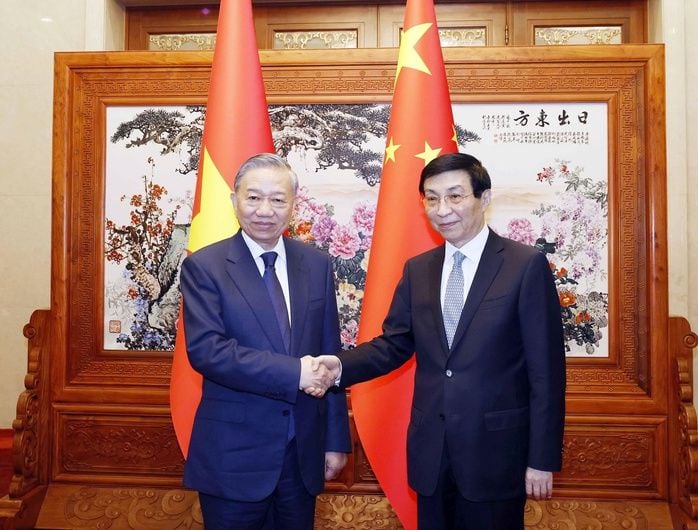
Following an invitation from Chinese General Secretary and President Xi Jinping and his wife, on April 14, General Secretary and President of Vietnam Tô Lâm and his spouse, together with a high-level Vietnamese delegation, arrived in Beijing to begin a state visit to China from April 14 to 17.
During the visit, Tô Lâm met with Wang Huo Ning, a member of the Standing Committee of the Political Bureau of the Communist Party of China (CPC) Central Committee and chairman of the National Committee of the Chinese People’s Political Consultative Conference (CPPCC).
The two sides exchanged views on the situation in each party and country, particularly since the XIV National Congresses of the Communist Parties of Vietnam and China. They discussed advancing a shared high-level understanding through the 15th Five-Year Plan for socio-economic development and explored directions to realize that understanding to push bilateral relations forward.
Tô Lâm congratulated China on its achievements in reform, opening up, and modernization, and reiterated Vietnam’s willingness to deepen the comprehensive strategic partnership and expand cooperation across multiple fields. Wang Huo Ning welcomed the visit in his new capacity, emphasizing the importance and strategic significance of strengthening Vietnam–China relations.
Tô Lâm said Vietnam aims to deepen political trust, expand comprehensive cooperation, and connect the partnership more extensively, with a stronger focus on defense-security cooperation. The two sides also agreed to expand cooperation in traditional areas such as trade and investment, while creating new highlights in transportation infrastructure (notably rail), digital transformation, and strategic technologies including artificial intelligence (AI), quantum computing, and semiconductors. They also highlighted education and high-quality human-resource development.
Tô Lâm urged stronger roles for the CPPCC and the Vietnam Fatherland Front in supporting and encouraging local-level cooperation, increasing exchanges among people, and promoting public awareness of the friendship between Vietnam and China and each country’s reform and opening achievements. Both sides expressed readiness to manage disputes peacefully at sea and to strengthen mutual understanding and friendship.
Wang Huo Ning affirmed that China views its relationship with Vietnam as a priority in its neighborhood diplomacy and appreciated Vietnam’s reform achievements toward socialism that align with its national conditions. The two sides agreed to intensify strategic connectivity, prioritizing infrastructure links, AI, and the digital economy.
China expressed willingness to expand imports of high-quality Vietnamese agricultural products and encouraged enterprises to invest and cooperate in Vietnam on mutually beneficial terms. Wang Huo Ning also said the CPPCC would further strengthen ties with the Vietnam Fatherland Front, promote people-to-people exchanges, broaden educational and healthcare cooperation, and support multilateral events, including hosting APEC 2026 in China and APEC 2027 in Vietnam.
On the same day, Tô Lâm visited the Vietnamese Embassy in China and spoke with staff and the Vietnamese community there.
In the afternoon of April 14, China’s Ministry of Education and Vietnam’s Ministry of Education and Training co-organized the Vietnam–China Forum on Higher Education, Science and Technology, and Innovation Cooperation. Tô Lâm attended and delivered a policy speech at Tsinghua University.
Speaking to faculty and students, Tô Lâm said Vietnam’s Party, Government, and people always regard developing Vietnam–China ties as an objective requirement, strategic choice, and top priority within Vietnam’s independent, self-reliant, multilateral foreign policy.
In the near term, he said Vietnam wants to further solidify the political and social foundation of the Vietnam–China relationship and push substantive cooperation forward. He described science and technology, innovation, and digital transformation as a new bright spot and pillar of the Vietnam–China relationship in the new era.
Tô Lâm also highlighted the need to deepen friendship between the youth of the two countries, expressing hope that Vietnamese and Chinese youths will work together to innovate, start ventures, and solve major development challenges. He reaffirmed confidence that Vietnam–China relations will continue to develop in a healthy, stable, and sustainable manner, bringing tangible benefits to both peoples and contributing to peace, cooperation, and development in the region and the world.
After Beijing, Tô Lâm and the high-level delegation visited the Hung An New Area in Hebei Province for on-site planning and field checks. Hebei provincial party secretary Nghu Nha Phong accompanied the delegation.
Hung An New Area was established in 2017 as a strategic national-level project intended to anchor the Beijing–Tianjin–Hebei economic triangle. It is envisioned as a model area for sustainable development, with a focus on a new ecological urban zone, leading in innovation, harmonious development, openness, and modernizing development. Nine years into its implementation, the area has progressed from construction to high-quality development.

Premium gym chains are entering a “golden era” that is ending or already in decline, as rising operating costs collide with shifting consumer preferences toward more flexible, community-based ways to exercise. Long-term memberships are shrinking, margins are pressured by higher rents and facility expenses, and competition from smaller, more personalized…