•
•
•
•
•
•
•
•
•
•
•
•
•
•
•
•
•
•
•
•
•
•
•
•
•
•
•
•
•
•
•
•
•
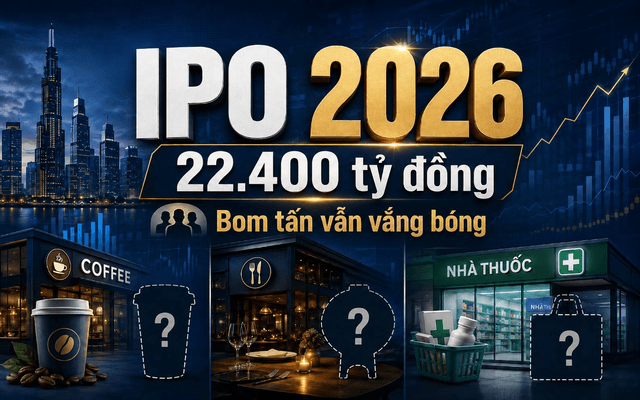
Vietnam’s IPO market in 2026 is projected to reach about VND 22.4 trillion, according to Fiingroup as of May 25, 2026. This would be a sharp decline from the VND 38.6 trillion recorded in 2025, down 42%. While the figure is still significant, the market does not yet show signs of a “blockbuster” IPO season.
Fiingroup says the total planned fundraising through equity issuance and IPOs by listed companies in 2026 is about VND 289.5 trillion, up 86.5% from 2025. However, the IPO portion has not produced the large-scale deals that many market participants expected.
More notably, several consumer and retail names that have been discussed for years have not yet appeared in prominent 2026 IPO plans. These include Golden Gate, Highlands Coffee, Long Châu, and The CrownX—companies with strong brand recognition and large operating footprints that could attract broad investor interest if listed.
Fiingroup characterizes the 2026 IPO market as selective rather than frozen. Compared with earlier IPO cycles that were often linked to privatization, state-owned enterprise divestment, or large real estate and finance deals, the current period appears more tilted toward the private sector, particularly spin-offs and restructuring within corporate ecosystems.
Fiingroup notes that IPO plans in 2026 are concentrated in the securities sector. Examples mentioned for 2026 include LPBS and KAFI. For 2025, Fiingroup cites VPS, VPBankS, and TCBS.
The securities firms have clear incentives to list, including access to additional capital to expand lending activities (including margin lending and proprietary trading), investment banking growth, and capitalization on the market recovery cycle.
While the consumer-retail segment is arguably more media-attractive, Fiingroup says it has not yet unlocked its full potential in 2026. Dien May Xanh is cited as one of the relatively few consumer-focused deals prepared for this year. Meanwhile, more widely recognized brands such as Golden Gate, Highlands Coffee, Long Châu, and The CrownX have not yet entered the spotlight.
Fiingroup points out that an IPO requires more than a familiar brand. Investors typically look for revenue growth, profit margins, cash flow, expansion potential, and governance quality. A retailer may be well known among consumers but still be less “sellable” to the market if profitability is not robust, margins are volatile, or the business is in a heavy investment phase.
For chains, the evaluation goes beyond store counts to include revenue per store, payback periods, after-rent costs, staffing and logistics, promotional spending, and the portion of profit remaining after these expenses. Golden Gate is cited as an example where management has indicated technical readiness to list for a long time, but the decision depends on market conditions and shareholder views. Fiingroup also notes that the founder is not under pressure to divest, so an IPO is not an immediate obligation.
Fiingroup contrasts the market’s perception of IPOs as flashy milestones with what listing means for companies. For firms, going public involves opening the books, complying with quarterly reporting, facing continuous market valuation, and meeting accountability requirements to public shareholders. If a company does not need capital immediately—or if it does not seek liquidity for existing shareholders—delaying an IPO can be a prudent choice.
In Highlands Coffee’s case, Fiingroup says the timing is not for 2026. Plans are discussed for Q1 2027 rather than 2026, which may reflect scheduling rather than a delay.
Fiingroup adds that the challenge for consumer brands is not only listing but building a scalable, well-managed, and transparently governed business that can sustain valuation after listing. Long Châu is presented as another example of a cautious approach by its parent, with FPT Retail emphasizing internal readiness and prioritizing operational standardization and platform enhancement over an early listing. Fiingroup notes that listing too soon could force the company to chase short-term growth expectations that conflict with the industry’s need for stability and long-term value creation.
Overall, the absence of Golden Gate, Highlands Coffee, and Long Châu suggests Vietnam’s consumer IPO market is in a “wait-and-see” mode. Fiingroup says enterprises may be waiting for better valuations, shareholders may want clearer ownership and exit strategies, and investors want transparent financial reporting, credible profitability narratives, and sustainable long-term growth stories.
This helps explain why 2026’s IPO market does not feel explosively buoyant. Fiingroup observes that transactions in financial and securities sectors may add instruments to the market, but a few consumer brands that investors can relate to in everyday life—such as coffee chains, restaurants, drugstores, and supermarkets—could shift sentiment rapidly if they appear.
Fiingroup concludes that for 2026, the key variable is not just total IPO value but the quality of the companies entering the market. If new supply comes mainly from financials and securities, the market may grow in quantity without generating a broader wave of personal-investor participation. Conversely, even a small number of large consumer-driven IPOs could quickly alter sentiment if their profitability and growth stories resonate with investors.
Fiingroup’s assessment is that 2026 is unlikely to enter a new boom cycle comparable to 2017–2012018. The focus remains on high-quality, transparent, and scalable opportunities capable of sustaining capital inflows beyond listing day.
Source: Fiingroup, market commentary and ongoing coverage of Vietnamese IPO activity.
Bitcoin (BTC) investors who use steady dollar-cost averaging (DCA) may be underperforming versus strategies that adjust exposure to the market’s cycle, according to new research arguing that Bitcoin’s behavior differs from traditional long-duration assets.
In a report cited by Markus Thielen of 10x Research, Bitcoin’s market…