•
•
•
•
•
•
•
•
•
•
•
•
•
•
•
•
•
•
•
•
•
•
•
•
•
•
•
•
•
•
•
•
•


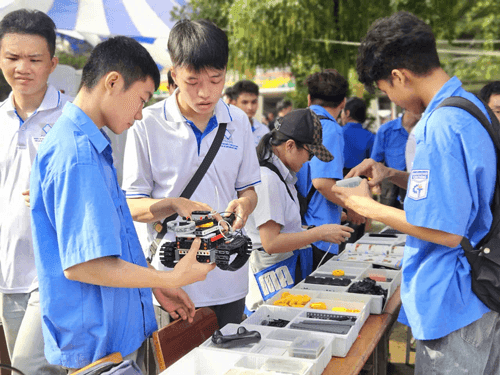
The Ministry of Education and Training is submitting to the Government a draft decree on policies to support students studying strategic technology fields. The ministry has received 185 talent-training programs proposed by 24 higher education institutions and plans to select about 80 programs for implementation from 2026.
The 185 proposed programs are designed at engineer and master’s levels and cover fields including natural sciences, life sciences, mathematics and statistics, information technology, engineering-technology, manufacturing-processing, and architecture and construction. After around 80 programs meet required criteria and are officially implemented from 2026, the ministry expects the number of talent-training programs to rise to 100 in subsequent years, attracting an average of about 6,000 students per year.
In the semiconductor industry, a prioritized development area, the ministry has issued training program standards at both undergraduate and master’s levels and assigned 19 institutions to participate. To date, 62 programs across 26 higher education institutions have registered to take part.
In the nuclear-energy sector, the ministry is implementing a talent-training program that includes establishing standards for undergraduate nuclear-energy programs. It is also submitting to the Government mechanisms such as scholarships, student loans, and incentives for lecturers and learners.
In rail, the talent-training program has been deployed following Prime Minister approval, aimed at preparing human resources for future major infrastructure projects.
TS Nguyen Trung Nhan, Head of the Training Department at Ho Chi Minh City University of Industry, said that while electrical engineering and electronics remain traditional fields, there is substantial potential for new majors, including renewable energy and nuclear power.
“Developing nuclear energy is an essential step if Vietnam wants to achieve breakthrough growth. Currently only about 30 countries worldwide master this technology; those are the countries with strong economies.”
According to Nhan, nuclear power offers advantages including stable electricity generation and less sensitivity to fuel-price volatility compared with oil or coal. He said that with positive signals from the Government, the sector can address energy needs while also creating broader career opportunities for younger people.
GS-TS Nguyen Tien Thao, Director of the Higher Education Department, said the ministry is presenting to the Government a decree proposal on policies to support students in strategic technology sectors. Under the proposal, students who rank in the top 30% of their high school exam results in groups with mathematics, physics, chemistry, biology, or English—when pursuing science-engineering majors—would receive full scholarships for all four years.
The policy is expected to help students pursue long-investment fields and strengthen recruitment into key sectors supporting national development.
Universities are also implementing additional measures to attract high-quality talent. For example, Hanoi University of Science and Technology plans to apply tuition waivers for PhD students from 2026 to encourage highly capable researchers to join scientific work at the university.
The University of Transport and Communications said it intends next academic year to focus on elite programs rather than broad-based education, allocating resources to train in strategic technology-linked areas and foundational engineering, including talented microelectronics engineers and fields related to high-speed rail and urban rail. The university plans to invest in human resources, facilities, and equipment to support development of the country’s strategic industries.
Many universities are also launching policies to attract talent to teaching and to build high-quality human resources for Ho Chi Minh City.
In April 2026, Vietnam National University Ho Chi Minh City issued Announcement No. 760/TB-ĐHQG inviting 68 visiting professors for 2026 under its Visiting Professor program. The notice states that the university has demand for 68 visiting professors across member units, with Information Technology University having the highest need at 15 professors.
PGS-TS Tran Cao Vinh, Deputy Director of VNU-HCM, also conducted a visit and discussions at the Ho Chi Minh City High-Tech Agriculture Park (AHTP). The collaboration includes developing scientific and technological capabilities; implementing interdisciplinary research programs; and applying advanced technologies such as artificial intelligence (AI), Big Data, Internet of Things (IoT), blockchain, and automation in agriculture, alongside biotech, breeding, and new materials for sustainable agriculture.
The cooperation plan aims to upgrade the High-Tech Agriculture Research and Development Center to international standards to improve research capacity, innovation, and technology transfer in Ho Chi Minh City.
Separately, the Ho Chi Minh City People’s Committee issued a plan to implement a cooperation program with VNU-HCM for 2026–2030, focusing on human resources, AI, semiconductors, and Special Urban Law.
In March 2026, UEH announced policies to attract and retain senior faculty, including professors, associate professors, and doctors, with support up to 500 million VND per person. According to PGS-TS Bui Quang Hung, UEH’s Deputy Director, under the plan linked to Resolution 71-NQ/TW on “Education and Training Breakthrough” and UEH’s initiative “Raise the quality of UEH staff - Top 250 Asia, 2025–2030,” support levels for senior academics who apply and join UEH include: 500 million VND per person for professors, 300 million VND per person for associate professors, and 150 million VND per person for doctors.
Technical colleges are also adjusting training and recruitment to match emerging fields. At Cao Thang Technical College, from 2026 five new programs will be added: Electrical Engineering and Renewable Energy Technology; Semiconductor and Microelectronics Technology; Industrial Equipment Maintenance Technology; Agricultural Automation Technology; and Financial Technology and Digital Business.
For the first year, the intake quota for the Semiconductor and Microelectronics Technology program is 90, the highest among the five new programs.
TS Le Dinh Kha, Principal of Cao Thang Technical College, said that most of the new majors currently have limited competition from other colleges, particularly renewable energy and semiconductor/microelectronics. He added that Semiconductor and Microelectronics Technology previously existed as a subspecialty of Electrical Engineering and Electronics, but has now become an independent field.






Premium gym chains are entering a “golden era” that is ending or already in decline, as rising operating costs collide with shifting consumer preferences toward more flexible, community-based ways to exercise. Long-term memberships are shrinking, margins are pressured by higher rents and facility expenses, and competition from smaller, more personalized…




