•
•
•
•
•
•
•
•
•
•
•
•
•
•
•
•
•
•
•
•
•
•
•
•
•
•
•
•
•
•
•
•
•


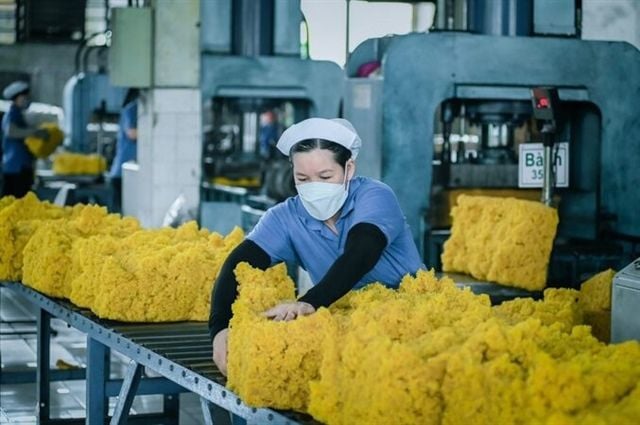
Vietnam’s agricultural exports are being pressured by the escalation of the conflict in the Middle East, which is raising global oil prices and international shipping costs and beginning to disrupt Vietnam’s export supply chains across several commodities. The impact is described as most direct in the rubber sector.
The conflict has pushed global crude oil prices higher, increasing both transport and production costs. This affects rubber because synthetic rubber—used in tire manufacturing—is derived from petroleum. As oil prices rise, the cost of producing synthetic rubber increases, encouraging manufacturers to shift toward natural rubber, which supports international rubber prices.
According to data from the Import-Export Department of the Ministry of Industry and Trade, in the first two months of the year Vietnam exported about 281,000 tons of rubber valued at over 503 million USD. This represents an increase in export quantity but a decline in export value compared with the same period last year, attributed to lower average prices.
The department also warned that if the conflict persists, the global economy could slow, reducing demand for industrial products such as tires and weighing on the rubber market.
For tea, geopolitical tensions are increasing input costs globally, particularly transport and insurance. Pakistan and Iran are identified as the two largest markets for Kenyan tea—the world’s largest tea exporter. As the conflict intensifies, transport and insurance costs have made it harder for Kenya to export tea. Airlines and shipping lines have cut services, and some marine insurers have reduced coverage due to war risk. Partial airspace closures and disruptions in regional shipping lanes have also slowed trade, increasing the risk of stockpiling and putting pressure on international tea prices.
For Vietnam, February tea exports reached 5,779 tons, valued at 10.27 million USD. This was down 53.4% in quantity and 50.8% in value versus January, and significantly lower than the same period last year. However, for the first two months of the year, Vietnam exported 18,169 tons of tea worth 31.15 million USD, up 4.8% in volume and 10% in value year-on-year.
Other crops and export categories, including coffee and wood and wood products, are also reported to be notably affected by geopolitical developments. The main reason is that many key global sea routes pass through the Middle East and the Red Sea. As tensions rise, shipping lines adjust routes or increase war risk insurance charges, which raises container shipping costs. If logistics costs remain elevated, exporters’ profits could be squeezed.
The Ministry of Agriculture and Rural Development expects significant risks to Vietnam’s agricultural, forestry and fishery exports and is preparing multiple contingency scenarios. If the conflict lasts about one month, export value could fall by around 1 billion USD. If it lasts three months, losses could reach 3–3.5 billion USD. In the worst case, if it lasts a year, total farm, forestry and fishery export value could drop by 7–8 billion USD.
The ministry said the expected decline is not because the Middle East is a major market for Vietnamese farm products, but because disruptions to international shipping routes and higher trade costs are affecting major markets such as Europe and North Africa.
In response to global market fluctuations, exporters are advised to diversify markets, expand shipping routes and strengthen supply chain resilience.






Premium gym chains are entering a “golden era” that is ending or already in decline, as rising operating costs collide with shifting consumer preferences toward more flexible, community-based ways to exercise. Long-term memberships are shrinking, margins are pressured by higher rents and facility expenses, and competition from smaller, more personalized…




