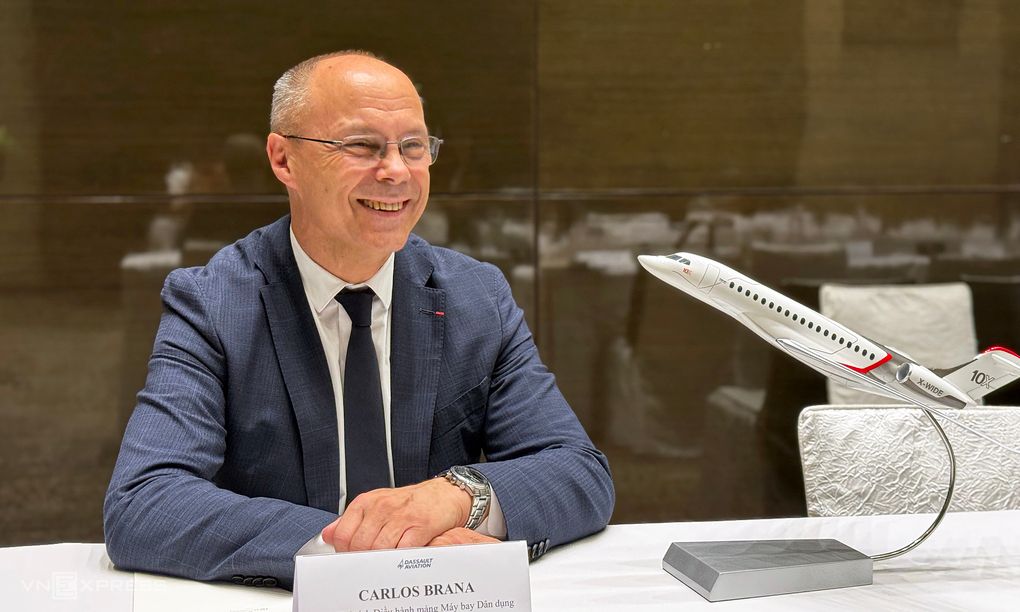
16 business jets are currently in operation in Vietnam, up more than 77% from 2025, the fastest growth rate in the Asia-Pacific region, according to Carlos Brana, Executive Vice President of Dassault Aviation's Civil Aviation division, who spoke at the Falcon 10X unveiling in Hanoi on July 9. Dassault, headquartered in France, is one of the world's leading aircraft manufacturers. In 110 years, the company has delivered more than 10,000 military and civil aircraft, including 2,800 Falcons. According to Brana, Vietnam is currently one of the fastest-growing markets for the business-jet sector in Asia-Pacific. Specifically, 16 business jets are in operation in Vietnam, up more than 77% versus last year, with the long-range fleet predominating. Dassault has delivered 9 Falcon aircraft since entering the Vietnamese aviation
market. Currently, the Falcon fleet has 7 aircraft in operation in Vietnam, comprising 6 Falcon 8Xs and 1 Falcon 2000S. A prior report by aviation consultancy Asian Sky Group also indicated that by the end of Q1 2026, Vietnam had 15 private aircraft, up 6 from 2025. Asian Sky Group also described this as the fastest growth rate for business jets in the region. In Nikkei, Paul Desgrosseilliers, CEO of ExecuJet Haite, said Vietnamese entrepreneurs are increasingly using private jets for transcontinental trips to Europe and North America to avoid layovers on commercial flights. Nikkei notes that the growth rate of business jets is also a sign that asset accumulation in Vietnam is accelerating alongside a rise in entrepreneurs and the ultra-wealthy. Brana adds that in any economy with strong growth, the tendency for business-jet use among entrepreneurs also rises. To develop the business aviation market in line with Vietnam’s economic growth, Dassault’s leadership says Vietnam needs more airports and improved airport-operating frameworks to meet domestic and international entrepreneur demand. Brana suggests Vietnam should establish specialized customs-clearance procedures, such as dedicated security gates, to allow business jet users to depart/arrive or retrieve baggage more quickly.