•
•
•
•
•
•
•
•
•
•
•
•
•
•
•
•
•
•
•
•
•
•
•
•
•
•
•
•
•
•
•
•
•

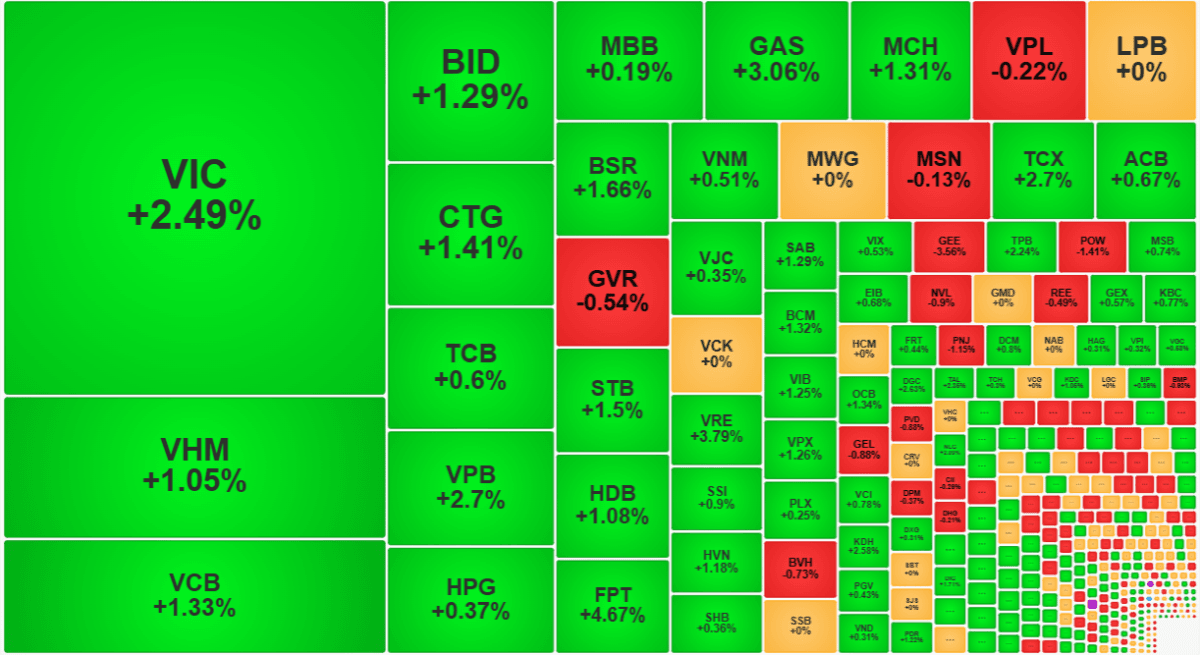
Four Vingroup stocks—VIC, VHM, VPL, and VRE—currently account for about 30% of HoSE's market capitalization, and movements in these shares have a significant influence on the VN-Index.
Vingroup's market capitalization rose sharply to about 1.6 quadrillion dong (around $60 billion), a record high that places the conglomerate led by Pham Nhat Vuong firmly in the No. 1 spot in Vietnam's stock market, well ahead of others.
Vingroup's market cap is even larger than the combined value of the five largest banks on the stock exchange: Vietcombank, BIDV, VietinBank, Techcombank, and VPBank. With this scale, every swing of Vingroup has a large impact; for instance, the latest up-limit day saw its market cap rise by more than 100 trillion dong in a single session, larger than SHB's value.
Concurrently, the market impact is substantial. Vingroup alone accounts for more than 18% of HoSE's capitalization-weighted index. If including the four listed Vuong Group companies—Vingroup, Vinhomes, Vinpearl, and Vincom Retail—the share rises to 30%. Therefore, movements in VIC, VHM, VPL, and VRE have a strong influence on the VN-Index.
Since the start of 2026, the four VIC, VHM, VPL, and VRE have contributed a total of more than 112 points to the VN-Index, which has risen by about 73 points. This underscores the market's heavy dependence on this group.
UBS analyst David Rabinowitz, Global Index & Asia-Pacific Market Structure, argues that this risk is priced in and is not Vietnam-specific but a global issue. In many developed markets like the US and Australia, concentration in a few large stocks also exists. Therefore, indices such as FTSE have accounted for this to ensure stability.
In his view, the key is not whether concentration exists, but how markets manage and assess this risk. Among indices, including VN30, concentration has been accounted for and controlled. For example, the financial sector currently accounts for a significant share, around 27%, indicating ongoing sector diversification.
Compared with some regional markets, such as Indonesia, the challenge is not only market cap size but also free-float and investor accessibility.
To reduce concentration risk, Vietnam's market should continue expanding its depth by adding quality stocks to the index, thereby providing more investment choices and promoting portfolio diversification.
From a capital-attraction perspective, especially for large inflows, liquidity remains the key factor. This requires a better market structure, clearer role for market makers, and improved transparency and operating efficiency. As the market broadens, investors will expect more investment products beyond traditional indices like VN30, expanding to broader indices and a wider range of instruments.
Bitcoin (BTC) investors who use steady dollar-cost averaging (DCA) may be underperforming versus strategies that adjust exposure to the market’s cycle, according to new research arguing that Bitcoin’s behavior differs from traditional long-duration assets.
In a report cited by Markus Thielen of 10x Research, Bitcoin’s market…